
 18 hours ago
17
18 hours ago
17
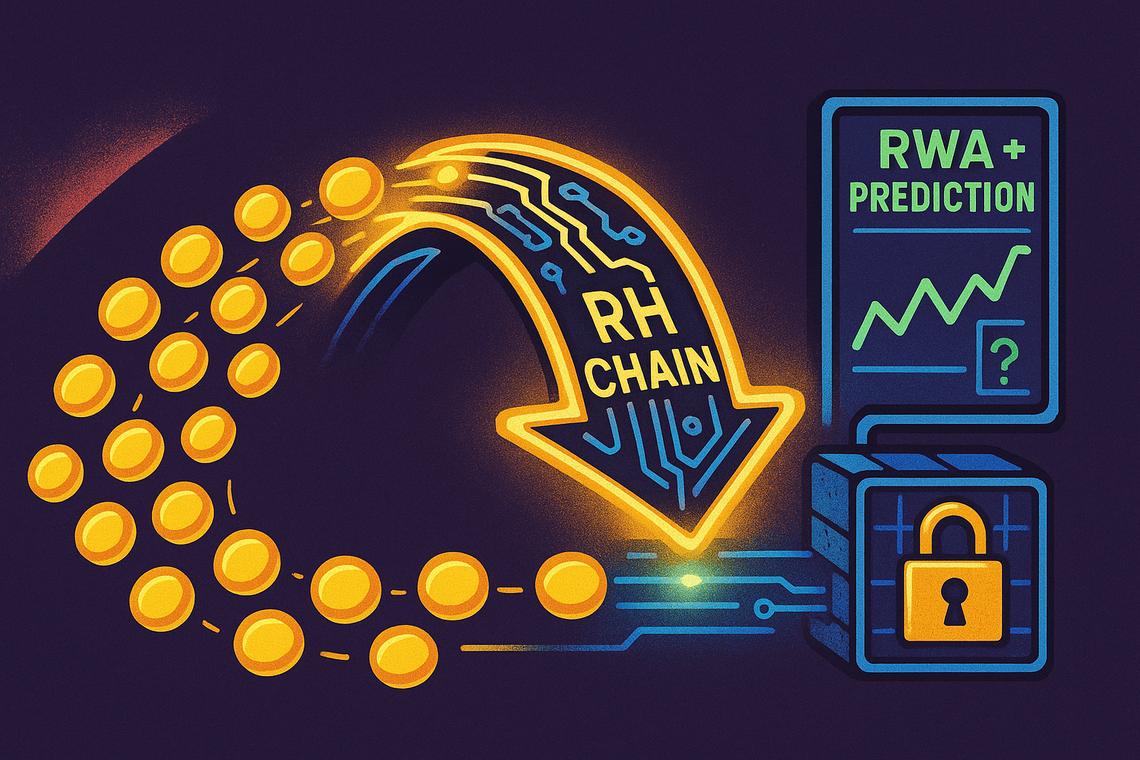
Bernstein just rewrote its thesis on Robinhood — and the story it’s telling has very little to do with crypto trading. The research firm lifted its price target on Robinhood Markets from $130 to $160 per share while maintaining an Outperform rating, but the more telling detail is why: analysts believe the platform’s next growth chapter will be driven by Robinhood tokenization strategies and prediction markets, not the volatile crypto volumes that powered earlier gains.
Key takeaways
- Bernstein raised Robinhood’s price target from $130 to $160 per share, maintaining an Outperform rating.
- Prediction markets are forecast to generate $1.7 billion in revenue by 2028 for Robinhood, at a 64% compound annual growth rate.
- Robinhood built Robinhood Chain, an Arbitrum-based layer-2 network, as proprietary infrastructure for tokenized real-world assets.
- Onchain real-world assets are projected to grow from roughly $35 billion today to between $2 trillion and $4 trillion by 2030.
- Tokenized stocks have already grown to nearly $2 billion in market value this year, according to RWA.xyz.
Bernstein’s price target upgrade and what it signals
The upgrade itself — moving from $130 to $160 — is notable. But what Bernstein is actually arguing is a structural repositioning: Robinhood is no longer best understood as a retail crypto broker. It’s being evaluated as an infrastructure play at the intersection of blockchain technology, capital markets, and event-based financial products.
That framing changes how investors should think about the stock. Traditional crypto trading revenue is cyclical, tied to market sentiment and token price movements. Prediction markets and tokenized assets, by contrast, represent product categories where Robinhood is building proprietary infrastructure with longer-term structural tailwinds — and where competition remains relatively thin.
Prediction markets as the fastest-growing segment
According to Bernstein’s research note, prediction markets are positioned to become Robinhood’s fastest-growing business segment. Analysts forecast that this segment alone could generate $1.7 billion in revenue by 2028, representing a 64% compound annual growth rate. That’s an extraordinary growth rate for any product line, and it explains much of the confidence behind the revised price target.
The implication here is significant. If those projections hold, prediction markets revenue could eventually rival or exceed what Robinhood earns from traditional crypto trading — a meaningful shift in how the company generates income and how exposed it is to crypto market cycles.
Robinhood Chain and the tokenized real-world assets opportunity
Beyond prediction markets, Bernstein identified tokenized equities as a major long-term opportunity and pointed specifically to the infrastructure Robinhood has built to capture it.
Robinhood Chain: An Arbitrum-based layer-2 network
Robinhood Chain is the company’s proprietary Arbitrum-based layer-2 blockchain network, designed to support tokenized real-world assets and onchain financial products. By building on its own infrastructure rather than relying on third-party blockchains, Robinhood retains greater control over the user experience, fee structure, and product development roadmap.
That kind of vertical integration matters strategically. Owning the rails — rather than renting them — gives Robinhood the ability to move faster on new financial products and capture more of the economic value as the tokenized asset market scales.
The scale of the market Robinhood is targeting
Bernstein projects that onchain real-world assets will grow from roughly $35 billion today to between $2 trillion and $4 trillion by 2030. Analysts expect tokenized equities to take an increasing share of that growth as adoption expands beyond Treasury securities and private credit into broader equity markets.
Tokenized stocks, as a standalone category, have already grown to nearly $2 billion in market value this year, according to data from RWA.xyz. It’s a small fraction of the projected total, but the trajectory is clear.
Institutional infrastructure is expanding in parallel
Robinhood isn’t building in isolation. The broader financial industry is simultaneously hardening the infrastructure that tokenized securities need to function at institutional scale.
Brokerage infrastructure provider Alpaca and financial technology company Broadridge Financial Solutions announced an integration of Broadridge’s shareholder governance tools into Alpaca’s Instant Tokenization Network. The capabilities added include proxy voting, investor communications, and regulatory disclosures for tokenized securities — giving token holders governance rights that more closely mirror those of traditional shareholders. That kind of parity between tokenized and conventional share ownership has long been a prerequisite for mainstream institutional adoption.
Separately, tokenization platform Securitize partnered with investment bank Cantor Fitzgerald to develop infrastructure for blockchain-based initial public offerings and follow-on equity offerings within existing US securities regulations. The partnership signals that tokenized capital raises — not just secondary market trading — are moving into the scope of serious institutional development.
Taken together, these developments point to a maturing ecosystem. Governance tooling, compliant issuance infrastructure, and proprietary distribution networks are all advancing simultaneously. For Robinhood, that broader institutional buildout validates rather than threatens its own position: a more robust tokenization ecosystem creates more demand for the kind of retail-facing on-ramp that Robinhood is designed to be.
The question now is whether Robinhood’s execution on Robinhood Chain and prediction markets can keep pace with Bernstein’s ambitious revenue curve — and whether the regulatory environment for tokenized equities and event contracts moves fast enough to let it.
FAQ
Why did Bernstein raise Robinhood’s price target?
Bernstein raised Robinhood’s price target from $130 to $160 per share because analysts expect the platform’s next growth phase to be driven by tokenized equities and prediction markets, rather than traditional crypto trading volumes.
What is Robinhood Chain?
Robinhood Chain is Robinhood’s proprietary Arbitrum-based layer-2 blockchain network, built to support tokenized real-world assets and onchain financial products without relying on third-party blockchain infrastructure.
How significant are prediction markets in Robinhood’s strategy?
According to Bernstein, prediction markets are forecast to become Robinhood’s fastest-growing business segment, with revenue expected to reach $1.7 billion by 2028 at a 64% compound annual growth rate.
What role do institutional partnerships play in tokenized securities infrastructure?
Partnerships such as Broadridge integrating governance tools with Alpaca’s Instant Tokenization Network, and Securitize partnering with Cantor Fitzgerald on blockchain-based IPO infrastructure, are advancing the governance and issuance capabilities needed for regulated tokenized securities to operate at scale.
Article produced with the assistance of artificial intelligence and reviewed by the editorial team.







 English (US) ·