
 1 hour ago
22
1 hour ago
22
TLDR
- Friday saw the S&P 500 decline 0.2%, yet the benchmark secured a 0.4% weekly advance for its third consecutive winning week
- Thursday’s trading session produced an all-time intraday peak of 7,816.70 before the index retreated
- Market volatility gauge VIX touched 14.28, marking one of its most subdued levels in over three decades
- July retail sales figures unexpectedly declined while August consumer sentiment deteriorated
- Probability of Fed maintaining current rates in September now stands at roughly 67%
The S&P 500 concluded Friday’s session at 7,785.76, representing a 0.2% decline, just 24 hours after establishing a fresh all-time intraday peak of 7,816.70. The Dow Jones Industrial Average retreated 107 points, or 0.2%, settling at 53,732.41. The Nasdaq Composite experienced a 0.3% slide, finishing at 26,729.16.
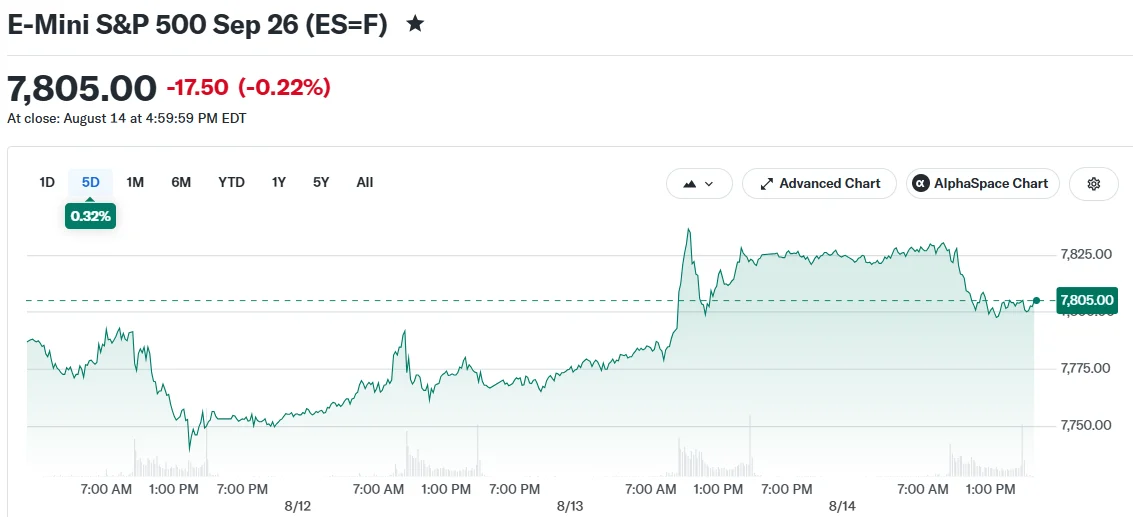 E-Mini S&P 500 Sep 26 (ES=F)
Friday’s modest retreat didn’t prevent the S&P 500 from securing a 0.4% weekly advance. This performance represents the index’s third consecutive week in positive territory. The Nasdaq managed a slim 0.1% weekly increase, whereas the Dow registered a 0.6% weekly loss.
The CBOE Volatility Index, Wall Street’s primary fear indicator, descended to 14.28 during Friday’s trading. This reading represents an exceptionally subdued level. Historical analysis dating back to 1990 reveals the VIX has traded beneath 15 only approximately 32% of the time, with a long-term average of 19.45.
This tranquility in volatility persists despite Brent crude oil advancing 1.7% on Iran-related developments. Market participants demonstrated minimal reaction to these geopolitical events.
Mizuho analyst Daniel O’Regan observed that market participants appear increasingly desensitized to geopolitical developments. He drew parallels between current Iran-focused news reactions and the market’s eventual indifference to Russia-Ukraine conflict updates.
Consumer Indicators Show Softness
Economic releases on Friday revealed disappointing trends. July’s retail sales figures underperformed analyst forecasts, registering a sequential monthly contraction. Meanwhile, August consumer confidence metrics retreated, erasing improvements observed during the June-July period.
Bret Kenwell from eToro emphasized that a single month of subdued spending shouldn’t signal imminent economic distress, though he acknowledged the data becomes more concerning when viewed alongside previously released weak GDP and employment figures.
Kenwell suggested that softer economic indicators might reduce Federal Reserve pressure to implement rate increases, though he cautioned that persistent economic sluggishness presents its own set of challenges.
Current market pricing indicates approximately two-thirds probability that the Federal Reserve will maintain its current rate stance during the September policy meeting. The 2-year Treasury yield advanced to 4.17%, while the 10-year yield approached 4.7%.
Corporate Results and Market Outlook
Over 90% of S&P 500 constituents have now disclosed second-quarter financial results. Year-over-year earnings expansion is currently trending near 50%, based on FactSet analysis.
Jay Hatfield from Infrastructure Capital Advisors shared with CNBC his projection for the S&P 500 to reach 8,100 before year-end, contingent on oil prices sustaining levels above $80, continued Strait of Hormuz closure, and unchanged Fed policy rates.
The upcoming week features minimal major economic data releases, directing market focus toward retail sector earnings announcements. Home Depot and Walmart represent notable companies scheduled to report results.
Market observers indicate these upcoming earnings releases will provide crucial insights into the actual state of consumer health.
The post S&P 500 Extends Winning Streak to Three Weeks Despite Friday Decline appeared first on Blockonomi.



 English (US) ·