
 4 months ago
60
4 months ago
60
OpenAI co-founder and CEO Sam Altman emphasized that with the arrival of superintelligence, society will have to experience a shift to preserve the social order and rebalance the economy to support the changes needed for citizens to maintain stability even when partially displaced.
Key Takeaways:
- OpenAI CEO Sam Altman proposes a wealth fund to share AI profits and protect future social safety nets.
- To offset AI job displacement, OpenAI calls for a 32-hour work week so workers benefit from future productivity.
- Altman also backs a shift to corporate tax to protect key social programs like Medicare from future AI impacts.
OpenAI Co-Founder Sam Altman Presents a New AI Deal in the Wake of Superintelligence
While artificial intelligence (AI) advancements accelerate, industry heads are dealing with the consequences of introducing these technologies in today’s society.
Sam Altman, co-founder and CEO of OpenAI, one of the largest companies in the AI arena, recently published a document that proposes a series of recommendations, a new AI deal, as society must prepare for dealing with the rise of superintelligence, defined by the company as “AI systems capable of outperforming the smartest humans even when they are assisted by AI.”
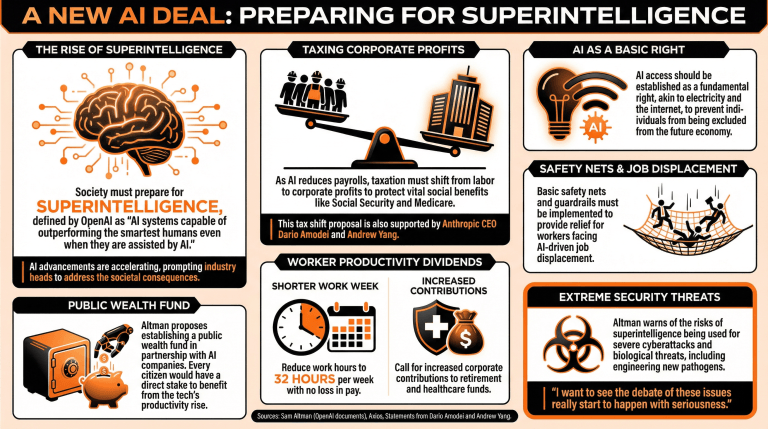
Among the pillars of this new deal, Altman calls for establishing a public wealth fund in partnership with AI companies, where every citizen will have a direct stake. The fund will invest in other tech and AI companies, allowing citizens to benefit from the productivity rise of this tech’s adoption.
The change in the tax focus from labor to corporate profits will also be necessary, as Altman argues that as companies reduce payrolls, social benefits that depend on this taxation, including Social Security payments and Medicare, might be impacted. This is a proposal also shared by Anthropic CEO Dario Amodei and former Presidential hopeful Andrew Yang.
Also, as companies ramp up productivity, workers should reduce their workload. OpenAI proposes reducing work hours to 32 per week without pay losses and calls for an increased contribution to retirement and healthcare funds.
Finally, the document calls for establishing AI as a right, like electricity and the internet, and individuals should have basic access to a level of this tech to avoid being excluded. In the same way, basic safety nets, guardrails against AI job displacements, should be implemented, allowing workers to receive relief when most needed.
Altman’s worries also include the use of this superintelligence to execute cyberattacks and biological threats, including the engineering of new pathogens. He told Axios that he wants to see “the debate of these issues really start to happen with seriousness.”








 English (US) ·