
 1 month ago
42
1 month ago
42
- The House Ways and Means Committee has introduced six crypto tax bills covering staking, mining, donations, reporting, and enforcement.
- Several proposals aim to reduce compliance burdens while others seek to align crypto taxation with traditional financial assets.
- If enacted, the package could become one of the most significant crypto tax reforms in U.S. history.
Crypto investors usually brace for the worst whenever lawmakers start discussing taxes. This time, however, the conversation is a bit different. Rather than introducing broad tax increases, the latest package of legislation focuses on resolving long-standing uncertainties that have frustrated investors, businesses, and regulators for years.
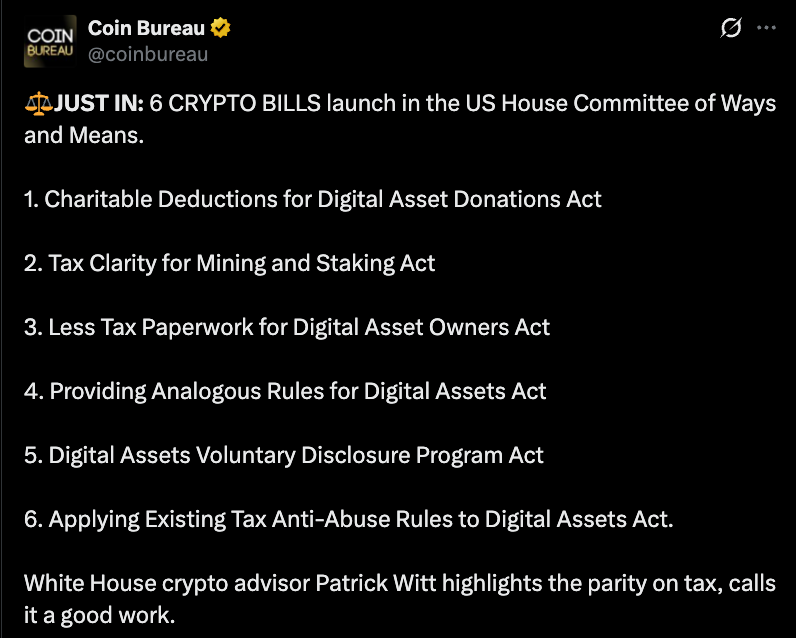
The House Ways and Means Committee recently unveiled six crypto-related tax bills that could significantly change how digital assets are treated under U.S. tax law. While the proposals vary in scope, they share a common objective: integrating cryptocurrency into the existing financial framework while providing clearer guidance for taxpayers.
Simplifying Crypto Donations and Rewards
One of the most notable proposals is the Charitable Deductions for Digital Asset Donations Act. The bill would simplify the process of donating cryptocurrency by eliminating appraisal requirements for highly liquid and actively traded digital assets. Currently, crypto donations exceeding $5,000 can trigger expensive valuation requirements, creating friction for donors and charitable organizations alike.
Another closely watched proposal is the Tax Clarity for Mining and Staking Act. The bill seeks to provide more certainty around when mining and staking rewards become taxable. Previous versions of similar legislation have explored allowing taxpayers to defer taxation until assets are sold rather than recognizing income immediately upon receipt, a change many crypto participants have long advocated.
Reducing Compliance Burdens for Everyday Users
The Less Tax Paperwork for Digital Asset Owners Act focuses on easing compliance obligations for retail users. Lawmakers have acknowledged that current reporting requirements can become impractical for small transactions, especially when minor purchases technically trigger taxable events.
The proposal could potentially create exemptions or simplified reporting standards for low-value transactions, making cryptocurrency more practical for everyday use. For many investors and users, reducing paperwork could be just as valuable as reducing taxes themselves.

Bringing Crypto Closer to Traditional Finance
Perhaps the most significant proposal is the Providing Analogous Rules for Digital Assets Act. This legislation would apply many existing financial tax principles to cryptocurrency transactions, including areas such as crypto lending, wash-sale rules, basis calculations, and other common investment activities.
In practical terms, the bill aims to make digital assets operate under a framework that resembles the one already used for stocks and securities. While that could introduce additional compliance requirements in certain areas, it would also provide a level of clarity that institutional investors have been requesting for years.
New Focus on Compliance and Enforcement
The package also includes the Digital Assets Voluntary Disclosure Program Act, which would create a structured pathway for taxpayers to correct previous crypto tax reporting mistakes before facing enforcement actions. The measure is designed to encourage compliance by giving investors an opportunity to resolve past issues without immediately facing penalties.
Meanwhile, the Applying Existing Tax Anti-Abuse Rules to Digital Assets Act would extend current anti-abuse provisions into the crypto sector. The goal is to prevent taxpayers from exploiting differences between traditional finance rules and digital asset regulations to reduce their tax obligations.
A Sign of Crypto’s Growing Acceptance
The broader takeaway from these proposals may be more important than the specific provisions themselves. Congress is no longer debating whether cryptocurrency belongs within the financial system. Instead, lawmakers are focused on determining how digital assets should fit into the existing tax and regulatory framework.
That shift represents a major evolution in Washington’s approach toward crypto. While some of the proposals may increase reporting obligations, clearer rules generally reduce uncertainty, and certainty tends to attract institutional capital.
None of these bills have become law yet, and revisions are likely before any final vote takes place. Still, the direction appears increasingly clear. Policymakers are moving away from questioning crypto’s legitimacy and toward establishing the rules needed to integrate digital assets into mainstream finance.
Disclaimer: BlockNews provides independent reporting on crypto, blockchain, and digital finance. All content is for informational purposes only and does not constitute financial advice. Readers should do their own research before making investment decisions. Some articles may use AI tools to assist in drafting, but every piece is reviewed and edited by our editorial team of experienced crypto writers and analysts before publication.









 English (US) ·