
 2 months ago
25
2 months ago
25
Ethereum is currently testing key resistance levels as the broader cryptocurrency market attempts to recover from the recent period of volatility and downward pressure. After weeks of corrective price action, ETH has begun to stabilize, with buyers gradually pushing the asset higher as traders reassess market conditions and liquidity flows across digital assets.
While price action suggests the possibility of a short-term rebound, derivatives market data indicate that bigger structural changes may be unfolding beneath the surface. According to a recent analysis from CryptoQuant analyst Arab Chain, the ETH Binance Futures Smart Money CVD (90D) indicator is beginning to reflect notable shifts in the demand dynamics within Ethereum’s derivatives market on Binance.
The indicator tracks the cumulative difference between aggressive buy orders and aggressive sell orders executed through market orders in the futures market. Because these orders represent traders willing to immediately execute trades, the metric provides valuable insight into real-time demand pressure from more active market participants.
According to the latest data, aggressive buying volume in Ethereum futures on Binance recently reached approximately $4.583 billion, while aggressive selling volume totaled around $4.576 billion. As a result, the daily Taker Delta recorded a positive value of roughly $7.15 million, indicating a slight advantage for buyers during that session as the market attempted to regain momentum.
Smart Money CVD Still Reflects Dominant Selling Pressure
Despite the recent session showing a slight advantage for buyers, the broader structure of Ethereum’s derivatives market remains tilted toward selling pressure. According to the analysis, the 90-day rolling Smart Money CVD still registers a negative reading of approximately -$5.71 billion, indicating that aggressive selling activity has outweighed aggressive buying over the past three months.

In practical terms, this means that market participants using market orders have been more willing to sell Ethereum than to accumulate it during that period. Because the CVD tracks the cumulative difference between buy and sell orders executed directly in the market, sustained negative values typically reflect a market environment dominated by sellers closing positions or initiating short trades.
However, analysts note that negative CVD readings do not automatically translate into immediate downward price movement. Market dynamics can sometimes produce a different outcome through a mechanism known as liquidity absorption.
In such situations, large buyers place substantial limit orders in the order book, allowing them to absorb selling pressure without significantly pushing the price higher in the short term. This behavior can create a temporary equilibrium where aggressive sellers continue to hit bids while patient buyers gradually accumulate supply.
If this absorption process persists, it may eventually reduce sell-side pressure and lay the groundwork for a potential shift in market momentum.
Ethereum Tests Long-Term Support Zone After Multi-Month Correction
The weekly chart shows Ethereum attempting to stabilize after a prolonged corrective phase that began following its rejection near the $4,800 region in 2025. Since that peak, price action has formed a clear sequence of lower highs and lower lows, confirming a sustained bearish structure across higher timeframes.
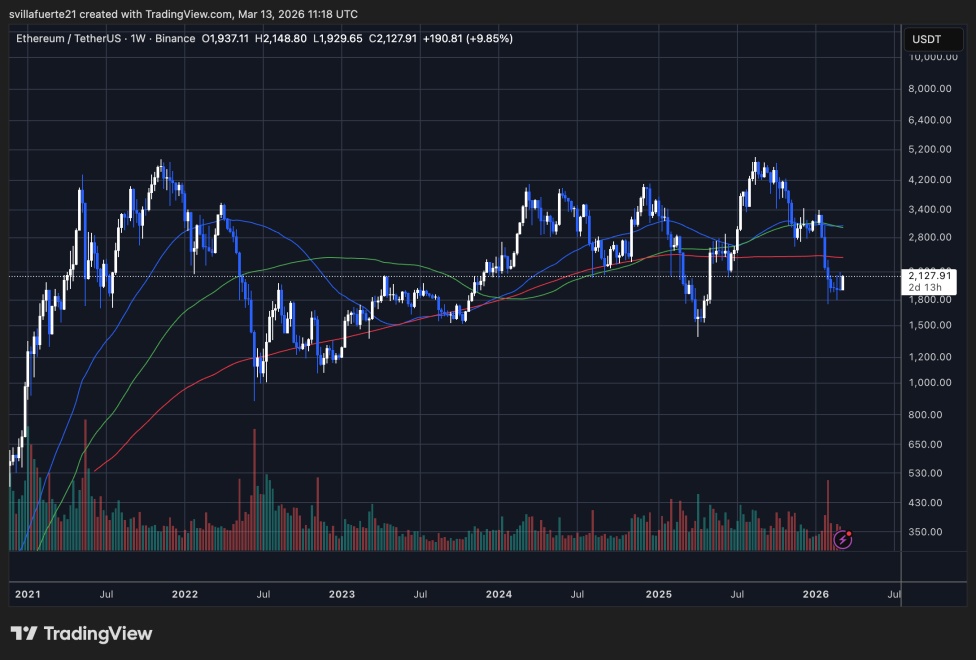
The recent selloff pushed ETH sharply below the $2,400–$2,600 region, which previously acted as an important support area during earlier consolidation phases. The breakdown triggered a rapid decline toward the $1,800 zone, where buyers finally stepped in and produced a short-term rebound.
Currently, Ethereum is trading around the $2,100 level, a price area that appears to be functioning as a temporary equilibrium between buyers and sellers. From a technical perspective, this region now acts as an important pivot level. Sustained price action above this zone could allow ETH to attempt a recovery toward the $2,600 resistance area, where the 100-week moving average is currently trending.
However, the broader structure remains fragile. The 200-week moving average sits slightly below the current price and may serve as a key long-term support level if selling pressure returns.
Volume data also shows elevated activity during the recent decline, suggesting that the market experienced a significant liquidation phase. Whether this represents capitulation or merely a pause in the downtrend will depend on Ethereum’s ability to reclaim higher resistance levels in the coming weeks.
Featured image from ChatGPT, chart from TradingView.com








 English (US) ·