
 3 months ago
112
3 months ago
112
- Solana remains under bearish pressure after failing to hold a rally and facing strong resistance near $88.
- Technical indicators continue favoring sellers, with RSI and moving averages pointing toward ongoing weakness.
- Despite price struggles, Solana is expanding its Web3 presence through its partnership with the Open Transaction Layer (OTL).
Solana (SOL) continues to trade under pressure after another failed attempt to regain bullish momentum. While the broader crypto market has shown occasional signs of recovery, SOL has struggled to sustain any meaningful rally, leaving traders increasingly focused on downside risks. The token is currently changing hands around $82, posting a modest daily gain, but the bigger picture remains uncertain as technical indicators continue favoring sellers.
The latest rejection near the $98 level appears to have reinforced bearish sentiment. Since that failed breakout attempt, Solana has carved out a clear sequence of lower highs and lower lows, a classic sign that momentum is fading rather than improving. For many traders, the trend remains simple: until buyers prove otherwise, rallies are likely to be viewed as opportunities to sell rather than signals of a new uptrend.
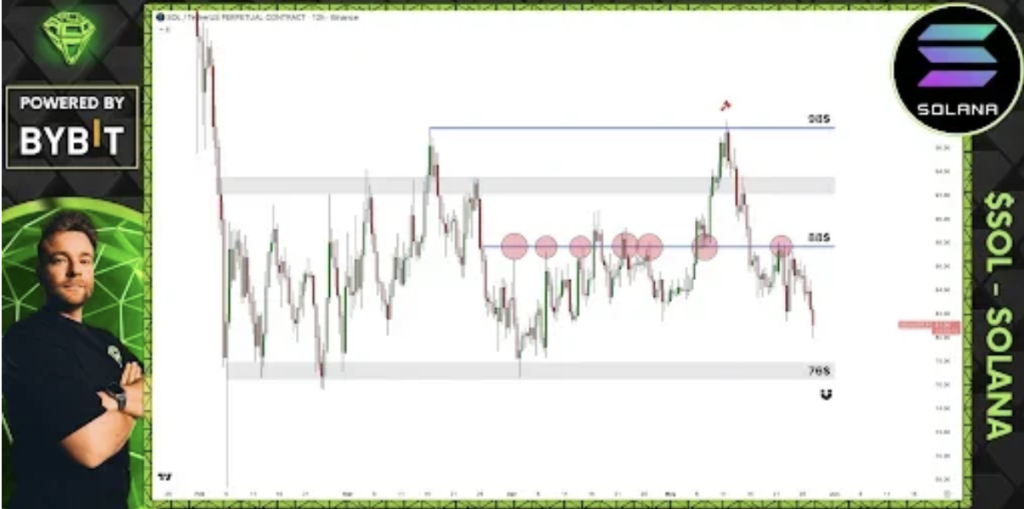
$88 Resistance and $76 Support Become Critical Levels
According to crypto analyst Sjuul, the $88 area has now emerged as one of the most important resistance zones on the chart. Buyers have repeatedly attempted to reclaim that level, but each effort has fallen short, allowing bears to maintain control of short-term market direction.
As a result, attention is increasingly shifting toward the $76 support region. This level represents the next major line of defense for bulls and could determine whether Solana enters a deeper correction phase. If sellers manage to push price below that support, the probability of revisiting lower local lows would increase significantly.
On the other hand, markets rarely move in straight lines. Should buyers regain enough strength to break above $88 and hold that level as support, sentiment could change rather quickly. A successful reclaim would likely force bearish traders to reassess their positions and could provide the foundation for a broader recovery attempt.
Technical Indicators Continue Favoring Sellers
A closer look at Solana’s technical structure reveals why caution remains widespread. According to TradingView data, SOL continues to trade beneath several important moving averages that have acted as overhead resistance for months. The 100-day and 200-day exponential moving averages remain pointed lower, reinforcing the larger bearish trend that has defined much of the recent price action.
Meanwhile, the shorter-term 20-day and 50-day EMAs are also sitting above current price levels, creating multiple layers of resistance that buyers must overcome before any meaningful trend reversal can occur. This type of setup often makes recoveries more difficult because each upward move faces resistance from a different group of traders.
The Relative Strength Index adds another layer of concern. Currently sitting near 39.57, the RSI remains below the neutral 50 level, indicating that bearish momentum still outweighs buying pressure. At the same time, the indicator has not reached oversold territory, suggesting there may still be room for additional downside before a stronger relief rally develops.
Solana Expands Its Web3 Ambitions Through OTL Partnership
Despite the challenging price action, Solana continues making progress on the development front. The network recently confirmed its role as one of the founding partners behind the Open Transaction Layer (OTL), an initiative designed to improve communication and transaction processing across multiple blockchain ecosystems.
The goal of OTL is relatively straightforward but highly important. The crypto industry remains fragmented, with different blockchains often operating in isolated environments. OTL aims to create a shared infrastructure layer that standardizes processes such as identity verification, compliance requirements, and messaging systems. By doing so, it could make moving assets and information between chains significantly easier.
For Solana, participation in the project highlights its growing role within the broader Web3 infrastructure landscape. Rather than focusing solely on its own ecosystem, the network is positioning itself as part of a larger framework designed to improve interoperability across the industry.
Long-Term Growth Story Remains Intact Despite Short-Term Weakness
The contrast surrounding Solana is becoming increasingly clear. On one side, the charts continue flashing warning signs as resistance levels hold firm and bearish momentum remains dominant. On the other, network development and institutional-focused initiatives continue moving forward, reinforcing Solana’s long-term relevance within the blockchain sector.
Projects like OTL may not immediately influence price action, but they contribute to the broader foundation needed for future adoption. Improved interoperability, stronger compliance standards, and smoother asset movement are all areas that institutions care deeply about when evaluating blockchain infrastructure.
For now, traders remain focused on the battle between $76 support and $88 resistance. But beyond those short-term levels, Solana continues expanding its footprint across Web3. Whether that growth eventually translates into stronger price performance will likely depend on whether buyers can regain control of the chart in the weeks ahead.
Disclaimer: BlockNews provides independent reporting on crypto, blockchain, and digital finance. All content is for informational purposes only and does not constitute financial advice. Readers should do their own research before making investment decisions. Some articles may use AI tools to assist in drafting, but every piece is reviewed and edited by our editorial team of experienced crypto writers and analysts before publication.






 English (US) ·