
 1 month ago
57
1 month ago
57
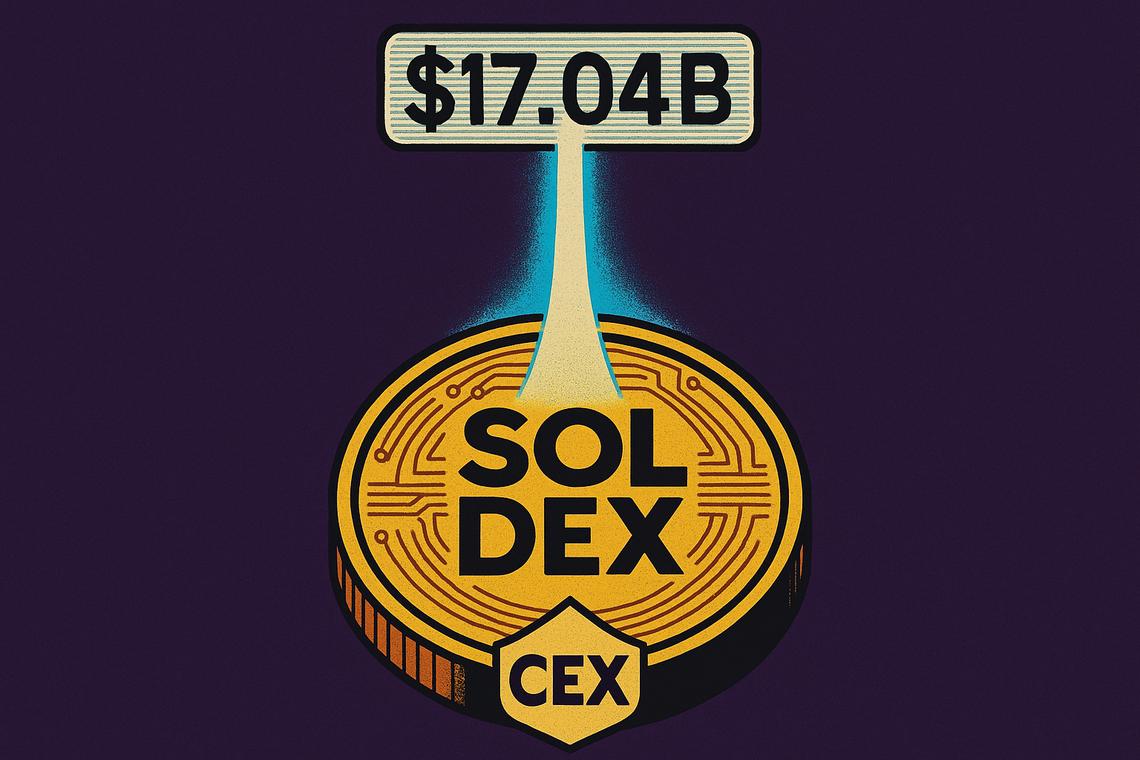
Something significant is happening on Solana’s decentralized exchanges, and the numbers are hard to dismiss. Daily Solana DEX volume has reached approximately $17.04 billion, according to data from DeFiLlama. This figure demonstrates the network’s significant on-chain trading activity and reflects Solana’s evolution into a major trading venue.
Key takeaways
- Solana-based DEXs recorded approximately $17.04 billion in daily trading volume, according to DeFiLlama data.
- Low fees and fast transaction confirmations drive retail and high-frequency trader activity on the network.
- Daily volume spikes can be volatile and may include speculative or short-lived token activity, not sustained demand.
- Converting high trading volume into durable DeFi infrastructure remains Solana’s defining challenge ahead.
Solana’s Decentralized Exchanges Reach $17 Billion in Daily Trading Volume
The $17.04 billion figure comes from DeFiLlama’s DEX dashboard, which tracks and compares chain-level trading activity across multiple blockchain ecosystems including Ethereum, BNB Chain, Base, Arbitrum, and Avalanche. This volume demonstrates Solana’s position as one of the most active on-chain trading environments in crypto.
Solana’s trading activity is significant in both user count and trade value. That dual weight matters. Volume that is large by count alone can reflect bot noise or dust transactions. Volume that is large by value suggests real capital is moving through the network — liquidity providers, market makers, and active traders routing meaningful positions through Solana’s DEX ecosystem.
Still, the figure deserves context. DeFiLlama’s data captures the full scope of on-chain swaps, which can include everything from institutional-scale transactions to rapid retail flips on newly launched tokens. The raw number tells you the network is busy. It does not, by itself, tell you why.
Why Solana Appeals to Retail and High-Frequency Traders
Solana’s structural advantages for traders are straightforward: low fees and fast transaction confirmations. Those two features unlock a style of trading that is genuinely difficult on more expensive networks. When a swap costs fractions of a cent and settles in under a second, smaller positions become viable, higher-frequency strategies become practical, and the barrier to entering or exiting a trade essentially disappears.
A retail flywheel that keeps spinning
The mechanics behind Solana’s recurring volume surges are well-established by now. Wallets are accessible to non-technical users. Token launches happen quickly and attract immediate speculative attention. DEX aggregators have strong distribution. When social momentum builds around a token, users can act within seconds without worrying that transaction costs will eat their position.
That combination creates a self-reinforcing retail flywheel. Fast execution encourages more trading. More trading attracts liquidity. More liquidity makes the venue more competitive. And greater competitiveness pulls in the next wave of users. It is a dynamic that Ethereum mainnet, with its higher costs, struggles to replicate at the retail end of the market — even as Layer 2 networks continue to grow.
Interpreting Solana’s Volatile DEX Volume Spikes
High DEX volume is not automatically a clean signal. Daily spikes can be volatile, and the $17 billion figure almost certainly contains a mix of durable and ephemeral activity.
What’s inside the volume number
Active users and moving liquidity are genuinely positive. They generate protocol fees, attract market makers, and keep the broader DeFi ecosystem functional. But some portion of that activity is speculative by nature — concentrated around new token launches, memecoin cycles, or high-volatility sessions that may not recur. High-frequency trading adds further complexity: it inflates volume metrics without necessarily reflecting the kind of sustained user engagement that builds lasting ecosystem value.
That is not an argument against the number. It is an argument for reading it carefully. A $17 billion day that includes significant speculative noise is still a $17 billion day. It still means capital is routing through Solana, fees are being generated, and the network is being used. The question is what percentage of that activity converts into repeat users, deeper liquidity, and protocol-level stickiness.
As DeFiLlama’s comparative data makes clear, volume is only one dimension of network health. Fees, active wallets, liquidity depth, token concentration, and user retention all contribute to a fuller picture. A standout volume day is impressive evidence of demand. It is not, on its own, proof of durability.
Solana’s Evolving Market Role and Future Challenges
The way the market talks about Solana has shifted fundamentally over the past few cycles. Early conversations centered on whether it could compete with Ethereum as a high-speed Layer 1 — a framing that positioned it as a challenger chasing someone else’s position. That framing no longer captures what Solana actually is. The network has evolved from an Ethereum competitor into a favored venue for fast on-chain trading, with its own distinct identity and user base.
From positioning to proving staying power
Ethereum mainnet retains its advantages in depth, security, and institutional credibility. Solana has carved out different territory — closer to the pace of centralized exchange speculation than traditional DeFi. That positioning is exactly why Solana DEX volume has become such a closely watched metric. It reflects whether the network’s identity as a trading venue is holding.
But identity is not the same as infrastructure. The real test ahead is whether Solana can convert high and volatile trading flows into something more structurally durable. Memecoin-driven volume brings users in. Lending markets, stablecoin liquidity, real-world asset protocols, and serious trading infrastructure are what keep an ecosystem deep over time. Solana has demonstrated it can attract enormous attention during speculative cycles. What it still needs to prove is that a meaningful baseline of activity survives when those cycles cool.
If Solana’s DEXs can sustain significant volume through quieter markets — not the peak days, but the ordinary ones — the network’s case as a permanent fixture in crypto trading infrastructure becomes much harder to argue against. That is the test that $17 billion daily volumes set up, even if they do not answer it.
FAQ
What is the recent daily trading volume on Solana’s decentralized exchanges?
Daily trading volume on Solana DEXs has reached around $17.04 billion, according to DeFiLlama data.
Why is Solana popular among retail and high-frequency traders?
Solana offers low fees and fast transaction confirmations, which make frequent and smaller trades practical. Combined with user-friendly wallets and rapid token launches, the network supports a retail trading environment where users can act quickly without transaction costs eroding their positions.
Does a high daily DEX volume guarantee long-term demand on Solana?
No. Daily volume spikes can be volatile and may include speculative or short-term activity. They do not on their own indicate sustained demand. Volume should be read alongside other metrics such as active users, liquidity depth, and user retention to assess whether trading activity is durable.
What challenges does Solana face despite high trading volume?
The main challenge is converting high and volatile trading volume into durable DeFi infrastructure — deeper liquidity, lending markets, stablecoin supply, and sustained user engagement. Volume spikes driven by memecoin activity or speculative cycles can fade quickly, and Solana’s maturation as a trading venue depends on maintaining a meaningful baseline of activity beyond those bursts.
Article produced with the assistance of artificial intelligence and reviewed by the editorial team.





 English (US) ·