
 2 months ago
54
2 months ago
54
- Solana processed a record 112.6 million average daily non-vote transactions during Q1.
- Trading apps and launchpads generated major revenue despite broader market weakness.
- RWAs, payments, and DePIN sectors continued attracting institutional and ecosystem growth.
Solana managed to hold up surprisingly well during Q1, even while broader crypto markets dealt with heavy corrections and weakening sentiment. Token prices across the industry faced pressure for much of the quarter, but underneath the volatility, Solana’s network activity stayed remarkably active across several major metrics.
Transaction counts, fee payer activity, and application revenue all remained strong despite the difficult market environment. That divergence between weak price action and solid network fundamentals has started drawing more attention from analysts watching Solana’s longer-term growth trajectory heading deeper into 2025.
In many ways, the numbers suggest Solana’s ecosystem kept expanding quietly while the market focused mostly on price declines.
Solana Printed Record Transaction Activity
One of the biggest signals came from Solana’s transaction volume. During Q1, the network reached a new all-time high in average daily non-vote transactions, processing roughly 112.6 million per day. That represented a massive 50% increase quarter-over-quarter, which honestly stands out considering how shaky overall crypto sentiment looked during the same period.
Those figures suggest user activity didn’t really slow down much at all despite the market correction. In fact, network usage kept climbing.
At the same time, Solana’s Chain GDP remained relatively stable around $342.2 million for the quarter, while average daily fee payers held steady near 2.2 million users. That consistency matters because it shows demand for Solana block space remained healthy even while speculative momentum across the broader market weakened.
Crypto analyst Kaff also pointed out on X that applications on Solana were “still making real money,” especially launchpad platforms, which reportedly generated around $144 million during the quarter.
That number alone accounted for roughly 42% of all Solana application revenue during Q1. Even more interesting, Solana’s App Revenue-to-Chain Revenue ratio climbed to around 382%, meaning applications running on the network captured substantially more value than the base blockchain layer itself.
Trading Apps Continued Dominating Revenue Growth
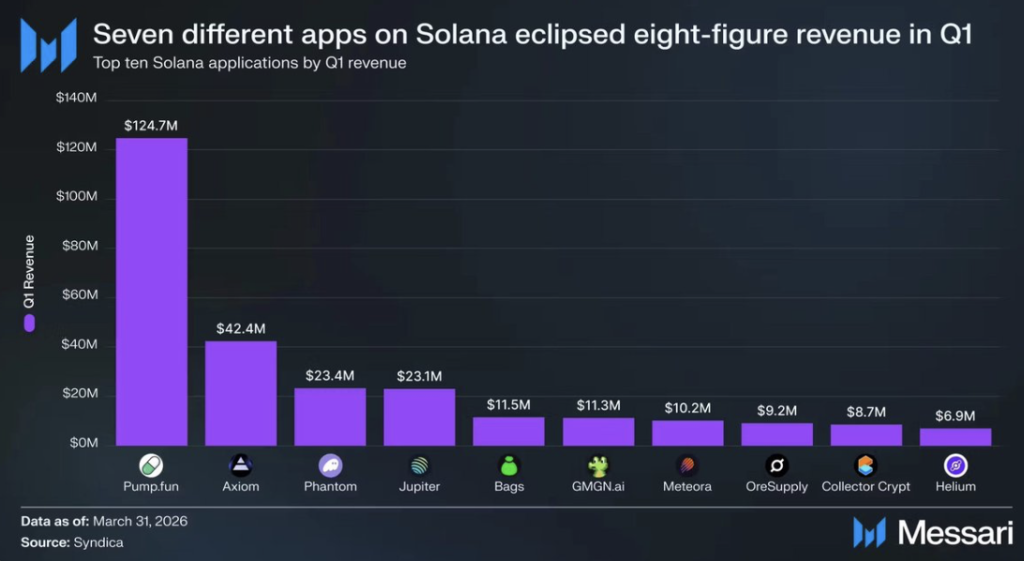
Trading-focused applications remained the biggest revenue drivers across the Solana ecosystem throughout the quarter. Pump.fun led the group after generating approximately $124.7 million in revenue, marking a 17% increase compared to the previous quarter.
Axiom Exchange also posted strong growth, bringing in around $42.4 million after climbing 36% quarter-over-quarter. Meanwhile, Raydium generated roughly $34.6 million, Phantom added $23.4 million, and Jupiter contributed another $23.1 million across a broader mix of services.
Those numbers reinforce the idea that Solana’s trading ecosystem continues attracting heavy user engagement even during periods of market weakness. Activity didn’t disappear — it just shifted more toward active trading, launchpads, and liquidity infrastructure instead of pure speculative price chasing.
That’s an important distinction because ecosystems that maintain user activity during corrections often recover stronger once broader sentiment improves again.
RWAs and Payments Are Becoming Major Solana Narratives
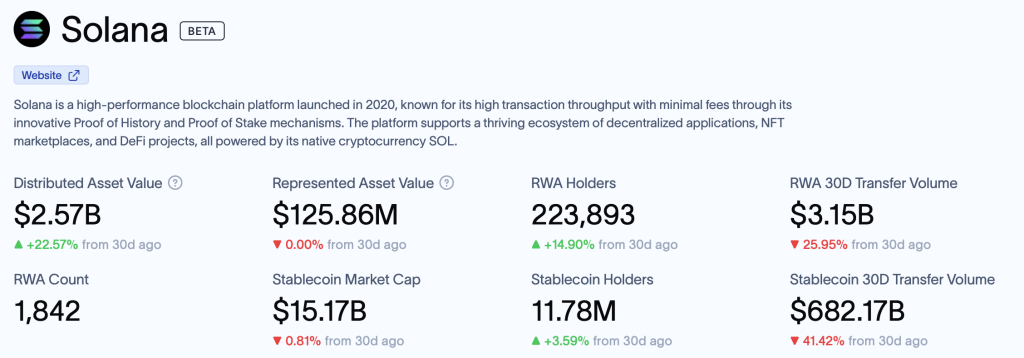
Beyond trading activity, real-world assets have started emerging as one of the most important growth areas across Solana’s ecosystem. Institutional interest in tokenized assets appears to be increasing steadily, and Solana is beginning to position itself more aggressively inside that market.
According to the latest data, the network’s RWA market cap grew roughly 43% quarter-over-quarter, reaching around $2.01 billion. BlackRock’s BUIDL fund alone doubled to approximately $525.4 million after Anchorage Digital added custody support.
Kamino Finance also remained relatively stable during the quarter, declining only about 8% while integrating both PRIME and ONyc into its DeFi infrastructure. That move is helping position Kamino as a growing institutional liquidity hub within Solana’s broader ecosystem.
At the same time, tokenized collectible and card platforms continued gaining traction as well. Collector Crypt reportedly captured about 89% of that specific market segment during Q1.
Payments infrastructure is becoming another increasingly important narrative for Solana too. Large companies including Visa, Stripe, Worldpay, Western Union, Fiserv, and PayPal all moved closer toward Solana-based settlement systems or product integrations during the quarter.
The network also expanded compatibility with x402 and Stripe’s Machine Payments Protocol, allowing support for major AI agent payment standards. That development could become more important later as machine-to-machine payments and automated financial systems continue growing.
DePIN and RWA Growth Continue Expanding Solana’s Ecosystem
Solana’s decentralized physical infrastructure sector, commonly called DePIN, also showed steady expansion during Q1. Revenue across the segment climbed roughly 28% to about $9.1 million, led largely by projects like Helium and GEODNET.
Meanwhile, perpetual DEX trading volume declined around 29% quarter-over-quarter to roughly $1.14 billion in daily volume. Even so, some projects still managed explosive growth inside niche sectors.
GM Trade, for example, reportedly saw daily trading volume surge more than 8,000% after pivoting toward real-world asset-based perpetual products. That kind of growth highlights how quickly new narratives can gain traction inside Solana’s ecosystem when infrastructure and liquidity align properly.
Overall, Solana’s Q1 performance painted a pretty interesting picture. Token prices struggled alongside the broader market, but the network itself kept processing record activity, expanding payment integrations, and attracting institutional attention across tokenized assets and decentralized infrastructure.
For many analysts, that disconnect between price and ecosystem growth may end up becoming one of Solana’s most important long-term signals heading into the rest of 2025.
Disclaimer: BlockNews provides independent reporting on crypto, blockchain, and digital finance. All content is for informational purposes only and does not constitute financial advice. Readers should do their own research before making investment decisions. Some articles may use AI tools to assist in drafting, but every piece is reviewed and edited by our editorial team of experienced crypto writers and analysts before publication.



 English (US) ·