
 4 months ago
75
4 months ago
75
- Solana co-founder Anatoly Yakovenko says Solana needs its own atomically composable perpetual futures DEX directly inside the SVM
- Hyperliquid is simultaneously pushing deeper into Washington as the CLARITY Act advances and regulators begin focusing on onchain derivatives
- The debate has exposed a deeper divide: isolated high-performance exchanges versus fully composable onchain financial infrastructure
Hyperliquid may dominate onchain perpetual trading today, but Solana’s leadership is making it very clear they do not intend to leave that market uncontested.
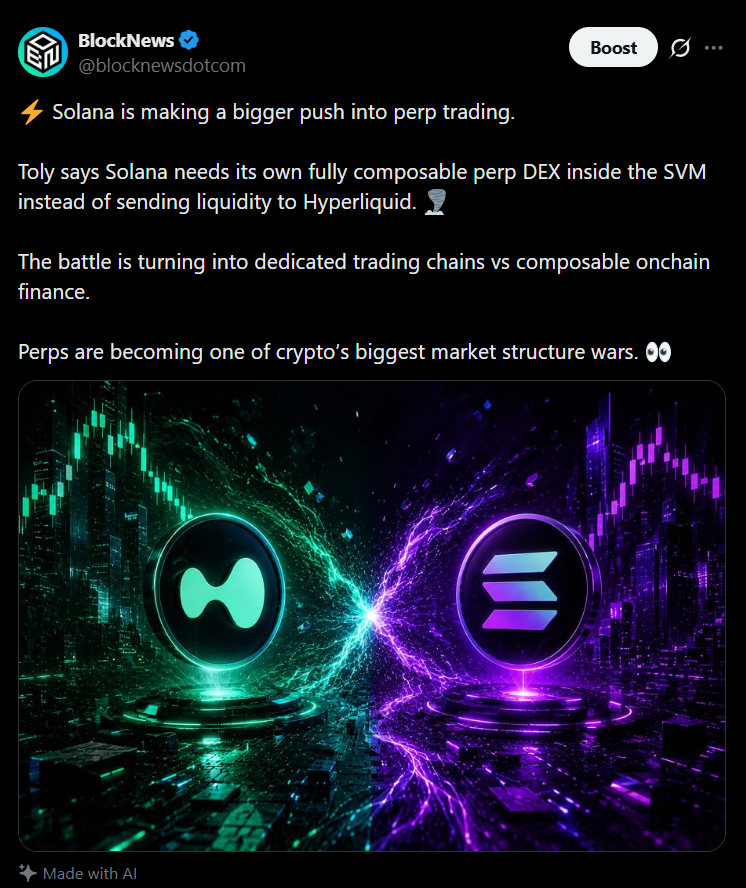
The latest clash started after Hyperliquid co-founder Jeffrey Yan revealed he had spent several days in Washington meeting policymakers alongside the Hyperliquid Policy Center while discussions around the CLARITY Act continue moving forward. According to Yan, the meetings focused on how decentralized derivatives markets could eventually fit inside the American regulatory framework.
Then Toly stepped directly into the conversation. And things escalated fast.
Toly’s Core Argument Is Bigger Than “Another Perp DEX”
Critics immediately questioned why Solana needs another perpetual futures platform when Hyperliquid already exists and dominates the category.
Toly’s answer was simple: composability.
According to him, Hyperliquid operates more like an isolated destination, while Solana’s SVM ecosystem needs a perpetual futures engine built directly into the runtime itself so other applications can compose around it atomically.
In other words, he is not arguing for “another exchange.” He is arguing for derivatives infrastructure that becomes native programmable financial plumbing inside the chain itself.
That distinction matters more than it sounds at first glance.
Hyperliquid Built the First Big Onchain Trading Destination
To Hyperliquid’s credit, the platform already proved something important to the industry: traders are willing to use a decentralized interface instead of relying entirely on Binance, CME, or Coinbase-style systems.
Self-custody, fast execution, no KYC, and community-driven ownership gave Hyperliquid genuine product-market fit.
But Toly’s position is that Hyperliquid still requires users and applications to effectively leave the Solana ecosystem and bridge into another environment. For Solana builders, that breaks composability.
And composability is basically Solana’s religion at this point.
Washington Is Quietly Becoming Part of the Story
What makes this timing especially interesting is that Hyperliquid is already proactively engaging regulators while the CLARITY Act advances through Congress.
That suggests the next phase of decentralized derivatives will not just be a technical race — it will also become a regulatory one.
Projects that successfully combine speed, liquidity, composability, and regulatory survivability may end up controlling an enormous portion of future financial infrastructure.
Right now, Hyperliquid has the lead.
But Solana clearly wants a seat at that table too — and Toly sounds very serious about building it.
Disclaimer: BlockNews provides independent reporting on crypto, blockchain, and digital finance. All content is for informational purposes only and does not constitute financial advice. Readers should do their own research before making investment decisions. Some articles may use AI tools to assist in drafting, but every piece is reviewed and edited by our editorial team of experienced crypto writers and analysts before publication.




 English (US) ·