
 2 months ago
51
2 months ago
51
- Stablecoins processed roughly $33 trillion in 2025, more than double Visa’s reported volume
- Monthly stablecoin transfers surpassed ACH volumes for the first time in February 2026
- Visa, SoFi, Western Union, and major financial firms are now building on stablecoin infrastructure
Stablecoins are no longer just a crypto trading tool. According to Binance Research, they processed roughly $33 trillion in transaction volume during 2025, more than doubling Visa’s reported $14 trillion payment volume over the same period.
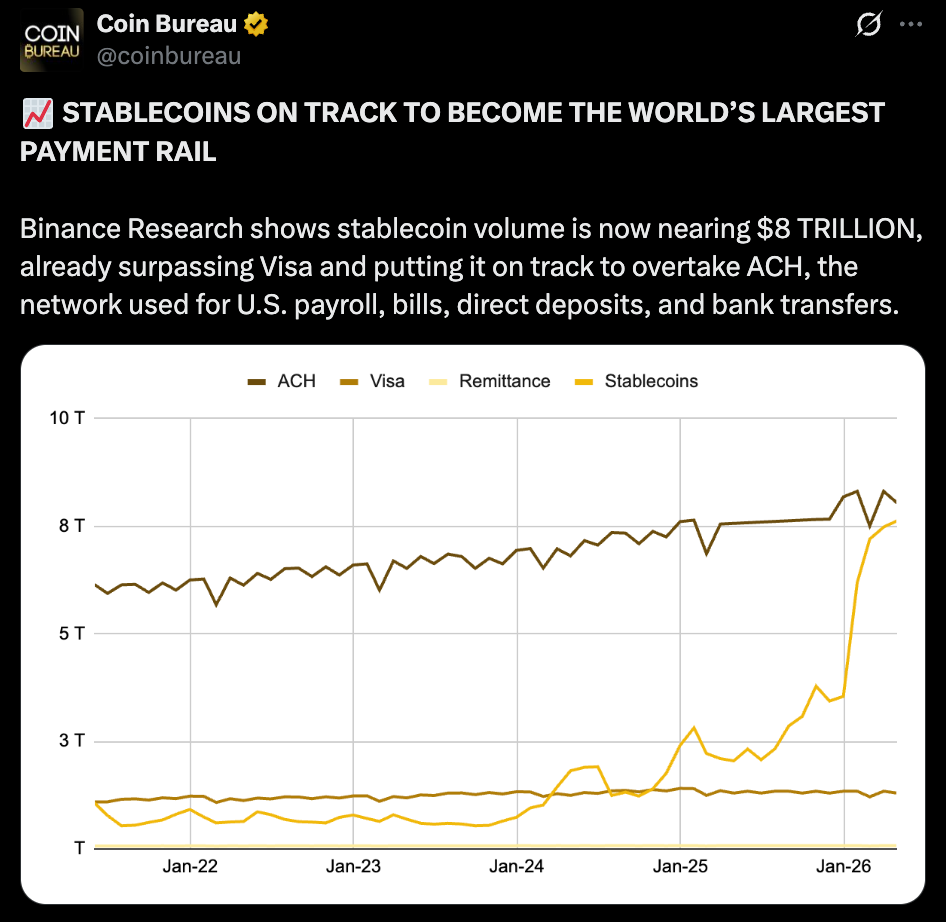
Even after removing exchange activity and inorganic flows, stablecoin usage reportedly exploded from around $0.5 trillion in 2022 to more than $7 trillion in organic transaction volume today. That kind of growth is starting to look less like a crypto experiment and more like a new global payment network scaling in real time.
ACH May Be The Bigger Threat
While surpassing Visa grabs headlines, the more important comparison may actually be ACH — the automated clearing network quietly powering much of the US financial system.
In February 2026, monthly stablecoin volume reportedly reached around $7.2 trillion, overtaking ACH’s roughly $6.8 trillion for the first time. That matters because ACH handles around 93% of salary payments in the United States, including direct deposits, payroll systems, bank transfers, and bill payments.
The contrast is becoming increasingly difficult to ignore. Stablecoins can settle globally in seconds for fractions of a cent, while traditional ACH transfers often still take days to finalize.
Institutions Are No Longer Ignoring It
The biggest signal may be how aggressively traditional financial firms are now entering the stablecoin market themselves. Companies like Western Union, Sony Bank, and SoFi have either launched or announced stablecoin-related products, while Visa has already expanded USDC settlement infrastructure on Solana.
There’s a certain irony in Visa helping support the same technology increasingly competing with its legacy rails, but that’s where the industry is heading.
The shift also reflects growing confidence that stablecoins are becoming long-term financial infrastructure rather than temporary crypto speculation vehicles.

Regulation Could Accelerate Adoption
Momentum around US crypto regulation may push the sector even further. The advancing CLARITY Act and broader stablecoin legislation discussions in Washington are helping create a more formal framework for how these digital payment systems operate inside the financial system.
That clarity matters for institutions deciding whether to integrate stablecoins into banking, payments, remittances, and treasury operations at scale.
Some research firms now project stablecoin transaction volumes could eventually reach as high as $1.5 quadrillion annually by 2035 if adoption continues accelerating across both crypto-native and traditional finance sectors.
Stablecoins Are Becoming Financial Infrastructure
What started as a tool for crypto traders moving between exchanges is increasingly evolving into something much larger. Stablecoins now sit at the intersection of payments, banking, settlement, remittances, and digital commerce globally.
And honestly, the speed of adoption is probably what surprises traditional finance the most. Visa spent decades building its network dominance. Stablecoins scaled globally in less than ten years.
The bigger question now is no longer whether stablecoins matter. It’s how much of the existing financial system they eventually replace.
Disclaimer: BlockNews provides independent reporting on crypto, blockchain, and digital finance. All content is for informational purposes only and does not constitute financial advice. Readers should do their own research before making investment decisions. Some articles may use AI tools to assist in drafting, but every piece is reviewed and edited by our editorial team of experienced crypto writers and analysts before publication.









 English (US) ·