
 1 hour ago
20
1 hour ago
20
Key Takeaways
- Equity futures retreated Tuesday morning, with Dow and S&P 500 contracts declining 0.5% while Nasdaq-100 futures tumbled 1%
- Crude prices surged following military confrontations between the US and Iran in the Strait of Hormuz, sending Brent above $92 per barrel
- Treasury yields climbed, with the 10-year note reaching 4.79%, intensifying speculation about additional Federal Reserve rate increases
- Historical patterns show September typically delivers losses for equities, with the S&P 500 averaging a 1.1% decline during the month
- Important economic indicators scheduled for release include JOLTS data, ISM manufacturing figures, and Friday’s crucial employment report
Equity markets faced headwinds at the start of September Tuesday as escalating energy costs, advancing bond yields, and persistent concerns about Federal Reserve monetary tightening weighed on futures trading.
Contracts tied to the Dow Jones Industrial Average declined approximately 255 points, representing a 0.5% decrease. S&P 500 futures retreated 0.5% while Nasdaq-100 futures experienced a sharper 1% pullback, diminishing gains accumulated during August’s rally.
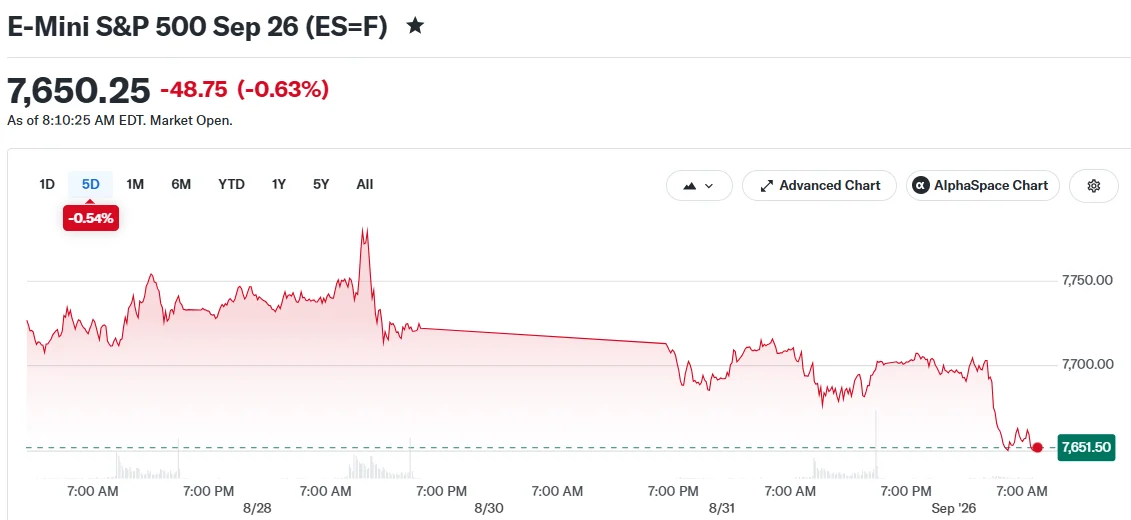
The three benchmark indices concluded August with impressive advances. The S&P 500 delivered its strongest August showing in half a decade. However, historical trends now pose challenges as September traditionally ranks as the calendar’s weakest month for equity performance.
Data indicates the S&P 500 generally declines approximately 1.1% during September. Market strategists note that traders have already factored in this seasonal weakness.
Crude Markets Rally Following Middle East Military Escalation
Fresh tensions stemming from US-Iran military engagement pushed energy prices upward Tuesday. The nations engaged in armed conflict in the Strait of Hormuz during the weekend, unsettling commodity markets.
Brent crude contracts advanced 1.8% to reach $92.07 per barrel. West Texas Intermediate gained 1.8% to trade at $87.28 per barrel.
Elevated oil prices threaten to accelerate inflation pressures, potentially compelling the Federal Reserve to implement additional rate hikes. This anxiety has already manifested in fixed-income markets.
The benchmark 10-year Treasury yield expanded 3 basis points to 4.79% during early Tuesday trading. Advancing yields increase borrowing costs and compress equity valuations.
Kathleen Brooks, research director at XTB, noted that market participants had become accustomed to viewing Iran-related tensions primarily through an economic lens. The resumption of actual military confrontations introduces fresh uncertainty that markets must now evaluate.
Employment Statistics and Corporate Reports Command Attention
Market participants are monitoring a busy week packed with economic releases. The Job Openings and Labor Turnover Survey publishes Tuesday, offering preliminary insights into labor conditions ahead of Friday’s comprehensive employment report.
Manufacturing indicators from S&P Global and the Institute for Supply Management are also scheduled for release during the week.
Regarding corporate earnings, Dell and Palo Alto Networks will announce quarterly results. Their financial performance may reveal corporate investment patterns in technology infrastructure and cloud computing platforms.
Equity futures began September maintaining double-digit gains for the year. Nevertheless, advancing crude prices, climbing yields, and geopolitical uncertainties have prompted caution among investors as the historically challenging month commences.
The post Stock Futures Decline as Crude Surges Past $92 and Bond Yields Spike Higher appeared first on Blockonomi.



 English (US) ·