
 3 months ago
80
3 months ago
80
- Strategy skipped Bitcoin purchases during the May 18–25 period
- The company repurchased $1.5 billion in convertible debt at an 8% discount
- Strategy still holds more than 843,000 BTC worth roughly $65 billion
Strategy, the company formerly known as MicroStrategy, temporarily stepped away from buying Bitcoin last week, though not because it suddenly turned bearish. Instead, Michael Saylor’s firm shifted focus toward reducing debt and tightening its broader capital structure while still positioning itself for long-term Bitcoin accumulation.
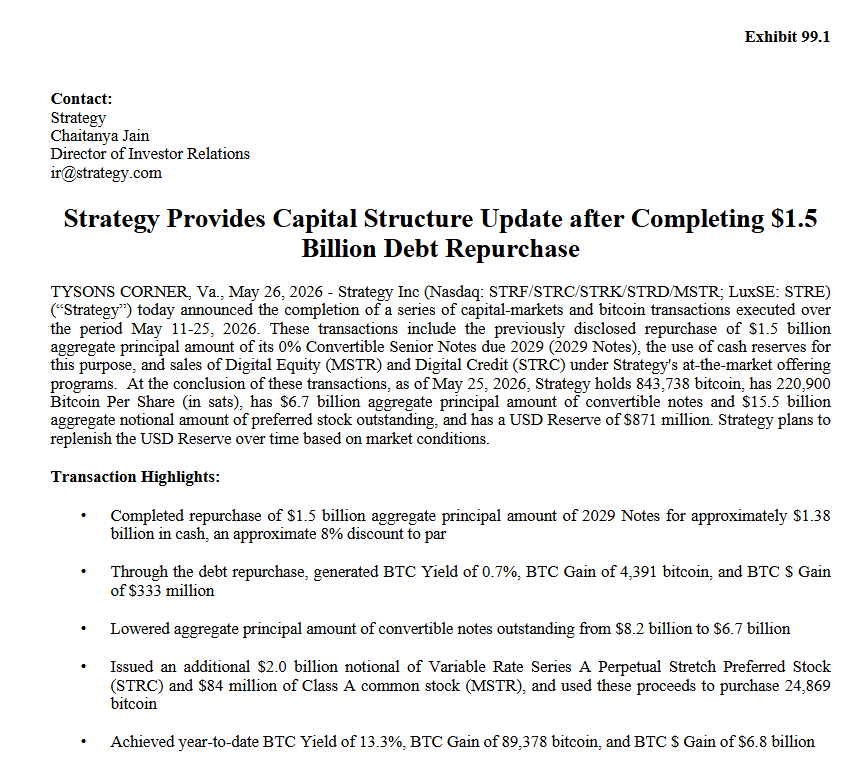
According to a new SEC filing, Strategy repurchased approximately $1.5 billion in 0% Convertible Senior Notes due in 2029 for roughly $1.38 billion in cash between May 11 and May 25. That effectively allowed the company to retire debt at about an 8% discount to face value, which is honestly a pretty favorable setup in this kind of environment.
Strategy Is Quietly Reshaping Its Balance Sheet
The debt repurchase reduced Strategy’s outstanding convertible notes from around $8.2 billion down to approximately $6.7 billion. The transaction was funded through a mix of existing cash reserves alongside proceeds generated from the company’s ongoing at-the-market equity and preferred stock programs.
While most people focus entirely on the Bitcoin purchases themselves, Strategy increasingly seems to be operating more like a sophisticated capital management machine wrapped around a Bitcoin treasury strategy. The company isn’t just buying BTC aggressively anymore, it’s actively optimizing liabilities, financing structures, and future flexibility at the same time.
And despite pausing purchases briefly, the company’s Bitcoin exposure remains enormous.
Strategy Still Holds Nearly $65 Billion In Bitcoin
Even after the latest debt-focused move, Strategy still holds roughly 843,738 Bitcoin, currently valued near $65 billion based on market prices. The company also reported maintaining a USD reserve of approximately $871 million.
Year-to-date, Strategy says it generated a BTC Yield of 13.3%, alongside a BTC Gain of 89,378 Bitcoin and a BTC Dollar Gain totaling roughly $6.8 billion.
The company also emphasized that retiring debt itself contributed positively to Bitcoin-related metrics, producing a BTC Yield of 0.7%, a BTC Gain equivalent to 4,391 BTC, and approximately $333 million in BTC Dollar Gain through the transaction structure.
It’s very “Michael Saylor accounting,” honestly. But investors following Strategy closely already understand the company increasingly measures corporate performance through a Bitcoin-centric framework rather than traditional treasury metrics alone.

The Pause Came Right After A Massive Bitcoin Buy
Importantly, the buying pause doesn’t signal a major shift away from accumulation. Just one week earlier, Strategy acquired roughly 25,000 Bitcoin worth more than $2 billion during the week ending May 17.
That purchase reinforced the company’s continued commitment to aggressively expanding reserves whenever management believes market conditions and financing structures make sense. The latest pause appears more tactical than philosophical.
Saylor recently explained that Strategy’s broader approach involves balancing continuous Bitcoin accumulation with careful management of debt obligations and dividend requirements. The goal is maintaining enough flexibility to continue scaling exposure without creating unsustainable financial pressure.
Strategy’s Entire Model Depends On Bitcoin Outperforming
One particularly interesting detail from Saylor’s recent comments involved the company’s estimated breakeven threshold for annual Bitcoin appreciation. According to him, Strategy only needs Bitcoin to appreciate roughly 2.3% annually for the overall model to remain viable.
If BTC outpaces that level, the company believes it can selectively sell portions of holdings to fund dividends while simultaneously replenishing reserves through additional capital raises tied to preferred stock programs like STRC.
That strategy essentially turns Strategy into a leveraged Bitcoin financial engine operating across debt markets, equity issuance, and treasury management simultaneously. Supporters see it as brilliant capital engineering. Critics still view it as an extremely high-risk structure tied almost entirely to Bitcoin’s long-term success.
For now, though, the numbers continue working in Strategy’s favor as long as Bitcoin keeps climbing faster than the company’s financing costs. And that remains the entire bet.
Disclaimer: BlockNews provides independent reporting on crypto, blockchain, and digital finance. All content is for informational purposes only and does not constitute financial advice. Readers should do their own research before making investment decisions. Some articles may use AI tools to assist in drafting, but every piece is reviewed and edited by our editorial team of experienced crypto writers and analysts before publication.









 English (US) ·