
 1 month ago
53
1 month ago
53
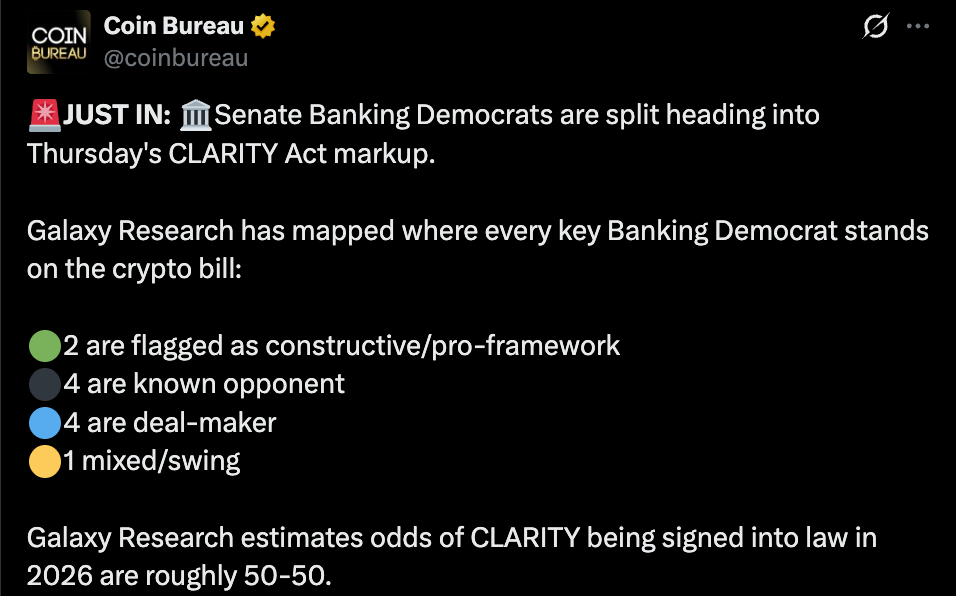
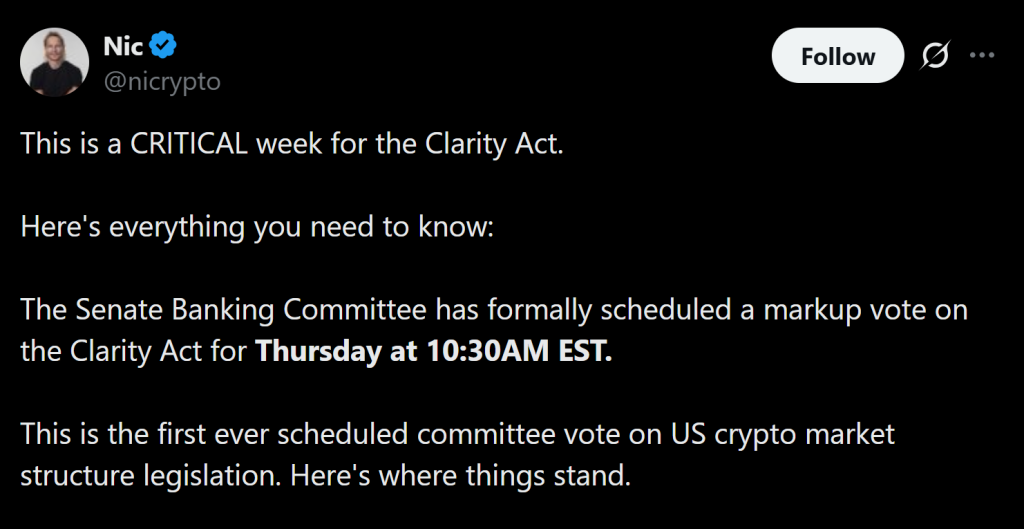
- The Senate Banking Committee will hold its first-ever crypto market structure markup vote on Thursday
- Lawmakers reportedly reached a compromise on stablecoin yield provisions after months of delays
- Analysts now estimate the odds of the CLARITY Act becoming law in 2026 at roughly 50%
The US crypto industry may finally be approaching one of its most important regulatory moments in years. On Thursday, May 14, the Senate Banking Committee is scheduled to consider the Digital Asset Market Clarity Act of 2025, marking the first official Senate committee vote ever held on comprehensive crypto market structure legislation.
For an industry that spent nearly a decade operating through lawsuits, enforcement actions, and regulatory confusion, the significance is hard to overstate. Whether the bill ultimately passes or stalls again, Thursday’s vote could shape how digital assets evolve inside the United States for years.
The CLARITY Act Has Been Delayed For Months
The CLARITY Act already passed the House back in July 2025 with a surprisingly strong bipartisan vote of 294 to 134. Since then though, progress inside the Senate slowed heavily as lawmakers argued over stablecoin regulation, decentralized finance language, SEC oversight authority, and broader ethics provisions tied to the industry.
At several points earlier this year, it genuinely looked like the bill might remain stuck indefinitely. The January postponement especially frustrated crypto companies hoping for clearer regulatory direction under the current administration.
Now though, momentum appears to be returning after senators reportedly reached a compromise around one of the biggest sticking points — stablecoin yields.
Stablecoin Yield Rules Are Mostly Settled
According to reports, Senators Thom Tillis and Angela Alsobrooks helped negotiate a compromise that would prohibit passive interest-style yields simply for holding stablecoins like USDC. However, activity-based rewards tied to transactions, platform engagement, or ecosystem participation would still remain allowed under the proposed framework.
That distinction matters because lawmakers were trying to avoid stablecoins functioning too similarly to uninsured bank deposits while still allowing blockchain platforms flexibility to incentivize usage.
Coinbase CEO Brian Armstrong reportedly signed off on the compromise after previously criticizing earlier Senate draft language. That alone suggests industry sentiment around the bill has improved significantly compared to earlier this year.
The White House is also reportedly pushing to get legislation finalized before July 4, with administration officials describing the timeline as achievable, although extremely tight.
Thursday’s Vote Could Go Three Ways
At this point, there are basically three realistic outcomes once the Senate Banking Committee begins markup discussions Thursday.
The most bullish scenario would be a relatively clean committee approval without major disruptive amendments. That outcome would likely boost market confidence immediately because it would signal serious bipartisan momentum toward finally establishing long-term crypto rules in the US.
A second possibility involves the bill passing with additional amendments or modifications. That would still be viewed as generally positive, although it could extend negotiations and create uncertainty around final Senate language later.
The bearish scenario would be another delay, major political fracture, or procedural collapse that effectively kills momentum again. Given how long crypto legislation has stalled historically in Washington, markets will probably react sharply to any signs of renewed dysfunction.
Other Countries Already Moved Ahead
Part of why the CLARITY Act matters so much now is because other global financial hubs already moved faster on crypto regulation. Countries including the UAE, Singapore, and the United Kingdom have spent the last several years implementing clearer digital asset frameworks, attracting companies, liquidity, and talent that might otherwise have stayed inside the United States.
Many crypto firms increasingly view regulatory clarity itself as a competitive advantage. Without clear rules, institutional participation becomes harder, banking relationships stay fragile, and long-term investment decisions become difficult.
That’s part of why analysts at Galaxy Research now reportedly estimate roughly 50-50 odds that the CLARITY Act could actually become law in 2026. Honestly, for crypto legislation in Washington, those are probably the strongest odds the industry has seen in years.
Thursday Could Become A Defining Moment
Even if Thursday’s markup succeeds, the bill still faces a long road involving full Senate approval and eventual reconciliation with the House version. But the symbolism of finally reaching an official Senate committee vote on crypto market structure legislation matters on its own.
After years of fragmented enforcement battles and political uncertainty, the industry is potentially approaching the point where comprehensive federal rules stop feeling theoretical and start becoming operational reality.
Whether Thursday delivers a breakthrough or another setback, one thing feels increasingly obvious: crypto regulation in the United States is no longer a side conversation. It’s becoming core financial policy.
Disclaimer: BlockNews provides independent reporting on crypto, blockchain, and digital finance. All content is for informational purposes only and does not constitute financial advice. Readers should do their own research before making investment decisions. Some articles may use AI tools to assist in drafting, but every piece is reviewed and edited by our editorial team of experienced crypto writers and analysts before publication.








 English (US) ·