
 2 months ago
42
2 months ago
42
- NFT market projected to hit $60.82B despite post-hype reset
- Gaming and utility-driven NFTs gaining share over PFP dominance
- “K-shaped” recovery separates strong projects from fading ones
The NFT market didn’t disappear, it just stopped pretending to be something it wasn’t. The days of $90 million JPEG headlines and overnight millionaires have mostly faded, replaced by something quieter, more structured, and honestly, a bit more real.
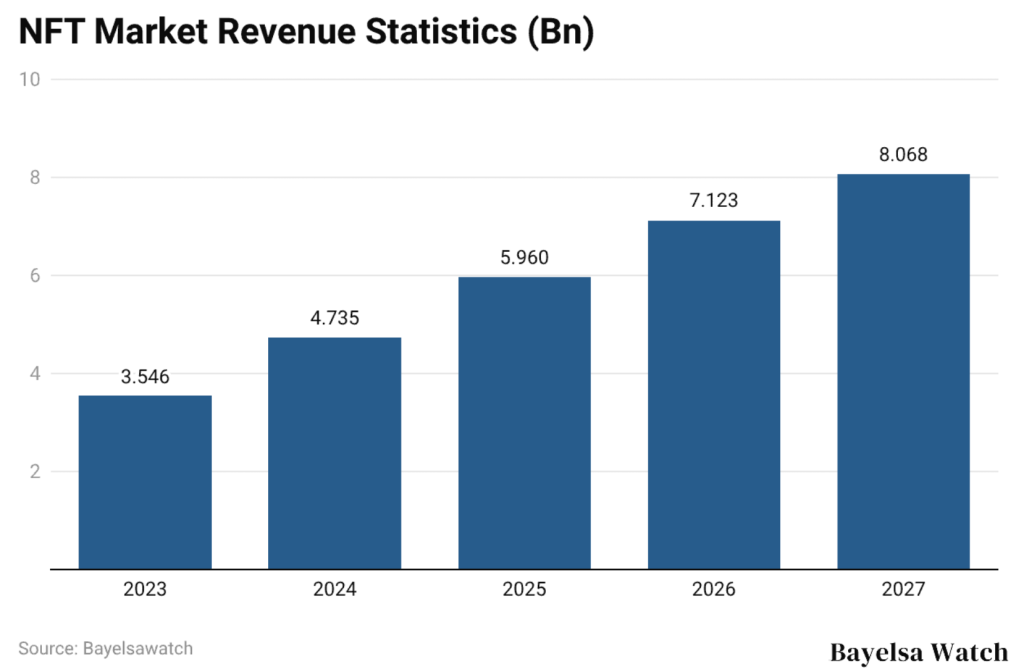
At first glance, the numbers look like a downturn, volume dropped sharply, activity cooled, and a lot of collections simply vanished. But underneath that, something else has been building, a more stable foundation that isn’t driven purely by hype cycles.
A Market That Reset Itself
After the frenzy of 2021, a correction was inevitable. Transaction volumes fell, daily activity slowed, and the majority of NFTs lost significant value, some almost entirely.
But what’s interesting is what happened next. Instead of collapsing completely, the market stabilized. Active participation actually grew, suggesting that while speculators left, more intentional users stayed, and that shift matters more than raw volume.
A “K-Shaped” Recovery Is Taking Form
Not all projects are recovering equally, and that’s where the idea of a “K-shaped” market comes in. A small group of high-quality collections continues to perform well, while thousands of low-effort projects have quietly faded into irrelevance.
It’s a kind of natural filtering process. The projects that offered real communities, real utility, or some form of ongoing value managed to hold attention. Everything else… didn’t.
Gaming and Utility Are Driving the Next Phase
One of the biggest shifts is where activity is actually going. Profile picture NFTs still dominate, but gaming NFTs are closing in fast, now making up a significant portion of market share.
There’s also growing traction in areas like real-world asset tokenization and “phygital” NFTs, where physical items are tied to digital ownership. These aren’t speculative flips, they’re functional use cases, and that’s a very different kind of demand.
Who’s Still in the Market
The demographic hasn’t changed dramatically, but the mindset has. Millennials remain a core group of collectors, and regions like Asia continue to lead in adoption, with countries like the Philippines showing especially high participation.
What’s different now is that buyers tend to understand what they’re purchasing. There’s less blind speculation and more focus on whether an NFT actually does something useful.
A Smaller, But Stronger Market
The NFT market in 2026 is undeniably smaller and less chaotic than its peak years. But that doesn’t necessarily mean weaker, it might actually be more durable now than it was before.
With projections pointing toward a $60 billion market, the space seems to be finding its footing again. Just not through hype, through utility, structure, and a bit more realism than it had the first time around.
Disclaimer: BlockNews provides independent reporting on crypto, blockchain, and digital finance. All content is for informational purposes only and does not constitute financial advice. Readers should do their own research before making investment decisions. Some articles may use AI tools to assist in drafting, but every piece is reviewed and edited by our editorial team of experienced crypto writers and analysts before publication.






 English (US) ·