
 3 months ago
70
3 months ago
70
- Aave founder Stani Kulechov says tokenization is where the crypto industry is ultimately heading.
- BlackRock’s Nikhil Sharma believes tokenization can provide yield while maintaining liquidity.
- Analysts forecast tokenized assets could grow into a multi-trillion-dollar market by 2030, potentially transforming global finance.
If the previous crypto cycle was defined by memecoins, NFTs, and speculation, the next one may be defined by something much larger: ownership itself.
At the recent Proof of Talk conference, Aave founder Stani Kulechov described tokenization as the direction the entire industry is moving toward. BlackRock’s Nikhil Sharma echoed that view, arguing that tokenized assets can solve one of traditional finance’s biggest challenges by allowing investors to access yield-generating opportunities without sacrificing liquidity.
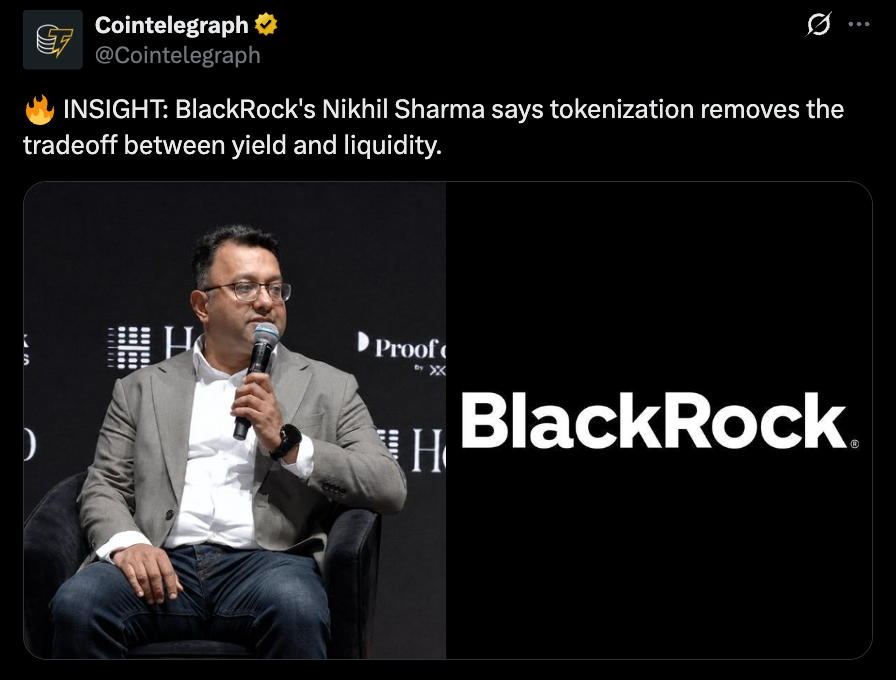
That may sound like Wall Street jargon, but the underlying concept is surprisingly straightforward. Instead of needing millions of dollars to invest in commercial real estate, private credit, infrastructure projects, or specialized funds, investors could own fractional pieces of those assets through blockchain-based tokens.
Why Tokenization Is Gaining Momentum
Tokenization converts ownership rights into digital tokens that can be traded on blockchain networks.
The idea is simple but powerful. Assets that have traditionally been difficult to buy, sell, or divide can become more accessible when ownership is represented digitally. Investors can purchase smaller portions, transactions can settle faster, and markets can operate around the clock rather than only during business hours.
For institutions, the potential benefits include lower costs, improved efficiency, and greater market accessibility. For investors, the appeal is broader access to investment opportunities that were historically limited to wealthy individuals and large financial firms.
This is one reason major institutions are increasingly paying attention.
Wall Street Is Already Building
Tokenization is no longer a niche crypto experiment.
BlackRock, JPMorgan, Nasdaq, Franklin Templeton, and several other financial giants are actively developing tokenized asset initiatives. Many view blockchain infrastructure as a way to modernize capital markets that still rely on systems built decades ago.
The shift is happening gradually, but momentum continues to build.
According to forecasts from Citi, tokenized assets could reach approximately $5.5 trillion by 2030 under its base-case scenario. More optimistic projections suggest the market could eventually surpass $8 trillion. Other industry estimates range as high as $11 trillion to $16 trillion over the coming decade.
While forecasts vary widely, the direction of travel appears increasingly clear.
The Yield And Liquidity Advantage
One of the most compelling arguments for tokenization is its ability to address a traditional tradeoff in investing.
Historically, many higher-yielding assets have suffered from limited liquidity. Private credit, real estate, infrastructure investments, and certain private funds often require investors to lock up capital for extended periods.

Tokenization has the potential to change that dynamic.
By creating digital representations of ownership that can trade more efficiently, investors may gain access to yield-generating opportunities while retaining greater flexibility. That possibility is one reason institutions view tokenization as more than just another blockchain trend.
It could fundamentally reshape how capital markets operate.
Where Retail Investors Fit In
The question many investors eventually ask is straightforward: how does the average person benefit?
There are two primary schools of thought emerging within the market.
The first focuses on owning tokenized assets directly. As tokenized treasuries, real estate, equities, and private credit products become more widely available, retail investors may gain access to opportunities that were previously reserved for institutions.
The second focuses on owning the infrastructure powering the ecosystem.
History often shows that the companies providing the tools, rails, and infrastructure can capture enormous value during periods of rapid growth. In the tokenization economy, that could include blockchain networks, exchanges, custody providers, settlement platforms, and protocols facilitating asset issuance and trading.
Challenges Still Remain
Despite the excitement, tokenization is still in its early stages.
Regulatory frameworks continue evolving, liquidity remains fragmented across markets, and investor protections are still being developed. Technical infrastructure also needs to mature before trillions of dollars can move seamlessly across blockchain networks.
These challenges are not insignificant.
However, many industry participants view them as growing pains rather than permanent obstacles. Similar concerns existed during the early development of internet commerce, online banking, and digital payments.
Over time, infrastructure improved and adoption followed.
The Next Major Crypto Narrative?
The tokenization story stands apart from many previous crypto trends because it directly connects blockchain technology to traditional financial markets.
Rather than creating entirely new asset classes, tokenization brings existing assets onchain. That distinction could dramatically expand the addressable market for blockchain technology.
The opportunity extends far beyond crypto-native investors. It touches real estate, bonds, private credit, commodities, equities, and potentially nearly every major asset class.
If the forecasts prove even partially accurate, tokenization could become one of the largest financial transformations of the coming decade.
For investors, the challenge may not be deciding whether tokenization matters. It may be deciding whether the bigger opportunity lies in owning the assets themselves or the infrastructure carrying trillions of dollars into the blockchain economy.
Disclaimer: BlockNews provides independent reporting on crypto, blockchain, and digital finance. All content is for informational purposes only and does not constitute financial advice. Readers should do their own research before making investment decisions. Some articles may use AI tools to assist in drafting, but every piece is reviewed and edited by our editorial team of experienced crypto writers and analysts before publication.







 English (US) ·