
 3 months ago
71
3 months ago
71
- TRX has slipped toward the critical $0.312 support zone despite broader crypto market strength.
- Daily transactions on the TRON network have reached a record 14.3 million, highlighting continued user activity.
- Traders are watching whether buyers can reclaim $0.321 to signal a potential recovery.
TRON is finding itself in a somewhat unusual position. While Bitcoin and several major cryptocurrencies have managed to push higher, TRX has moved in the opposite direction, sliding nearly 3% over the past 24 hours and falling back toward the important $0.312 level. The divergence suggests this isn’t simply a market-wide pullback. Instead, TRON appears to be dealing with its own set of short-term pressures.
What makes the situation more interesting is that the weakness in price is arriving at the same time network activity continues to expand. In many cases, stronger blockchain usage helps support positive market sentiment. Right now though, the market seems more focused on selling pressure than on fundamentals.
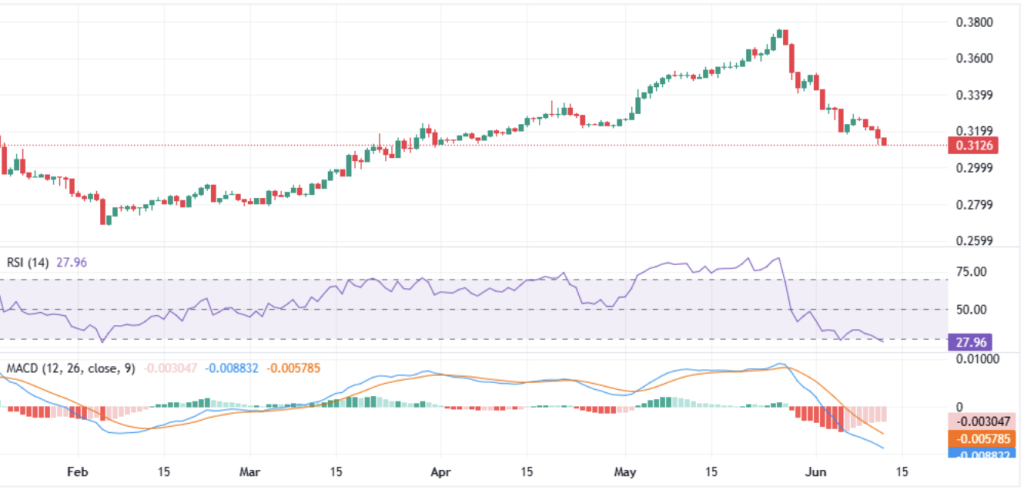
TRON Price Remains Under Pressure
TRX has retreated noticeably from its late-May highs near $0.37 and is now testing an area that buyers previously defended. The current zone around $0.312 has become a critical battleground. If bulls fail to hold it, the market could quickly begin looking lower.
The contrast with Bitcoin is hard to ignore. During the same period that TRX weakened, Bitcoin posted gains and several large-cap cryptocurrencies showed stronger demand. That kind of relative weakness often signals local distribution, where sellers gradually outweigh buyers despite a stable broader market.
Market flow indicators appear to support that idea. The cumulative volume delta remains negative, suggesting aggressive market sellers continue to dominate trading activity. In practical terms, more traders are hitting the sell button than stepping in to accumulate.
Technical Indicators Send Mixed Signals
Some technical metrics suggest the selling may be becoming stretched. The Relative Strength Index has fallen below 30, placing TRX in oversold territory. Traders often view those conditions as a warning that downside momentum may be exhausting itself.
Still, oversold does not automatically mean reversal. Markets can remain oversold longer than many expect, especially when confidence remains weak.
The MACD isn’t offering much encouragement either. The indicator remains below its neutral line and has yet to produce a meaningful bullish crossover. Until momentum improves, any rebound attempt could struggle to gain traction.
For now, the chart paints a picture of consolidation near local lows rather than a confirmed recovery. The bears may be losing some energy, but they haven’t left the field yet.
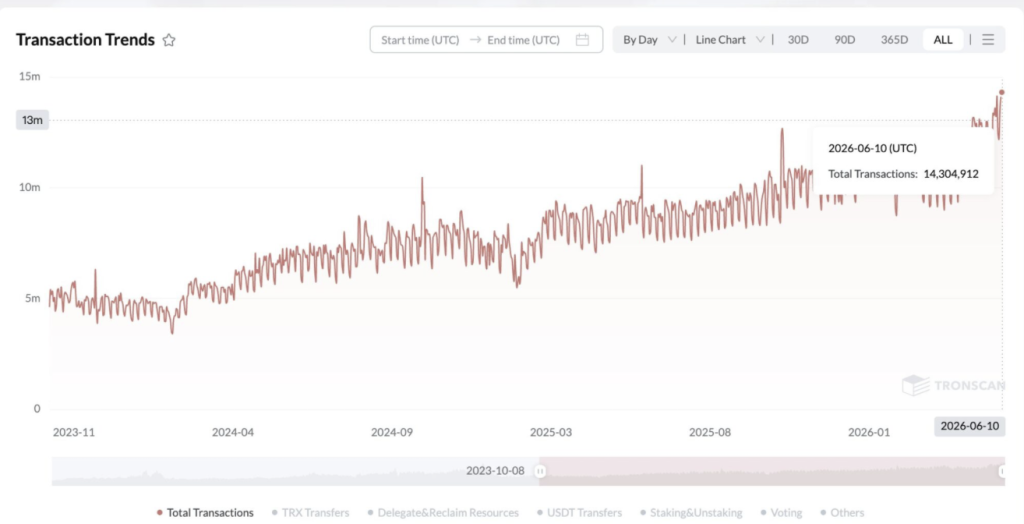
Network Growth Continues to Impress
While price action remains soft, the underlying TRON network continues moving in the opposite direction. Daily transaction counts recently climbed to an all-time high above 14.3 million, while overall activity has increased roughly 15% over the past month.
That level of usage matters. TRON remains one of the most active networks for stablecoin transfers and blockchain-based payments, giving it a strong position within the broader digital asset ecosystem.
Historically, there have been periods where blockchain usage strengthened long before token prices followed. Sometimes the market notices quickly. Other times, the disconnect can persist for weeks or even months.
The real question is whether network growth can eventually translate into stronger buying demand for TRX itself. User activity is valuable, but price appreciation still requires investors willing to accumulate the token in meaningful volume.
Treasury Buying Adds a Bullish Layer
Another encouraging development comes from treasury accumulation. Reports indicate that Tron Inc. recently purchased approximately 154,608 TRX at an average price near $0.3234. That acquisition pushed the company’s holdings beyond 700 million TRX.
Large-scale purchases like this are often interpreted as a sign of long-term confidence. Institutions and corporate treasuries generally aren’t focused on short-term market noise. Their buying decisions tend to reflect broader strategic convictions.
However, even that support has not been enough to completely offset current selling pressure. The market remains cautious, and traders appear reluctant to chase higher prices until momentum improves.
Key TRX Levels Traders Are Watching
Everything now revolves around the $0.312 support level. If buyers successfully defend this area, the first upside target sits around $0.318. Beyond that, a move above $0.321 would be especially important because it could signal that demand is beginning to return.
A stronger recovery could eventually bring the $0.36 region back into focus. That’s where the previous market structure started to break down, making it a natural resistance zone.
On the downside, the risks are fairly clear. A decisive drop below $0.312 could expose support near $0.302. If that level fails, attention would likely shift toward the psychologically important $0.30 mark.
At the moment, TRON is caught between two competing narratives. On one side sits a rapidly growing network with record transaction activity. On the other sits a market still struggling with weak momentum and persistent selling pressure. Until buyers regain control, caution remains warranted. A positive shift in volume flow, rising spot demand, and a clean move back above $0.321 would be among the first signs that sentiment is beginning to turn.
Disclaimer: BlockNews provides independent reporting on crypto, blockchain, and digital finance. All content is for informational purposes only and does not constitute financial advice. Readers should do their own research before making investment decisions. Some articles may use AI tools to assist in drafting, but every piece is reviewed and edited by our editorial team of experienced crypto writers and analysts before publication.








 English (US) ·