
 2 months ago
40
2 months ago
40
Quick Overview
- President Trump issued an 8 p.m. ET Tuesday ultimatum demanding Iran reopen the Strait of Hormuz or face military action
- Crude markets showed minimal response—Brent crude fell 0.3% while WTI increased marginally
- The President threatened to demolish Iranian infrastructure including bridges and electrical facilities within hours
- Tehran countered with warnings of retaliatory strikes on Persian Gulf energy assets
- Traders appear skeptical as Trump has previously shifted similar deadlines multiple times
Crude oil markets displayed remarkable composure Tuesday despite President Donald Trump’s ultimatum to Iran regarding the Strait of Hormuz. The standoff, now entering its seventh week, has already triggered significant disruptions in worldwide petroleum supply chains.
The President established an 8 p.m. Eastern deadline for Iran to reach an agreement. He warned that American forces could demolish “every bridge in Iran by 12 o’clock tomorrow night” if Tehran refuses to comply. He added that power facilities would be “burning, exploding and never to be used again.”
Yet these aggressive warnings failed to generate significant market turbulence. Oil prices showed remarkably subdued movement. Brent crude contracts declined 0.3% to approximately $109.40 per barrel. West Texas Intermediate crept up merely 0.2% to reach $112.59. Both major benchmarks remained essentially unchanged from Monday’s close.
July Brent crude contracts briefly dipped under the $100 per barrel threshold. Meanwhile, July WTI traded at $90.43, actually lower than prices observed seven days earlier.
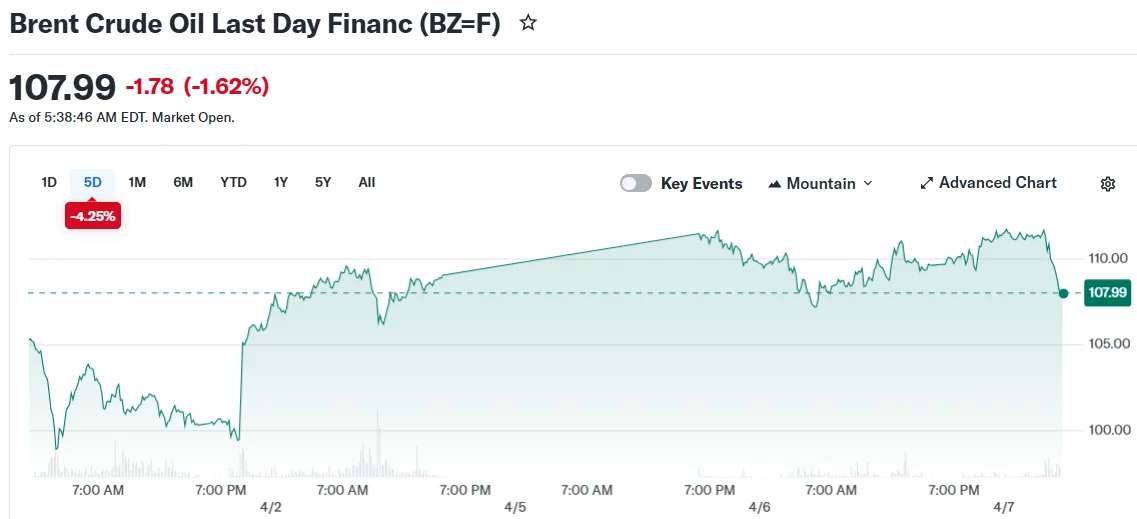 Brent Crude Oil Last Day Financ (BZ=F)
The muted market response may stem from Trump’s pattern of postponing previous deadlines. Energy traders appear increasingly doubtful he will execute his threats this time around.
Dan Coatsworth, an analyst at AJ Bell, outlined several potential scenarios. Either Washington or Tehran could retreat, potentially triggering an equity market rally and energy price decline. Alternatively, a serious escalation could occur with far-reaching implications across global financial markets.
Coatsworth identified a third scenario—yet another deadline extension, trapping markets in continued uncertainty.
Tehran’s Warning on Gulf Energy Assets
Iran has made clear it will retaliate against any American military action by targeting energy infrastructure throughout the Persian Gulf region. Such counterattacks could further constrict global petroleum availability and intensify economic pressures worldwide.
Negotiators reportedly hold little optimism that Iran will satisfy Trump’s conditions, according to Wall Street Journal sources. The Strait of Hormuz represents one of the planet’s most critical oil transit chokepoints.
Analysts at Societe Generale outlined two primary scenarios confronting markets. The first involves a tenuous ceasefire without ground combat and gradual supply normalization. The second scenario features prolonged conflict with ground forces deployed and permanently elevated energy market volatility.
Supply Indicators Point to Tightening Conditions
Market indicators suggest traders are already anticipating constrained near-term availability. The WTI prompt spread—representing the price differential between its two nearest-dated futures—reached approximately $15.50 per barrel Monday, approaching record territory.
This movement coincided with international buyers aggressively securing American crude supplies. Expectations for US petroleum availability have contracted as the confrontation continues.
Trump stated Monday that negotiations with Iran were “going well,” though he emphasized the serious ramifications if no agreement materializes before his deadline.
The post Trump’s Iran Deadline Passes as Oil Markets Remain Surprisingly Stable appeared first on Blockonomi.







 English (US) ·