
 1 month ago
51
1 month ago
51
- President Trump threatened further action after Iran launched attacks targeting U.S. military assets across the Middle East.
- Iran says the strikes were retaliation for recent U.S. operations against its military infrastructure.
- Rising tensions are adding fresh uncertainty to global markets, energy prices, and risk assets such as cryptocurrencies.
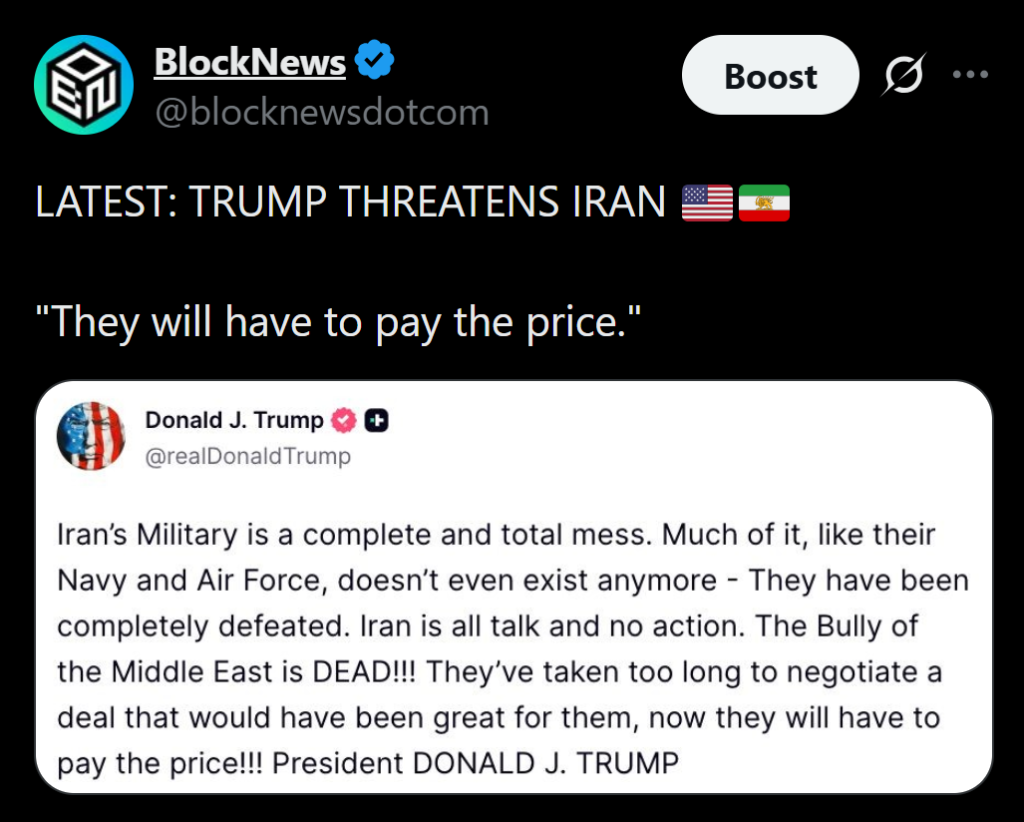
The fragile ceasefire that had helped ease tensions between the United States and Iran appears to be under increasing strain after a fresh exchange of military actions across the Middle East. President Donald Trump warned that Iran would “pay the price” following a series of attacks targeting U.S. assets in the region, raising concerns that the conflict could escalate once again.
The latest developments come just weeks after optimism emerged around potential diplomatic progress between Washington and Tehran. Instead, both sides are now exchanging military responses that threaten to reignite broader regional instability.
Iran Responds to U.S. Strikes
The latest escalation began after U.S. Central Command carried out what it described as “self-defense strikes” against Iranian military infrastructure. According to U.S. officials, the operation followed the downing of an American Army Apache helicopter that was conducting patrol operations near the Strait of Hormuz.
The helicopter incident marked a significant escalation on its own, resulting in the rescue of two Army aviators through what officials described as the first rescue operation involving a naval sea drone.
In response, Iran launched attacks targeting multiple U.S.-linked military installations across the Middle East. Iranian media reported strikes against sites associated with the U.S. Fifth Fleet in Bahrain, Ali al-Salem Air Base in Kuwait, and military facilities in Jordan.
Regional Defenses Intercept Most Attacks
Several countries in the region reported successfully intercepting incoming missiles and drones. Kuwait’s military confirmed it had neutralized aerial threats, while Jordan’s armed forces reported intercepting five missiles launched from Iran.
Bahrain also announced that its defense systems had intercepted an unspecified number of projectiles. No deaths were reported following the attacks, though governments across the region condemned the escalation and warned about the risks posed to civilians and critical infrastructure.
Iran’s Foreign Ministry defended its actions, stating that the country had targeted assets connected to what it described as acts of aggression against Iranian interests.
Trump Signals More Action Could Follow
President Trump responded strongly following the attacks. In a post on social media, he criticized Iran for failing to finalize what he described as a favorable agreement and warned that the country would now face consequences.
The comments suggest the administration remains prepared to take additional action if attacks on American personnel or assets continue. At the same time, Trump has continued to insist that a broader diplomatic agreement remains possible.

Earlier this week, the President stated that negotiations were still progressing and suggested that a deal preventing Iranian nuclear weapons development remained within reach.
Why Markets Are Paying Attention
Beyond the geopolitical implications, investors are closely monitoring developments because of their potential impact on energy markets and global risk assets. The Strait of Hormuz remains one of the world’s most important energy shipping routes, and any disruption to traffic through the region could place additional pressure on oil and fuel prices.
Energy markets have already experienced heightened volatility due to Middle East tensions. Further escalation could worsen inflation concerns and complicate central bank policy decisions around the world.
Cryptocurrency markets are also sensitive to these developments. Increased geopolitical uncertainty often drives investors toward safer assets while reducing appetite for higher-risk investments such as digital assets and growth-oriented equities.
A Delicate Situation Remains
The latest exchange highlights how quickly tensions can return despite ongoing diplomatic efforts. While neither side appears eager to trigger a full-scale conflict, the cycle of attacks and retaliatory strikes continues creating uncertainty throughout the region.
For investors, policymakers, and global markets, the coming days may prove critical. Whether diplomatic channels can regain momentum or whether military responses continue escalating will likely influence everything from energy prices to broader market sentiment.
For now, the ceasefire remains intact on paper, but the situation on the ground is becoming increasingly fragile.
Disclaimer: BlockNews provides independent reporting on crypto, blockchain, and digital finance. All content is for informational purposes only and does not constitute financial advice. Readers should do their own research before making investment decisions. Some articles may use AI tools to assist in drafting, but every piece is reviewed and edited by our editorial team of experienced crypto writers and analysts before publication.








 English (US) ·