
 2 months ago
42
2 months ago
42
TLDR
- National gasoline prices in the United States exceeded $4 per gallon for the first time since the summer of 2022, reaching an average of $4.018.
- Global oil benchmarks have climbed approximately 50% in the past month following the escalation of the US-Iran military conflict.
- Emergency regulatory waivers from the White House on ethanol blending and maritime shipping laws have failed to reduce prices.
- Diesel fuel reached $5.45 per gallon — representing an unprecedented monthly increase.
- Goldman Sachs increased its April Brent projection to $115, while certain market observers caution that prices might reach $200 should hostilities extend into summer.
American motorists reached a significant price threshold this Tuesday as gasoline costs surpassed $4 per gallon nationwide for the first time in nearly three years. The national benchmark climbed to $4.018 per gallon, representing the steepest monthly price acceleration ever recorded, according to fuel tracking service GasBuddy.
This dramatic escalation stems from the continuing military confrontation between the United States and Iran, which has now entered its fifth week. Throughout the past thirty days, both Brent crude and West Texas Intermediate benchmarks have jumped approximately 50%, with Brent hovering around $107.80 per barrel and WTI near $102 per barrel.
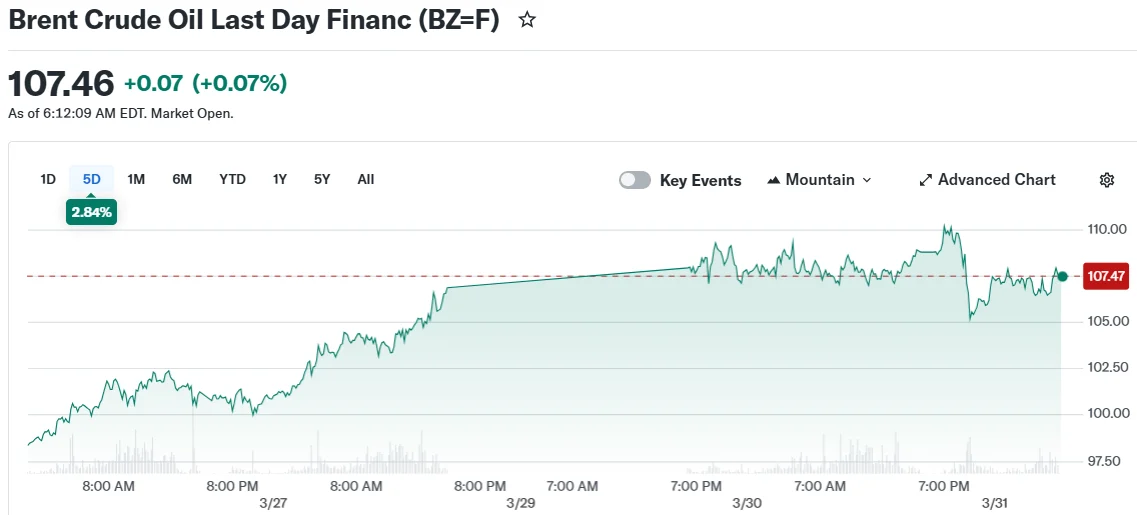 Brent Crude Oil Last Day Financ (BZ=F)
Compared to the same period last year, consumers are paying roughly an additional dollar per gallon. The majority of this increase has materialized since military operations commenced.
Commercial transportation operators face even steeper challenges. The nationwide diesel average reached $5.45 per gallon on Tuesday — another unprecedented monthly surge, according to GasBuddy’s tracking data.
On March 25, the White House issued emergency regulatory relief relaxing federal mandates on E15 ethanol-blend gasoline, a more economical fuel formulation. The administration simultaneously suspended Jones Act maritime regulations for a temporary 60-day period, which typically increase costs for domestic shipping operations.
Both interventions have thus far failed to produce meaningful relief at service stations across the country.
The Strait of Hormuz Problem
Regardless of when military operations conclude, oil prices may remain elevated for some time. The critical factor is the Strait of Hormuz, a maritime chokepoint that facilitated approximately 20% of worldwide petroleum and natural gas shipments prior to the current crisis.
According to a Wall Street Journal report citing senior administration sources, President Trump has indicated openness to de-escalating military operations even if the Strait remains substantially obstructed. As long as this vital shipping lane stays compromised, petroleum prices are likely to maintain elevated levels.
The consequences are already spreading across Asia. Since the majority of crude oil transiting through the Strait was destined for Asian refineries, countries throughout the region are implementing emergency measures. Bangladesh has temporarily closed university campuses, while both Pakistan and the Philippines have instituted condensed work schedules to reduce energy consumption.
Defense Secretary Pete Hegseth alongside Chairman of the Joint Chiefs of Staff Gen. Dan Caine were expected to address the media Tuesday morning at 8 a.m. Eastern time.
What Analysts Are Saying
Goldman Sachs revised its April Brent crude projection upward from $85 to $115 per barrel, attributing the adjustment to prolonged disruption and elevated risk premiums surrounding the Strait of Hormuz situation. High-ranking Saudi Arabian officials have internally modeled scenarios placing Brent at $180 should the conflict persist through April. Meanwhile, energy analysts at Macquarie have projected that Brent could exceed $200 per barrel if military operations continue through the end of June.
Premium gasoline grades and aviation fuel costs are experiencing similar upward pressure. While consumer gasoline prices represent a significant burden, they remain below the rates that commercial diesel operators are currently absorbing.
Brent crude futures were most recently trading near $107.61, posting modest gains during the session.
The post U.S. Gasoline Prices Breach $4 Mark Amid Iran Conflict – Analysts Warn of Further Spikes appeared first on Blockonomi.





 English (US) ·