
 3 months ago
94
3 months ago
94
- A long-term UNI whale transferred $6.61 million worth of tokens to Binance, realizing an estimated $6.39 million loss.
- Exchange inflows have increased, adding fresh selling pressure while UNI trades near key support.
- Despite bearish technical signals, Binance’s largest traders continue maintaining a bullish bias near the $3 level.
A major Uniswap (UNI) holder has caught the market’s attention after transferring 2.16 million UNI tokens, worth approximately $6.61 million, to Binance. While large transfers happen regularly across crypto markets, this one stands out for a different reason. The same investor originally withdrew the position when its value was close to $13 million, meaning the latest deposit effectively locked in a loss of roughly $6.39 million.
That kind of move often sends a message. Large holders, particularly those willing to sit through months of volatility, don’t typically sell at a significant loss unless confidence has weakened or priorities have changed. Whether this was pure capitulation or simply a portfolio adjustment remains unclear, but the timing is noteworthy. UNI continues trading near a crucial support area, making the whale’s decision particularly relevant for traders already watching the market closely.
In many cases, when long-term holders finally surrender after an extended decline, markets can either find a bottom or accelerate lower. That’s what makes this transaction so interesting. It doesn’t guarantee anything, but it certainly adds another layer of uncertainty to an already fragile setup.
Rising Exchange Inflows Increase Selling Pressure
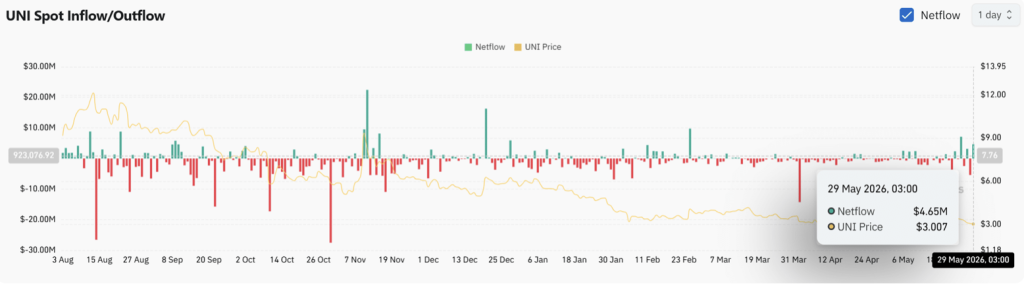
The whale transfer wasn’t the only warning sign emerging for Uniswap. Broader exchange flow data has also begun shifting in a direction that typically favors sellers. Recent figures show UNI spot netflows turning positive, with approximately $4.65 million worth of tokens moving onto exchanges during the latest trading session.
Positive netflows generally indicate that more assets are being transferred to exchanges than withdrawn from them. Since exchanges are where most selling takes place, growing balances often suggest increased selling availability. It’s not always bearish, but it rarely helps bullish momentum.
What’s particularly concerning is that this increase arrived while UNI was already struggling near the $3 level. Previous weeks saw relatively muted exchange activity, making the latest spike stand out even more. If this trend continues and exchange balances keep growing, buyers may find themselves fighting against an expanding pool of available supply.
UNI Clings to Support While Technical Indicators Favor Bears
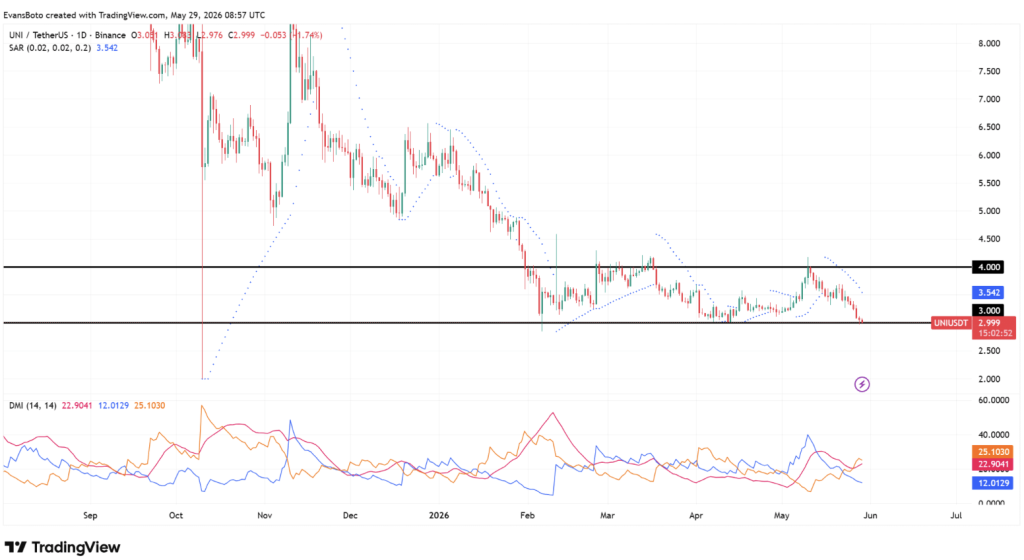
Price action remains focused on one key area: the $3 support zone. At the time of writing, Uniswap was trading around $2.99, sitting almost directly on top of that critical level. So far, buyers have managed to prevent a decisive breakdown, but the margin for error is becoming increasingly narrow.
Above the market, resistance remains firmly established near $4. Every meaningful recovery attempt has stalled around that region, reinforcing the broader bearish structure. The chart continues producing lower highs, which is typically one of the clearest signs that sellers remain in control of the larger trend.
Several technical indicators support that view. The Directional Movement Index shows the negative directional indicator holding comfortably above the positive indicator, suggesting bearish momentum remains dominant. Meanwhile, the Average Directional Index remains elevated enough to confirm that the trend still has strength behind it.
Adding to the pressure, the Parabolic SAR indicator continues printing above current price levels. Traders often interpret this as confirmation that downward momentum remains intact. In simple terms, the technical picture still leans bearish unless buyers can reclaim lost ground quickly.
Top Traders Continue Betting on a Rebound
Interestingly, not everyone appears concerned by the recent weakness. Data from Binance shows that many of the platform’s largest traders continue maintaining a bullish stance despite the negative headlines and deteriorating technical structure.
Approximately 60.71% of top trader accounts remain positioned long, compared to just 39.29% holding short positions. That creates a Long/Short ratio of 1.55, indicating a noticeable bias toward upside expectations among experienced market participants.
This creates a fascinating contrast. On one hand, a major whale has exited at a substantial loss, exchange inflows are increasing, and technical indicators continue favoring sellers. On the other hand, some of the market’s most active traders are still betting that support will hold and a recovery will emerge.
The $3 Level May Decide UNI’s Next Major Move
For now, Uniswap finds itself at a crossroads. The $3 support zone continues acting as the market’s main battleground, with buyers and sellers fighting for control. If bulls successfully defend this area and absorb the growing exchange supply, another recovery attempt toward higher resistance levels could emerge.
However, support zones only matter when they hold. A clean breakdown below $3 would likely damage market confidence further and expose UNI to another wave of selling pressure. Combined with increasing exchange balances and lingering bearish momentum, that scenario could create a much more difficult environment for buyers.
What’s clear is that conviction remains divided. Whale activity suggests caution, exchange flows point toward increased supply, yet top traders continue positioning for a rebound. Eventually, one side will be proven right. Until then, all eyes remain fixed on the level that could determine Uniswap’s next major trend.
Disclaimer: BlockNews provides independent reporting on crypto, blockchain, and digital finance. All content is for informational purposes only and does not constitute financial advice. Readers should do their own research before making investment decisions. Some articles may use AI tools to assist in drafting, but every piece is reviewed and edited by our editorial team of experienced crypto writers and analysts before publication.









 English (US) ·