
 8 hours ago
18
8 hours ago
18
- The U.S. Senate is scheduled to vote on the Clarity Act on September 15, marking a major step toward establishing comprehensive crypto market rules.
- The legislation seeks to divide digital asset regulatory responsibilities between the SEC and CFTC while providing clearer classifications for crypto assets.
- Senate approval could move the bill significantly closer to becoming law and give crypto companies and investors greater regulatory certainty in the U.S.
The U.S. Senate is preparing for a closely watched vote on the Digital Asset Market Clarity Act of 2025, better known as the Clarity Act, as lawmakers continue working toward a federal regulatory framework for cryptocurrency. The vote is scheduled for Tuesday, September 15, during the 2 p.m. hour, representing another important procedural hurdle for legislation that could reshape how digital assets are regulated across the country.
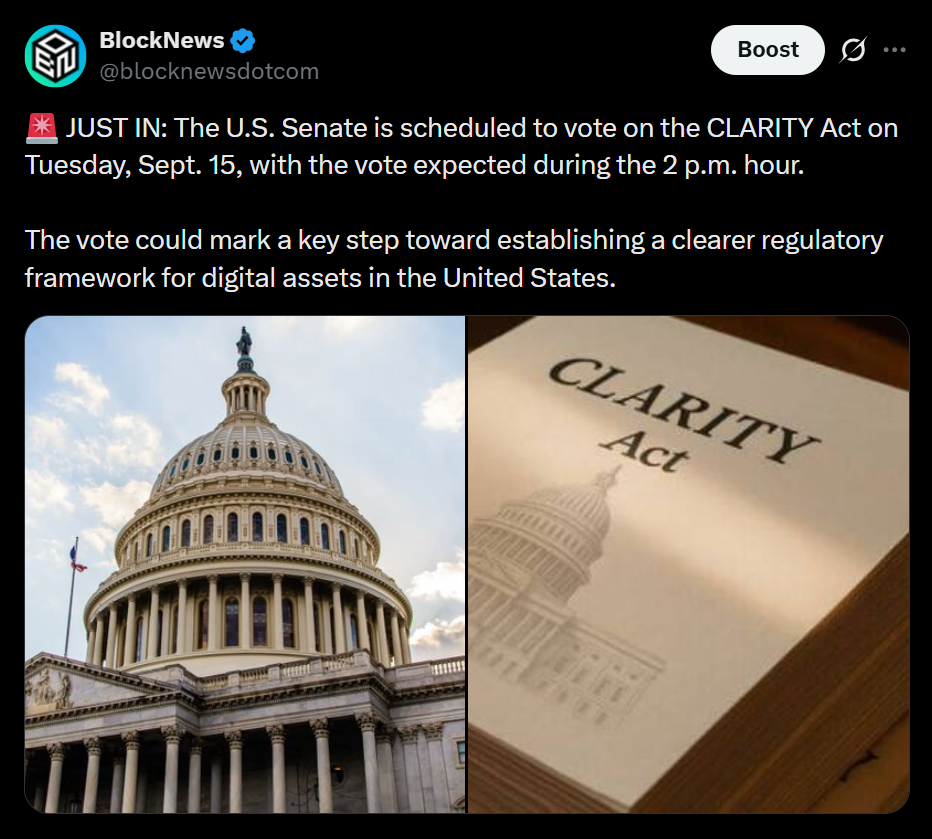
The bill has already cleared the House of Representatives and advanced through the Senate Banking Committee. Its progress has made it one of the most significant pieces of crypto legislation under consideration in Washington, particularly as exchanges, investors, developers, and traditional financial institutions continue calling for clearer federal rules.
SEC and CFTC Roles Could Become Clearer
A central goal of the Clarity Act is to establish more defined boundaries between the Securities and Exchange Commission and the Commodity Futures Trading Commission.
For years, one of the crypto industry’s biggest regulatory concerns has been uncertainty over whether individual digital assets should fall under securities or commodities laws. The Clarity Act attempts to address that issue by establishing clearer regulatory categories, including rules surrounding digital commodities and investment contract assets.
Greater clarity could also give crypto exchanges and other intermediaries a more predictable framework for determining which regulator oversees their activities. That could reduce some of the legal uncertainty that has complicated the development of the U.S. digital asset market.
Senate Vote Could Shape the Bill’s Future
The September vote will be closely watched because Senate approval would represent a significant step toward sending the legislation through the remaining congressional process and potentially to the president.
However, the vote itself would not necessarily guarantee that the Clarity Act becomes law. Any differences between House and Senate versions could still need to be resolved, while amendments and other procedural hurdles could influence the final legislation.
The debate surrounding the bill has also extended beyond basic crypto classifications. Lawmakers have previously raised concerns involving consumer protection, illicit finance, decentralized finance, ethics provisions, stablecoin rewards, and the precise authority granted to federal regulators.
Crypto Markets Await Regulatory Certainty
For the crypto industry, the stakes extend well beyond Washington politics. A comprehensive federal market structure framework could influence how exchanges operate, how institutional investors approach digital assets, and how blockchain companies decide where to build their businesses.
Clearer SEC and CFTC responsibilities could also make it easier for traditional financial institutions to expand into tokenization, custody, trading, and other blockchain-based services without facing the same degree of regulatory uncertainty.
The upcoming Senate vote therefore represents another potentially important moment for U.S. crypto regulation. Here Is why September 15 could become a key date for the industry: a successful vote could move Washington considerably closer to establishing the comprehensive digital asset rules that market participants have sought for years.
Disclaimer: BlockNews provides independent reporting on crypto, blockchain, and digital finance. All content is for informational purposes only and does not constitute financial advice. Readers should do their own research before making investment decisions. Some articles may use AI tools to assist in drafting, but every piece is reviewed and edited by our editorial team of experienced crypto writers and analysts before publication.









 English (US) ·