
 3 months ago
60
3 months ago
60
- Vitalik Buterin says Europe cannot beat Silicon Valley by copying closed AI ecosystems
- He believes open-source software and locally controlled AI infrastructure are Europe’s biggest advantages
- Governments increasingly view AI systems as strategic national infrastructure rather than simple tech products
Ethereum co-founder Vitalik Buterin thinks Europe is making a major mistake trying to compete with Silicon Valley on Silicon Valley’s terms. His message to European tech leaders is pretty direct: stop chasing closed corporate AI empires and start building the systems Big Tech companies refuse to build in the first place.
Speaking recently about Europe’s long-term technology strategy, Buterin argued that open-source development, transparency, and locally controlled infrastructure represent the continent’s strongest competitive advantage in the AI era.
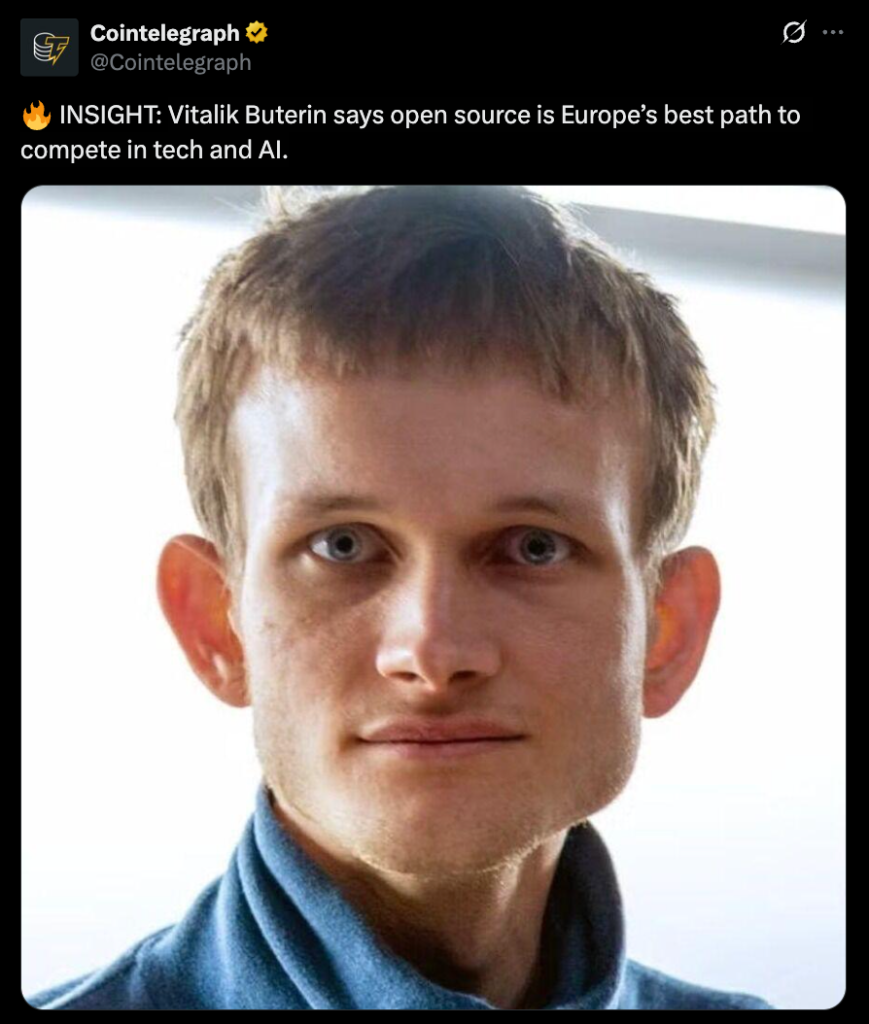
And honestly, he may not be wrong. Europe has historically been much better at regulating technology than aggressively monetizing it, which sounded like a weakness for years until AI suddenly turned privacy, transparency, and digital sovereignty into geopolitical priorities almost overnight.
AI Infrastructure Is Becoming A National Security Issue
What makes Buterin’s comments especially important is the timing. Governments globally are increasingly treating AI infrastructure the same way they treat energy systems, semiconductors, telecommunications, or defense technology.
Compute power, large language models, cloud infrastructure, chips, and data ownership are rapidly becoming strategic national concerns rather than purely commercial products.
That shift changes the entire conversation around AI development. Instead of asking only which companies build the most powerful models, governments increasingly care about who controls those systems, where they operate, how transparent they are, and whether foreign corporations effectively own critical parts of national digital infrastructure.
Europe, in particular, already worries heavily about dependence on U.S. technology giants.
Buterin’s “Sanctuary Technology” Philosophy Is Gaining Attention
Buterin described his preferred approach as building “sanctuary technologies,” systems designed to resist centralized control while remaining transparent and locally verifiable.
Part of that philosophy involves running open-source AI models directly on local hardware rather than routing everything through massive centralized cloud providers controlled by a handful of corporations.

The idea itself is fairly straightforward. If users cannot inspect the systems they rely on, they are ultimately forced to trust the incentives of whoever owns the infrastructure underneath.
That concern feels increasingly relevant as AI systems become more deeply integrated into communication, finance, healthcare, media, research, and government operations.
And Europe already tends to prioritize transparency, data privacy, and regulatory oversight far more aggressively than most American technology firms historically have.
Crypto’s Open-Source Culture Suddenly Looks Less Crazy
One of the more ironic parts of this shift is how many ideas originally associated with crypto culture are quietly entering mainstream AI and government discussions.
For years, critics mocked blockchain communities for obsessing over decentralization, open-source software, permissionless systems, and distrust of centralized intermediaries. Those ideas were often dismissed as ideological or impractical compared to polished corporate platforms.
Now many of those same principles suddenly look strategically valuable in a world where governments worry about handing enormous amounts of economic and informational power to a tiny number of private AI companies.
The biggest endorsement of crypto’s open-source philosophy may ultimately come less from memecoins or ETF approvals and more from governments realizing they do not want their digital future entirely controlled by a few corporations in California.
Europe May Actually Have A Unique Advantage Here
Unlike the United States, Europe never really dominated the modern internet platform economy at scale. But that relative weakness may ironically become an advantage during the next phase of AI infrastructure development.
European policymakers already focus heavily on digital sovereignty, privacy rights, antitrust regulation, and limiting concentrated corporate control over information systems. Those priorities align surprisingly well with open-source AI frameworks emphasizing transparency and local ownership.
Instead of trying to outspend Silicon Valley directly on massive closed ecosystems, Buterin argues Europe could differentiate itself by building trusted, inspectable, decentralized alternatives instead.
And in an AI world increasingly shaped by trust, sovereignty, and infrastructure control, that strategy may end up mattering more than people currently expect.
The AI Race Is Becoming About Control, Not Just Capability
The broader takeaway from Buterin’s comments is that the global AI race is evolving beyond pure technological performance metrics alone. Capability still matters obviously, but so do governance, transparency, infrastructure ownership, and public trust.
Who controls the models may become just as important as how powerful the models are.
And if governments increasingly view AI as foundational national infrastructure rather than just another software industry, open-source systems could end up playing a much larger strategic role than many traditional tech companies currently anticipate.
Disclaimer: BlockNews provides independent reporting on crypto, blockchain, and digital finance. All content is for informational purposes only and does not constitute financial advice. Readers should do their own research before making investment decisions. Some articles may use AI tools to assist in drafting, but every piece is reviewed and edited by our editorial team of experienced crypto writers and analysts before publication.







 English (US) ·