
 3 months ago
86
3 months ago
86
- The Wall Street Journal reports that Hyperliquid is increasingly attracting traders seeking 24/7 perpetual futures exposure.
- Users are trading everything from commodities to private-company markets through the platform’s growing ecosystem.
- The trend suggests decentralized exchanges are beginning to compete directly with traditional financial infrastructure.
For years, crypto enthusiasts promised that decentralized finance would eventually challenge traditional financial markets. Most of those predictions were easy to dismiss, especially when they arrived alongside speculative tokens and ambitious roadmaps that rarely survived a full market cycle. Hyperliquid, however, may be presenting a far more serious case. According to a recent Wall Street Journal report, the decentralized trading platform is becoming an increasingly popular destination for traders seeking around-the-clock access to perpetual futures markets, including exposure tied to commodities and even private companies that have not yet gone public.
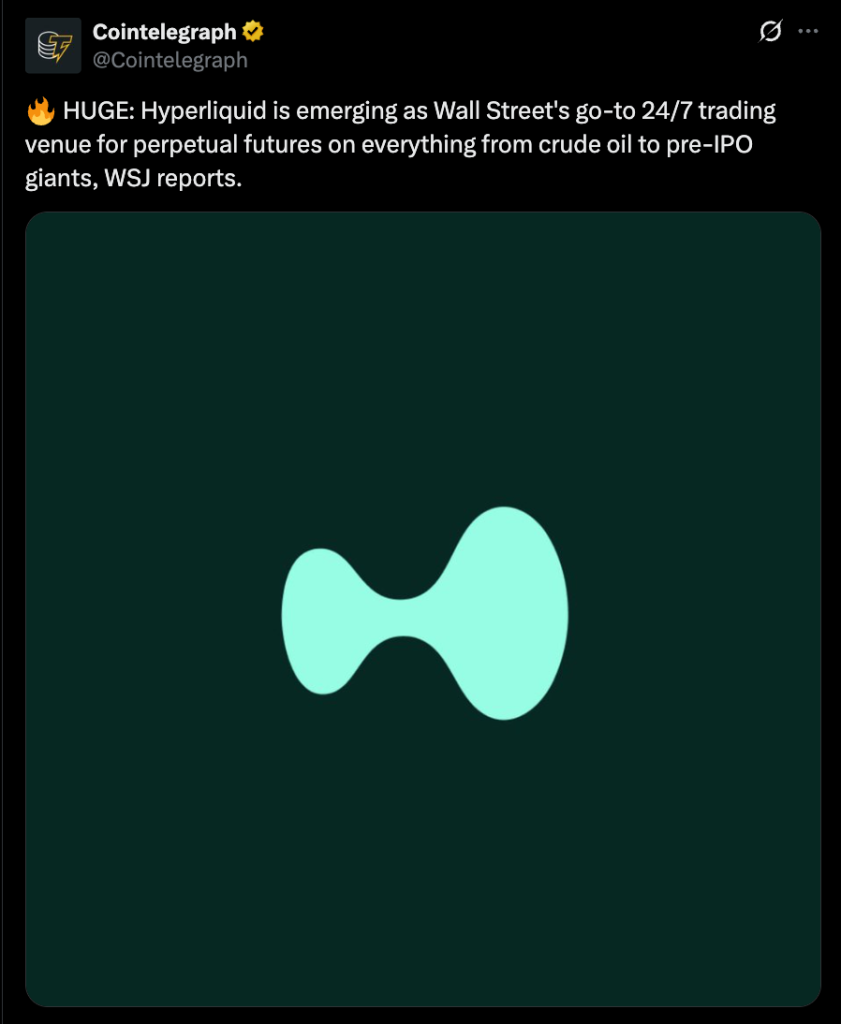
The development is noteworthy because it touches one of traditional finance‘s biggest limitations. While global events unfold every hour of every day, many financial markets remain tied to fixed operating schedules. Traders often find themselves waiting for exchanges to reopen before reacting to important developments. Hyperliquid is attempting to eliminate that delay entirely by offering markets that never close.
Why Hyperliquid Is Gaining Momentum
The platform’s appeal is relatively easy to understand. Hyperliquid provides access to perpetual futures trading twenty-four hours a day, seven days a week, allowing users to enter or exit positions whenever market conditions change. In a world where major news can break on a Saturday night or during a holiday weekend, continuous market access has become increasingly valuable.
Beyond availability, Hyperliquid has built a reputation for offering deep liquidity, competitive fees, and an experience that many traders believe rivals centralized exchanges. Those advantages have helped the platform attract significant trading volume and establish itself as one of the fastest-growing decentralized trading venues in the industry. As liquidity improves and execution quality strengthens, more traders appear willing to treat decentralized platforms as serious alternatives rather than experimental side projects.
The Shift Beyond Crypto Assets
Perhaps the most interesting aspect of Hyperliquid’s growth is that it extends beyond cryptocurrencies themselves. Traders are increasingly seeking exposure to a wider range of assets through blockchain-based markets. Commodities, equities, and private-company related opportunities are beginning to attract attention as users look for ways to participate in markets that have traditionally been difficult to access.

This evolution represents a major shift in how decentralized exchanges are viewed. Rather than serving exclusively as venues for crypto-native assets, platforms like Hyperliquid are positioning themselves as broader financial marketplaces. If that trend continues, the competition may no longer be between one crypto exchange and another. Instead, it could become a direct contest between decentralized platforms and traditional brokerages.
Why Wall Street Is Watching
Institutional interest in blockchain infrastructure has grown significantly over the past several years. Major banks, asset managers, and financial firms are actively exploring tokenization, stablecoins, and on-chain settlement systems. Hyperliquid’s rise fits into that larger narrative because it demonstrates that blockchain networks can support trading activity at a scale that begins to resemble traditional financial venues.
The attraction is not necessarily ideological. Traders care about efficiency, liquidity, access, and execution quality. If decentralized exchanges can provide those benefits while eliminating restrictions tied to geography and market hours, adoption becomes a practical decision rather than a philosophical one. That reality is likely one reason platforms like Hyperliquid are attracting increasing attention from investors and market observers.
The Future Of Always-On Markets
The broader implication is that financial markets may gradually move toward a twenty-four-hour model. Crypto traders have already grown accustomed to markets that never sleep, and that expectation is beginning to influence how investors think about other asset classes. The idea of waiting for markets to open feels increasingly outdated in an economy that operates continuously.
Blockchain infrastructure offers a pathway toward that future by allowing assets to trade and settle at any time. While regulatory hurdles and market structure challenges remain, the demand for constant access appears to be growing. Hyperliquid’s success suggests there is a meaningful audience willing to embrace that model.
A Bigger Story Than Crypto
Hyperliquid’s significance extends beyond its growth metrics or trading volume. The platform represents a broader shift in how financial markets may function in the future. By expanding beyond cryptocurrencies and attracting traders interested in a wider range of assets, it is beginning to challenge assumptions about when and how markets should operate.
If adoption continues, the most important disruption may not be cryptocurrencies replacing traditional financial institutions. Instead, it could be decentralized exchanges replacing the very concept of limited market hours. For an industry built around constant connectivity, that may be a far bigger opportunity than many investors currently realize.
Disclaimer: BlockNews provides independent reporting on crypto, blockchain, and digital finance. All content is for informational purposes only and does not constitute financial advice. Readers should do their own research before making investment decisions. Some articles may use AI tools to assist in drafting, but every piece is reviewed and edited by our editorial team of experienced crypto writers and analysts before publication.







 English (US) ·