
 4 months ago
48
4 months ago
48
- Treasury Secretary Scott Bessent openly criticized crypto firms blocking market structure progress
- Stablecoin yield rules have become the central fault line between banks and exchanges
- Coinbase’s opposition has slowed a bill meant to bring long-term clarity to crypto
Treasury Secretary Scott Bessent didn’t soften his words when he accused parts of the crypto industry of undermining meaningful regulation because it doesn’t perfectly suit their interests. His remarks weren’t political theater. They reflected a genuine breakdown in negotiations around the Digital Asset Market Clarity Act, legislation designed to finally define how crypto is regulated in the United States.
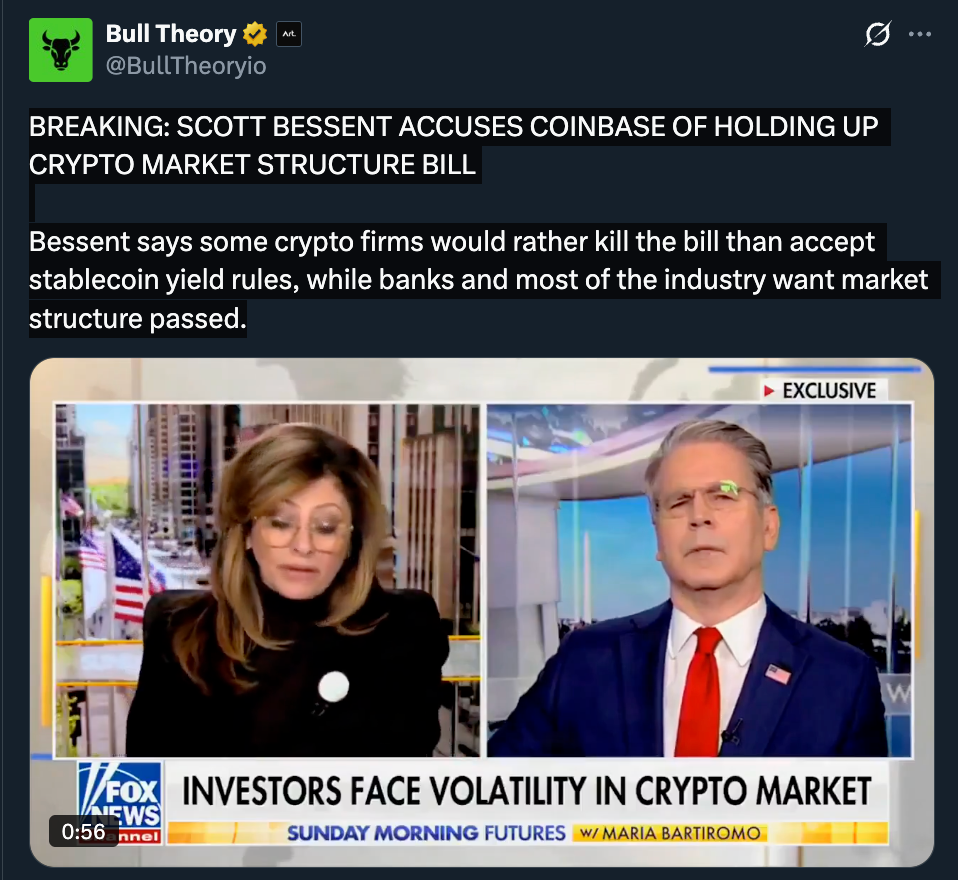
After years of uncertainty, this bill was supposed to be the framework the industry had been asking for. Instead, it’s now stuck, and Bessent’s irritation suggests patience inside the Treasury is wearing thin.
Stablecoin Yield Became the Deal Breaker
At the center of the impasse is a single but explosive issue: whether stablecoin platforms should be allowed to pay interest or rewards to users. Banks and regulators strongly oppose it, arguing that yield-bearing stablecoins could siphon deposits from traditional banks, especially smaller community institutions.
From their perspective, this isn’t a theoretical concern. Stablecoins already represent hundreds of billions in digital dollars, and attaching yield to them could reshape deposit flows in ways regulators aren’t prepared to allow. For lawmakers trying to balance innovation with financial stability, stablecoin yield became the red line.
Coinbase’s Pushback Changed the Bill’s Trajectory
Tensions escalated when Coinbase, the largest U.S.-based crypto exchange, publicly withdrew its support for the bill. The reason was simple. Coinbase doesn’t want an outright ban on stablecoin rewards, seeing it as an unnecessary concession to traditional banking interests.
That move had immediate consequences. Senate momentum stalled, negotiations fractured, and what once looked like a viable bipartisan effort turned into a scramble to keep the bill alive. Bessent responded by telling holdouts to either compromise or accept that federal regulation will move forward without them, even suggesting that those unwilling to operate under U.S. rules could relocate to looser jurisdictions.

What’s at Stake Goes Beyond One Company
This isn’t just a spat between Coinbase and regulators. The outcome will determine whether the U.S. gets a coherent digital asset framework or continues relying on enforcement actions, lawsuits, and agency turf wars. If the bill collapses over stablecoin yield, the industry risks years more of uncertainty at a moment when other countries are rapidly formalizing their crypto rules.
The irony is hard to miss. Crypto has long argued it needs clarity to grow responsibly. Now, internal disagreements threaten to derail the very legislation meant to provide it.
A Test of the Industry’s Ability to Compromise
Stablecoins are no longer a niche experiment. They’re a critical layer of global digital finance, and how they’re regulated will shape the future of payments, exchanges, and onchain markets. This fight isn’t just procedural. It’s a test of whether the crypto industry can negotiate its own future or fracture itself out of the room.
Bessent’s message was blunt for a reason. Regulation is coming either way. The only question left is whether crypto helps shape it, or watches it happen without a seat at the table.
Disclaimer: BlockNews provides independent reporting on crypto, blockchain, and digital finance. All content is for informational purposes only and does not constitute financial advice. Readers should do their own research before making investment decisions. Some articles may use AI tools to assist in drafting, but every piece is reviewed and edited by our editorial team of experienced crypto writers and analysts before publication.








 English (US) ·