
 3 months ago
52
3 months ago
52
- David Schwartz said a return to $0.25 for XRP is possible but unlikely.
- Debate continues over Ripple’s corporate structure and XRP’s role in the ecosystem.
- XRP recently rebounded near $1.52 as analysts watch key resistance levels ahead.
Ripple’s longtime CTO emeritus, David Schwartz, recently stepped into a lively debate about XRP’s past price swings and its relationship with Ripple as a company. The conversation unfolded on X, where users began speculating about whether XRP could someday repeat the kind of cycle it once experienced—climbing to several dollars and then crashing back to the $0.20 range.
Schwartz responded directly to one user who wondered if XRP could rise to around $4 and later tumble back to roughly $0.25 or $0.31. His answer was measured. He pointed out that XRP had already gone through something similar before, surging to about $3 during a previous cycle and eventually falling near $0.20.
That history, he said, means extreme moves can’t be ruled out completely. At the same time, Schwartz emphasized that such a scenario today would probably be unlikely. Markets change, adoption evolves, and circumstances rarely repeat in exactly the same way.
Still, he added a small caveat—many price events that eventually happened once seemed “unlikely” too. Crypto markets have a habit of surprising people.
Debate Intensifies Around Ripple’s Business Model
The exchange quickly broadened into a bigger discussion about Ripple’s corporate structure and how it interacts with XRP. Some critics argued that Ripple’s business model creates tension between shareholders and public token holders.
The criticism gained traction after Ripple reportedly repurchased around $750 million worth of company shares at a valuation near $50 billion. Several commentators suggested that retail investors buying XRP might indirectly support Ripple’s growth while shareholders capture the direct financial upside.
In their view, that dynamic creates a kind of imbalance. XRP buyers help fund the ecosystem, they argue, yet they don’t receive ownership in the company itself.
Schwartz disagreed with the premise.
Ripple Sales and Market Pricing
According to Schwartz, Ripple’s financial actions—such as selling XRP—are visible to the market and therefore priced in by traders. If those sales create downward pressure on price, that pressure affects everyone equally, both buyers and sellers.
In other words, the market adjusts. Participants enter trades knowing the conditions.
He also suggested that lower prices caused by known supply factors could actually benefit some investors. When prices remain suppressed for a period, buyers who believe in the asset may accumulate larger positions than they otherwise could.
His argument focused less on corporate strategy and more on how markets naturally incorporate known information.
Critics Question XRP’s Link to Ripple
Part of the criticism came from Chainlink supporter Zach Rynes, who pointed out that owning XRP does not grant investors any equity stake in Ripple. From that perspective, XRP holders don’t directly benefit from the company’s acquisitions, partnerships, or share buybacks.
Rynes argued that Ripple can sell pre-mined XRP, use the proceeds for corporate expansion, and still leave token holders without shareholder rights.
Other users pushed back against that line of thinking. They noted that many cryptocurrencies operate under similar dynamics.
Holding Ethereum doesn’t give investors ownership in companies building on the Ethereum network. The same applies to Solana and its ecosystem projects. In that sense, XRP functions more like a digital asset tied to network usage and market demand—not a share of corporate equity.
Schwartz avoided directly comparing XRP to Ripple stock, instead keeping his comments centered on how markets process supply, demand, and expectations.
Early Crypto Days Look Very Different in Hindsight
Schwartz also addressed a separate claim about how early developers viewed XRP’s future value. Some critics suggested Ripple insiders expected enormous long-term gains from the start.
Schwartz pushed back on that idea. He explained that during XRP’s early years, very few people imagined the token would eventually reach the price levels seen today.
He even shared a personal anecdote. At one point, he sold 40,000 Ethereum at just $1.05, believing the rally had likely ended. In hindsight, that decision seems shocking—but it illustrates how uncertain the early crypto market was.
If people truly believed XRP would reach $1.50 years later, he said, they probably wouldn’t have sold it so cheaply at the time.
XRP Price Jumps as Analysts Eye Bigger Targets
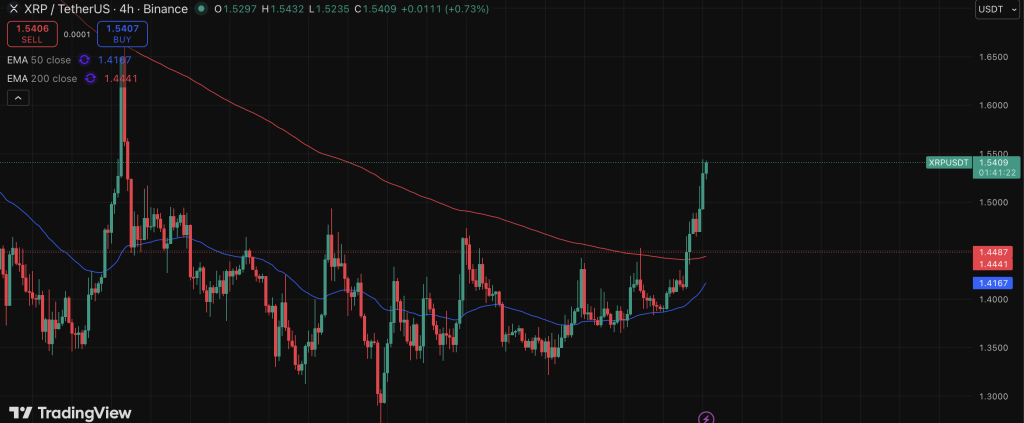
Meanwhile, XRP’s market price has been climbing again. The token recently posted a roughly 7% rebound from its 24-hour low, bringing it back near $1.52.
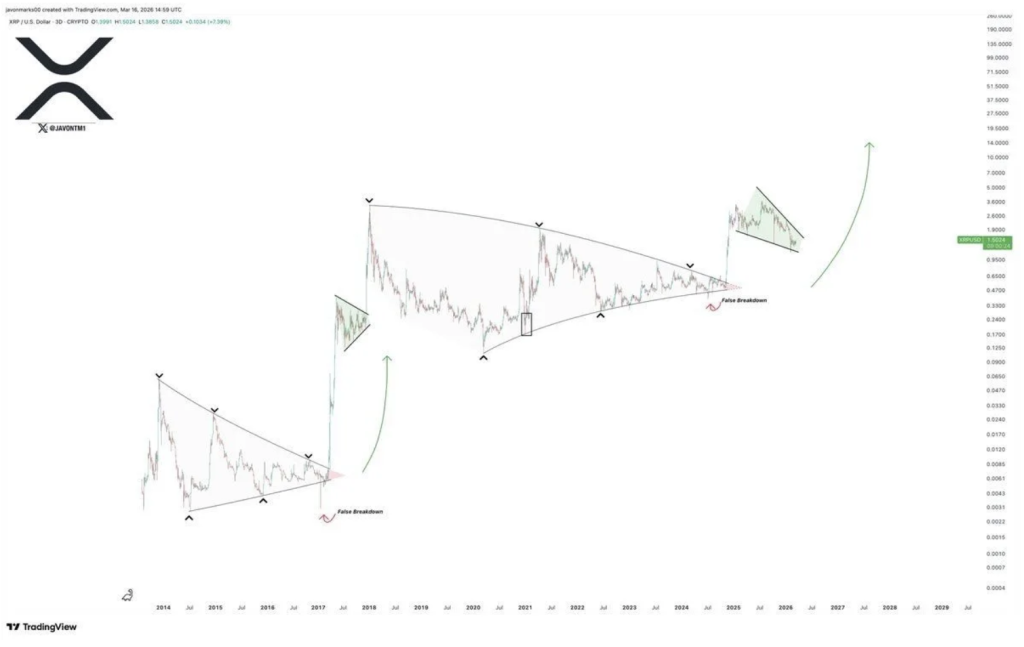
Some analysts believe the broader structure still supports higher price levels. Crypto analyst Javon Marks recently suggested XRP could be preparing for a much larger breakout.
According to his chart analysis, key support zones appear around $0.95 and $0.65. On the upside, the next major resistance levels sit near $1.90 and then $3.60.
If XRP manages to break out of its current flag formation, Marks believes the move could extend first toward $7.00 and eventually into the $14–$15 range. Those projections remain speculative, of course—but they show why traders are watching the chart closely.
Disclaimer: BlockNews provides independent reporting on crypto, blockchain, and digital finance. All content is for informational purposes only and does not constitute financial advice. Readers should do their own research before making investment decisions. Some articles may use AI tools to assist in drafting, but every piece is reviewed and edited by our editorial team of experienced crypto writers and analysts before publication.





 English (US) ·