
 7 months ago
88
7 months ago
88
- RLUSD launching on Binance adds liquidity and strengthens the XRP Ledger’s real-world utility.
- A potential U.S. banking license could reposition Ripple as a regulated settlement gateway into the dollar system.
- XRP could target $3 first, then $5–$7 if institutional settlement adoption accelerates, though ETF inflows remain hesitant.
The XRP ecosystem is moving fast right now, even if the price action still feels cautious and kind of stuck. This week alone, Ripple’s stablecoin RLUSD officially went live on Binance, which is a pretty big deal because it adds liquidity and gives the XRP Ledger a more direct “real use” lane. Stablecoins are where most of crypto’s daily transaction volume lives, so getting RLUSD into a major exchange pipeline matters more than people realize.
At the same time, institutional signals are starting to show up in weird, uneven ways. Goldman Sachs reportedly disclosed around $152 million in exposure tied to an XRP ETF position, which suggests large investors are at least paying attention. But then you look at the ETF flow data and see XRP ETFs recorded zero inflows on February 11, and suddenly it feels like the market is still hesitating. Progress is real, but conviction isn’t fully there yet.
And that mix of momentum and doubt is exactly why one question keeps coming back: what happens if Ripple takes the next big step?
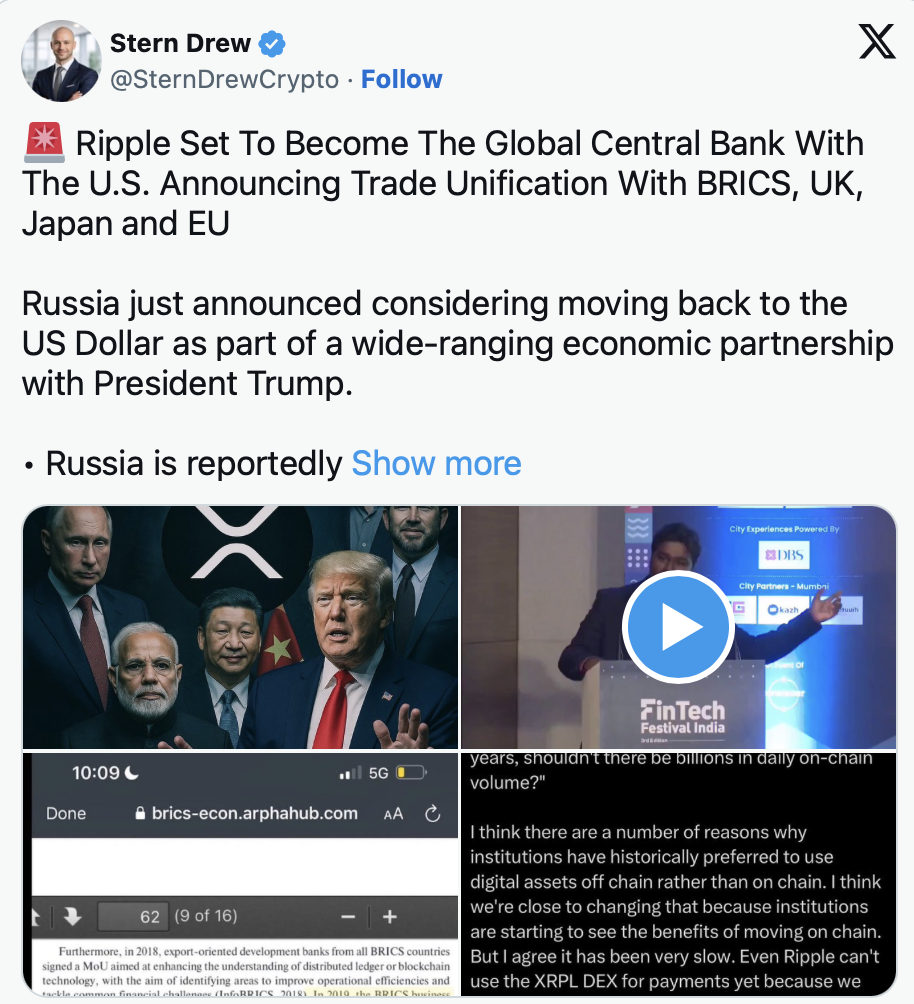
The Banking License Scenario Is Bigger Than Most People Think
A tweet from Stern Drew lit up the conversation with a bold idea that’s been quietly building for a while. The theory is that Ripple may be positioning itself to become a future global settlement layer, especially if it secures a U.S. banking license.
The logic behind it is pretty simple, and honestly kind of compelling. Global trade relationships are shifting, cross-border payment rails are under pressure, and countries want faster, compliant ways to move liquidity. Stern Drew even pointed out that Russia has discussed moving back toward the U.S. dollar in certain settlement frameworks, which shows how messy and fluid global settlement politics have become.
Ripple’s advantage is that it’s already been tested. India has seen banks experiment with XRPL rails. China was involved in early Ripple testing years ago. Japan remains one of Ripple’s strongest regions, with partnerships across dozens of banks and plans to formally recognize XRP as a financial asset by late 2026.
On top of that, Ripple already holds regulatory approvals across Europe and has a payments license in Singapore. These aren’t just random headlines. They’re the kind of building blocks you need if you’re serious about creating global corridors, one region at a time.
Why a U.S. Banking License Would Change Everything
This is the part that could really flip the narrative.
If Ripple secures a U.S. banking license, it doesn’t just become “another blockchain company with partnerships.” It becomes something closer to a regulated gateway into the U.S. dollar system. That’s a massive shift in how institutions would view Ripple, and it would also change how RLUSD could be used.
In that scenario, RLUSD becomes a stablecoin designed for regulated settlement, and the XRP Ledger becomes the rails underneath. That’s the infrastructure story. It’s not about hype or memes, it’s about compliance, settlement speed, and the ability to move value globally without friction.
And that’s also why this idea keeps gaining attention. XRP has always had a payments narrative, but a banking license would make that narrative harder to dismiss.
What Could This Mean for XRP Price?
XRP is trading around $1.35 right now, and the market clearly hasn’t priced in anything close to a “regulated banking gateway” scenario. If Ripple actually locked in a U.S. banking license, the market would likely reprice XRP quickly, because it would be a major confirmation of Ripple’s role inside regulated finance.
The first obvious upside target would be the previous cycle zone around $3. That level has historically attracted heavy attention, and it’s where XRP tends to get loud again when momentum returns.
Beyond that, a move into the $5 to $7 range becomes realistic if institutional settlement adoption accelerates and XRP starts being viewed as a core liquidity asset again. Not just a token people trade, but something tied to real payment flow. That distinction matters.
The real “moon” scenario is if XRP begins capturing global payment volume at scale. If that ever happens, double-digit prices are not impossible, but it would require years of execution, tight regulatory alignment, and actual transaction demand, not just headlines.
The Market Still Isn’t Fully Convinced Yet
Even with the ecosystem progress, the market is still cautious. ETF inflows have paused, and broader crypto sentiment remains fragile, which makes it harder for XRP to run. XRP usually moves hardest when two things line up at the same time: regulatory clarity and adoption. Right now, we have pieces of adoption building, but the breakout catalyst hasn’t fully arrived.
That’s why this moment feels like a waiting game. The foundation is being built in public, step by step, but the market is still sitting back, watching, and asking for proof. And in crypto, proof is usually what triggers the real move.
Disclaimer: BlockNews provides independent reporting on crypto, blockchain, and digital finance. All content is for informational purposes only and does not constitute financial advice. Readers should do their own research before making investment decisions. Some articles may use AI tools to assist in drafting, but every piece is reviewed and edited by our editorial team of experienced crypto writers and analysts before publication.



 English (US) ·