
 3 months ago
52
3 months ago
52
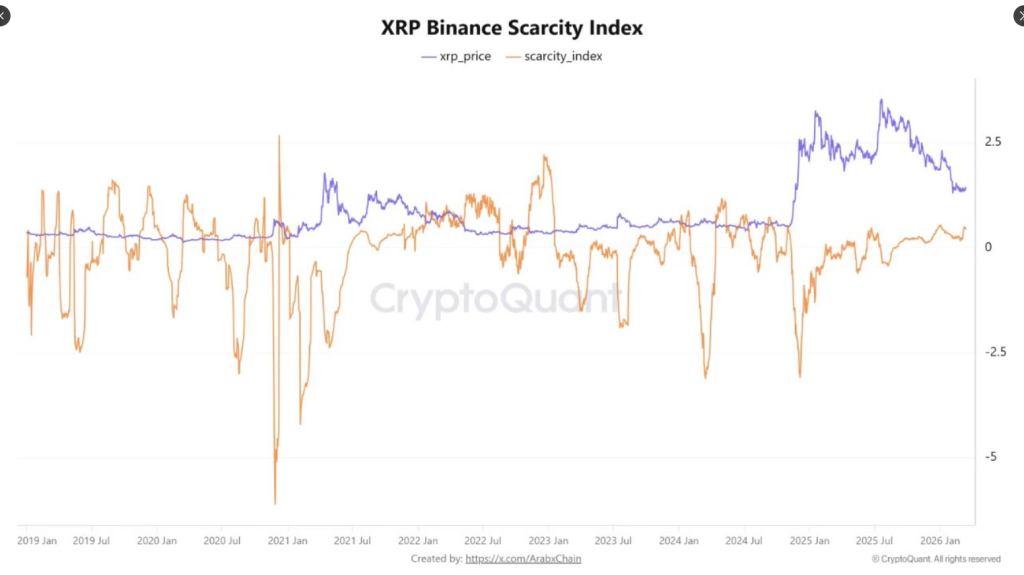
The Scarcity Index flipped to +0.48, a reading that lines up with a clear drop in XRP held on exchanges and signals that less XRP is sitting in tradable wallets than the recent average. CryptoQuant data shows the move was most visible on Binance, where on-platform balances have moved lower over the past weeks.
Exchange Balances Have Fallen
Reports indicate a portion of XRP once held on exchanges has been shifted into private wallets. Large transfers off Binance and other venues reduced the amount of XRP readily available for quick trades. That can shrink the liquid float — the coins traders can buy and sell instantly — even though the total supply of XRP remains unchanged.
Based on reports, some of the outflows appear to be custodial moves to cold storage or institutional custody, not token burns. When holders move assets off exchanges, tokens aren’t destroyed; they’re simply harder to access for fast selling. Traders watching on-chain flows see that as accumulation by holders who prefer possession over sitting on an exchange.
Short Positions Loom Over Price
Open interest in derivatives markets shows short positions clustered above current price levels, and that concentration matters. Reports note if buying volume grows quickly, those short positions can trigger stop-outs and push price sharply in one direction.
 $XRP SUPPLY IS THINNING ON BINANCE.
The Scarcity Index just flipped to +0.48.
$XRP SUPPLY IS THINNING ON BINANCE.
The Scarcity Index just flipped to +0.48.
That means less XRP is sitting on exchanges than the historical average. Coins are being pulled into private wallets. Supply is quietly disappearing.
This is NOT moon math. It’s basic economics.… pic.twitter.com/af1gdWnJUj
— Xaif Crypto |
| (@Xaif_Crypto) March 15, 2026
That makes markets more sensitive. But sensitivity doesn’t equal certainty. Price still needs buyers. A thinner exchange float can amplify moves when volume arrives, but it won’t create demand out of nothing.
Data shows the Scarcity Index is one lens among many. Analysts and traders typically compare it with total exchange reserves across platforms, order book depth, and derivatives positioning to assess risk.
If only one exchange shows declining balances, the signal is weaker than if multiple major venues report the same trend.
According to on-chain observers, a single positive reading of a scarcity metric is not conclusive. Market participants usually look for corroborating signs: cross-exchange reserve declines, inflows into institutional custody products, rising buy volumes, or shifts in open interest that support a directional move. Without those, the scarcity reading is incomplete.
Reports indicate the community reaction is mixed. Some traders interpret lower exchange balances as a bullish sign because there may be fewer sellers. Others caution that large holders can still redistribute coins back to exchanges and that a single exchange’s data can be noisy.
Based on the current data, expect volatility if buying picks up and shorts are forced to cover. Watch total exchange reserves, order book liquidity, and derivative metrics together.
For now, the Scarcity Index flip to +0.48 is a notable data point. Reports from market watchers and custodians will determine whether it becomes the start of a broader trend or remains a short-lived signal.
Featured image from Bitpanda Blog, chart from TradingView









 English (US) ·