
 2 months ago
39
2 months ago
39
- Lawyers warn crypto wallets and digital assets are becoming major blind spots in estate planning
- Families often inherit ownership rights but still cannot access funds without passwords or private keys
- Courts increasingly recognize crypto as inheritable property, though huge legal and technical gaps remain
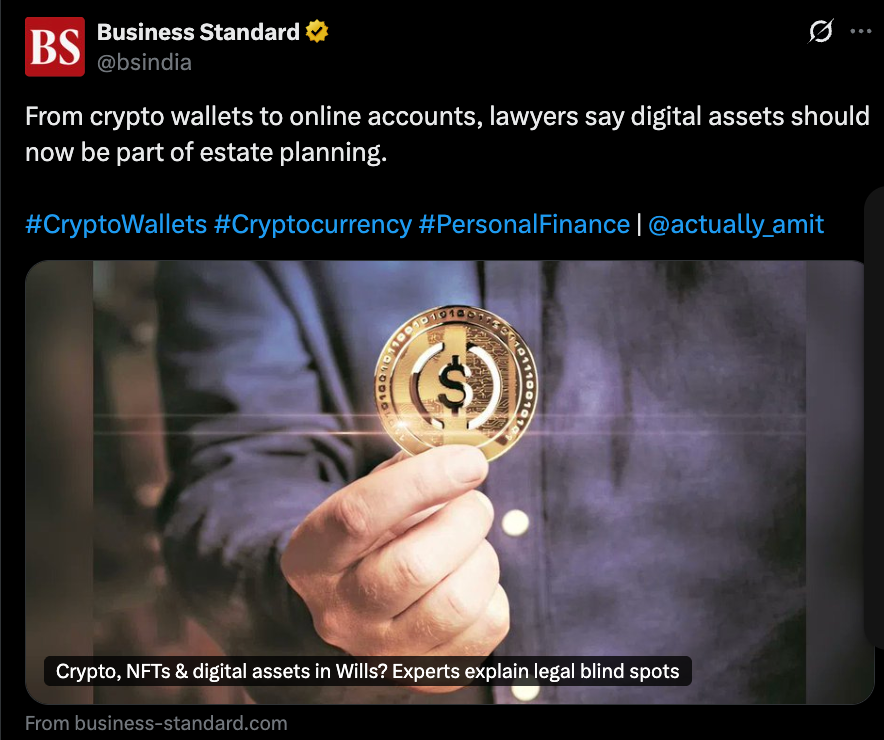
For years, crypto investors proudly repeated the phrase “be your own bank” like it was the greatest financial revolution ever invented. Turns out that idea becomes considerably less charming once nobody can access the bank after you die.
Estate lawyers and financial experts are increasingly warning that cryptocurrencies, NFTs, online businesses, cloud storage accounts, and monetized digital platforms are creating an entirely new inheritance problem modern legal systems are still struggling to handle properly.
And honestly, the problem is bigger than most crypto holders probably realize.
Owning Crypto And Accessing Crypto Are Two Different Things
One of the biggest misconceptions surrounding digital assets is that legal ownership automatically guarantees practical access. In reality, those are completely separate issues.
Families may legally inherit Bitcoin wallets, NFTs, exchange accounts, or online businesses through wills and estate structures, but without passwords, private keys, recovery phrases, or authentication credentials, those assets can remain permanently inaccessible forever.
Unlike traditional banks, decentralized wallets do not have customer support lines waiting to help recover forgotten seed phrases. There is no “forgot password” button for a cold wallet holding millions in Bitcoin.
That means enormous amounts of crypto wealth could theoretically remain trapped onchain indefinitely simply because someone failed to leave instructions behind somewhere secure.
Somewhere, hardcore Bitcoin maximalists are probably still insisting that counts as decentralization working perfectly.
Courts Are Slowly Catching Up To Digital Ownership
Traditional inheritance law was built around physical property, bank accounts, paper documentation, and centralized financial institutions. Crypto operates inside a completely different framework involving encryption, decentralized protocols, offshore exchanges, and private key ownership systems.
Lawyers interviewed by Business Standard noted that even when courts recognize inheritance rights over digital assets, recovering those assets often becomes operationally complicated very quickly.
One important legal milestone came in 2025 when India’s Madras High Court formally recognized cryptocurrency as inheritable property capable of ownership and trust structures. That ruling represented a major step forward for digital asset estate law.
But even then, practical recovery issues remain everywhere. Especially when assets sit inside decentralized wallets or foreign platforms unable, or unwilling, to simply reset account access.

Digital Wealth Is Becoming Impossible To Ignore
Ironically, the fact inheritance lawyers are now seriously discussing crypto may actually represent one of the strongest signs the industry matured beyond speculation alone.
Nobody spends years developing inheritance frameworks around technologies they expect to disappear entirely. People create estate structures around assets they believe families may still care about decades later.
That shift matters because it shows digital ownership increasingly moving from speculative internet culture into actual long-term wealth planning. Crypto is gradually becoming something families need to manage across generations rather than just trade during bull markets.
And that introduces responsibilities many early investors probably never fully considered.
Estate Planning Is Entering The Blockchain Era
Financial advisors increasingly recommend crypto holders document wallet locations, recovery methods, access credentials, and inheritance instructions through secure estate planning systems. Some investors use legal trusts, encrypted vault services, multi-signature arrangements, or carefully structured custody solutions to reduce the risk of permanent loss.
Because right now, the technical reality is pretty unforgiving. If nobody knows where the private keys are, the blockchain does not care what a court order says afterward.
The assets may still exist legally. Practically, though, they become unreachable.
That creates one of the strangest features of modern digital wealth: someone can technically inherit millions of dollars while still being completely unable to access a single cent of it.
Crypto’s Future Is Becoming Increasingly Human
The broader takeaway here is that crypto conversations are evolving beyond trading, speculation, and price predictions into much more human questions involving family planning, generational wealth, inheritance rights, and long-term financial continuity.
Digital assets are no longer just internet experiments sitting outside normal life. They are increasingly becoming part of real estates, real portfolios, real businesses, and real families.
And as crypto ownership expands globally, the next generation of estate lawyers may genuinely need to understand seed phrases, cold wallets, and multisig security structures as much as traditional safety deposit boxes and probate law.
Disclaimer: BlockNews provides independent reporting on crypto, blockchain, and digital finance. All content is for informational purposes only and does not constitute financial advice. Readers should do their own research before making investment decisions. Some articles may use AI tools to assist in drafting, but every piece is reviewed and edited by our editorial team of experienced crypto writers and analysts before publication.





 English (US) ·