
 3 months ago
86
3 months ago
86
- Reports claimed Zcash had stopped producing blocks for more than four hours, raising fears of a network outage.
- The issue was later traced to block explorers that failed to update properly after a coordinated network upgrade.
- Developers confirmed the blockchain continued processing transactions normally throughout the incident.
Crypto markets received a brief scare this week when several blockchain explorers appeared to show that Zcash had stopped producing blocks for more than four hours.
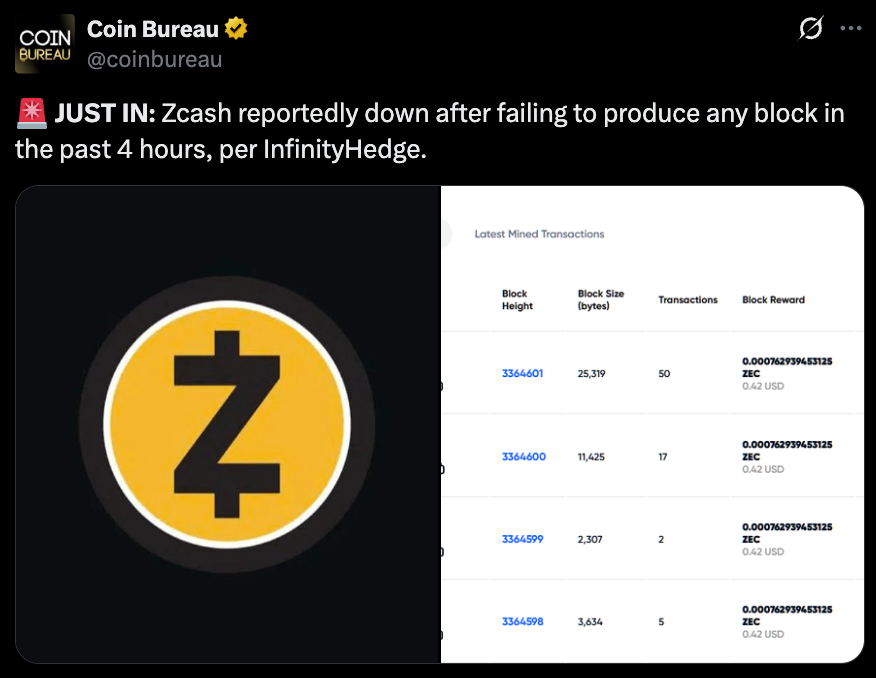
According to the data displayed by multiple tracking services, the privacy-focused blockchain seemed frozen at block 3,364,601. Unsurprisingly, concern spread quickly. In the crypto world, a blockchain that suddenly stops producing blocks tends to attract attention for all the wrong reasons.
For a few hours, some users believed Zcash was experiencing a major outage. The reality turned out to be much less dramatic.
The Blockchain Never Actually Stopped
Despite what block explorers appeared to show, the Zcash network continued functioning normally.
Developers later clarified that the apparent outage was caused by infrastructure providers that failed to properly update their systems following a coordinated network upgrade. While certain explorers displayed outdated information, the blockchain itself continued producing blocks and processing activity behind the scenes.
In other words, the network was running normally. The tools people used to monitor it were the ones experiencing problems.
That distinction is important, even if it wasn’t immediately obvious to users watching frozen block heights.
The Upgrade Behind The Confusion
The issue emerged after a scheduled network upgrade designed to address a vulnerability involving Zcash’s Orchard shielded pool.
As part of the process, infrastructure operators needed to update their systems to remain synchronized with the network. Some providers failed to complete those updates properly, causing their services to stop displaying new blockchain activity.
To users relying on those explorers, it appeared as though block production had completely halted.
Meanwhile, validators and nodes running updated software continued operating as expected.
Why Visibility Problems Matter
The incident highlights an often-overlooked reality within crypto.
Most users do not interact directly with blockchain networks. Instead, they rely on third-party services such as explorers, analytics platforms, wallets, and data providers to understand what is happening on-chain.
When those services malfunction, perception can quickly diverge from reality.
A blockchain can be operating perfectly while users believe it has failed. Conversely, a blockchain can experience issues while monitoring tools continue displaying incomplete or delayed information.
In this case, the problem was not with Zcash itself. It was with the visibility layer built around it.
A Familiar Lesson For Crypto Markets
Crypto has experienced similar situations before.
Over the years, network outages, exchange reporting errors, oracle failures, and analytics glitches have all triggered unnecessary panic. Markets often react first and verify later, particularly when information is limited.
The Zcash incident serves as another reminder that blockchain data should be verified through multiple sources before drawing conclusions.
A frozen explorer does not automatically mean a frozen blockchain.
The Network Passed An Unexpected Test
Ironically, the situation may have demonstrated Zcash’s resilience rather than its weakness.
Despite widespread reports suggesting the network was offline, the blockchain continued functioning throughout the event. Transactions continued processing, blocks continued being produced, and the protocol itself remained operational.
The issue exposed shortcomings in supporting infrastructure rather than flaws in the underlying blockchain.
That distinction matters for investors evaluating network reliability and long-term viability.
A Crisis That Wasn’t
What initially looked like a major outage ultimately became a lesson in how blockchain ecosystems depend on far more than the chain itself.
The Zcash network never stopped working. Instead, several monitoring tools failed to keep pace with a network upgrade, creating the appearance of a shutdown that never occurred.
For investors and users alike, the episode offers a useful reminder. In crypto, infrastructure surrounding a blockchain can sometimes fail long before the blockchain itself does.
Before assuming the worst, it may be worth checking whether the problem is with the network or simply with the window you’re using to look at it.
Disclaimer: BlockNews provides independent reporting on crypto, blockchain, and digital finance. All content is for informational purposes only and does not constitute financial advice. Readers should do their own research before making investment decisions. Some articles may use AI tools to assist in drafting, but every piece is reviewed and edited by our editorial team of experienced crypto writers and analysts before publication.





 English (US) ·