
 2 months ago
48
2 months ago
48
- Ripple executive Fiona Murray said low interest rates in Japan and Korea are changing investor behavior.
- Weak returns from traditional savings products are pushing more retail investors toward alternative assets like XRP.
- Institutional initiatives in Japan and strong retail trading activity in South Korea continue supporting XRP adoption across Asia.
Ripple’s APAC Vice President Fiona Murray recently highlighted a growing shift happening across parts of Asia, particularly in Japan and South Korea, where years of ultra-low interest rates are slowly reshaping how retail investors think about money, savings, and alternative assets. Her argument was fairly simple, honestly. When traditional financial products stop generating meaningful returns, people naturally begin searching elsewhere for growth opportunities, and cryptocurrencies like XRP are increasingly becoming part of that conversation.
For years now, Japan has operated under extremely low-rate conditions, including long periods where interest rates hovered near zero or even dipped negative. South Korea has also experienced prolonged low-yield conditions compared to earlier decades. In environments like these, traditional savings tools such as bank deposits, government bonds, and conservative fixed-income products start losing their appeal because the returns barely keep pace with inflation, if they even manage that much at all.
Over time, this changes investor behavior in a pretty fundamental way. Saving money alone no longer feels enough. People start looking outward.
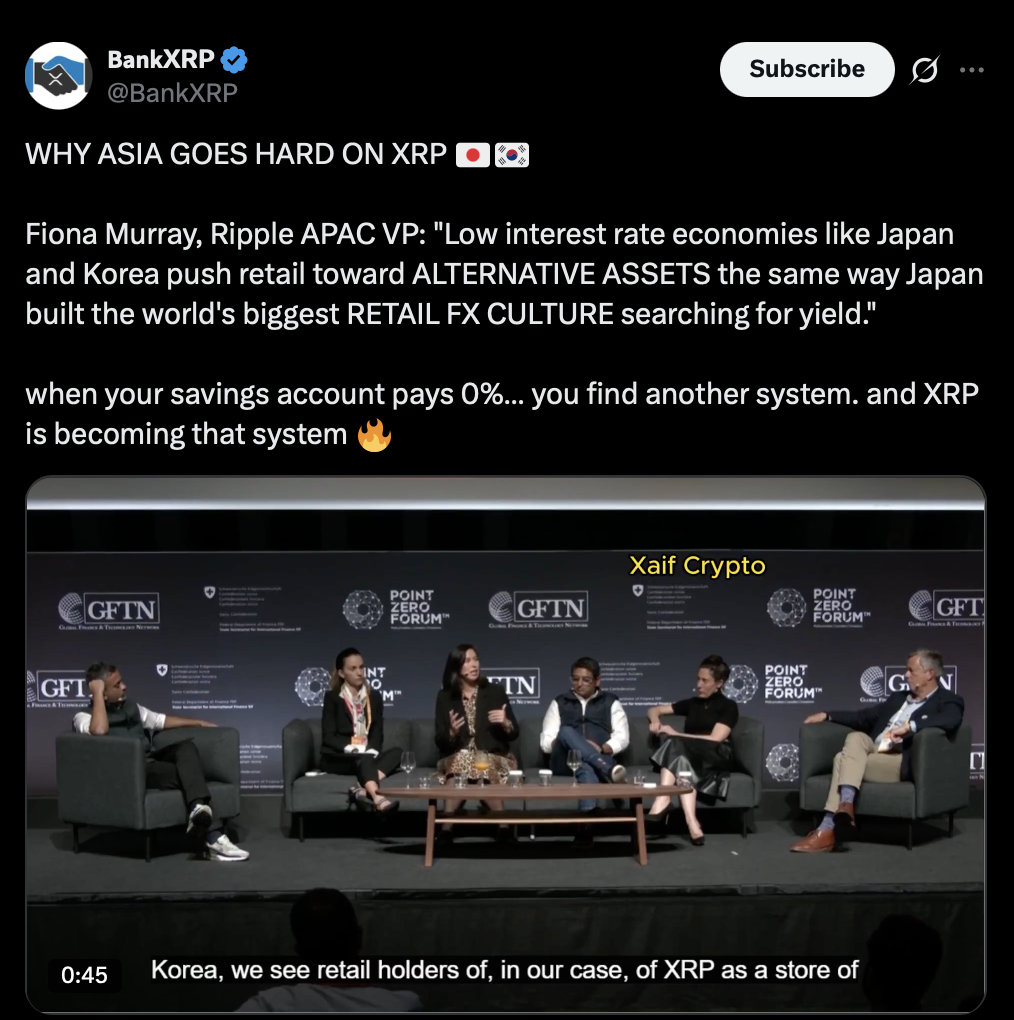
Low-Yield Economies Push Investors Toward Alternative Assets
This shift isn’t entirely new in Japan. The country has long been known for having one of the world’s largest and most active retail foreign exchange trading communities. That culture developed for a reason. When domestic returns weakened, Japanese retail capital started flowing into overseas opportunities where higher yields and stronger volatility created better profit potential.
Now, according to Murray’s broader point, parts of that same behavior are beginning to appear inside digital asset markets too.
When savings accounts offer almost nothing in return, investors begin rethinking what it actually means to preserve wealth over time. That process has gradually pushed more attention toward alternative assets like gold, U.S. equities, foreign currencies, and increasingly, cryptocurrencies. Within that landscape, XRP is often viewed by some market participants as a highly liquid digital asset that operates outside traditional banking constraints while remaining accessible around the clock.
Importantly though, the argument isn’t that XRP replaces fiat savings accounts or behaves like a traditional yield-generating instrument. It’s more about psychology. In low-interest environments, investors often move away from stagnant, guaranteed returns and toward assets that offer liquidity, flexibility, and at least the possibility of stronger upside.
XRP Gains Attention as Retail and Institutional Interest Expands
That changing mindset appears especially visible among retail traders across Asia. XRP has gradually become part of the broader discussion because it combines high liquidity, constant market access, and close integration with larger crypto market cycles. For some investors, those characteristics make it feel like a more dynamic alternative compared to traditional domestic savings products that have remained largely stagnant for years.
Institutional developments are also helping reinforce that narrative.
In Japan, financial giant SBI Group has continued expanding XRP-related initiatives, including projects tied to exchange-traded products and broader digital asset infrastructure linked to the Tokyo Stock Exchange ecosystem. SBI has been one of Ripple’s longest-standing institutional partners, and its continued involvement keeps XRP visible within parts of the Japanese financial market.
Meanwhile, in South Korea, XRP trading activity on Upbit has repeatedly ranked among the highest in the region. In several trading periods, XRP volume has even surpassed both Bitcoin and Ethereum on the platform, highlighting just how strong retail demand around the token remains there. Korean retail traders have historically moved aggressively toward volatile, liquid markets, and XRP continues attracting significant interest during active trading cycles.
Capital Rarely Stays Idle in Low-Rate Environments
The bigger takeaway from Murray’s comments goes beyond XRP itself. What’s really happening is a broader capital rotation inside economies where traditional returns have weakened for extended periods of time. When interest rates remain low year after year, investors start adapting. They seek movement, opportunity, and assets capable of generating stronger long-term growth potential.
That doesn’t guarantee XRP will dominate the space or suddenly replace traditional finance systems overnight. Markets rarely work that neatly. But across parts of Asia, particularly in Japan and South Korea, XRP is increasingly becoming part of a wider shift in how retail and institutional investors approach liquidity, risk, and alternative stores of value in a low-yield world.
And honestly, that trend may still be in its early stages.
Disclaimer: BlockNews provides independent reporting on crypto, blockchain, and digital finance. All content is for informational purposes only and does not constitute financial advice. Readers should do their own research before making investment decisions. Some articles may use AI tools to assist in drafting, but every piece is reviewed and edited by our editorial team of experienced crypto writers and analysts before publication.




 English (US) ·