
 2 months ago
37
2 months ago
37
- Azuki turns NFTs into real-world running challenges and team competition
- “Domain Wars” connects physical activity with digital identity
- Shift from earn-based models to participation-driven NFT utility
Most NFT projects struggle to get users to do anything beyond watching prices move. Azuki, somehow, is getting people to go outside and run. Literally. The Azuki Run Club sounds simple on the surface, but there’s something different about how it’s being executed, something that doesn’t feel forced or overly engineered.
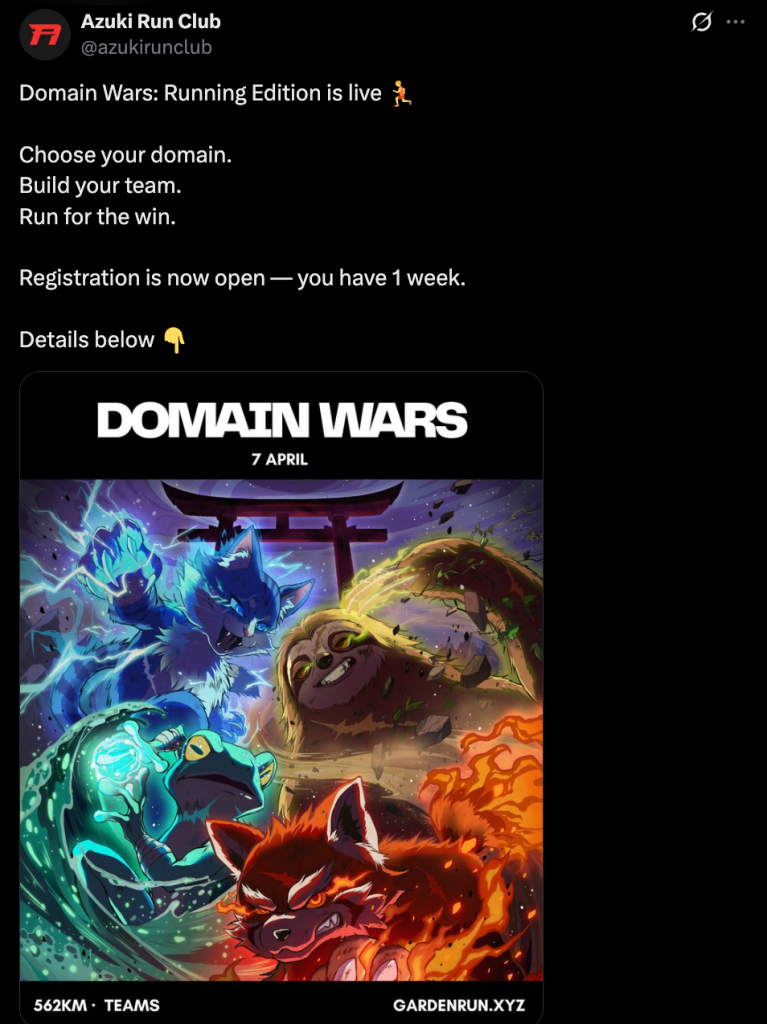
Instead of staking or farming rewards, holders log real-world runs that contribute to team-based challenges. No emissions, no complicated mechanics, just movement tied to community. And oddly enough, that simplicity is what makes it stand out.
A Crypto Race Built on Real-World Activity
The current event, “Domain Wars: Running Edition,” splits participants into four themed teams, each representing its own domain. It leans heavily into Azuki’s anime-style branding, with groups like Fireforce and Mizukari creating a sense of identity beyond just wallet ownership.
The goal is straightforward. Teams collectively run the equivalent distance from Tokyo to Kyoto, roughly 560 kilometers. Every run tracked through apps like Strava adds to the total, pushing teams closer to the finish line. It’s competitive, but not in the usual financial sense.
Competition Without Financial Incentives
What’s interesting is the reward structure, or lack of one. Instead of token payouts or yield mechanics, the prize is a custom artist commission. That choice feels intentional, almost like a rejection of the usual “earn” model.
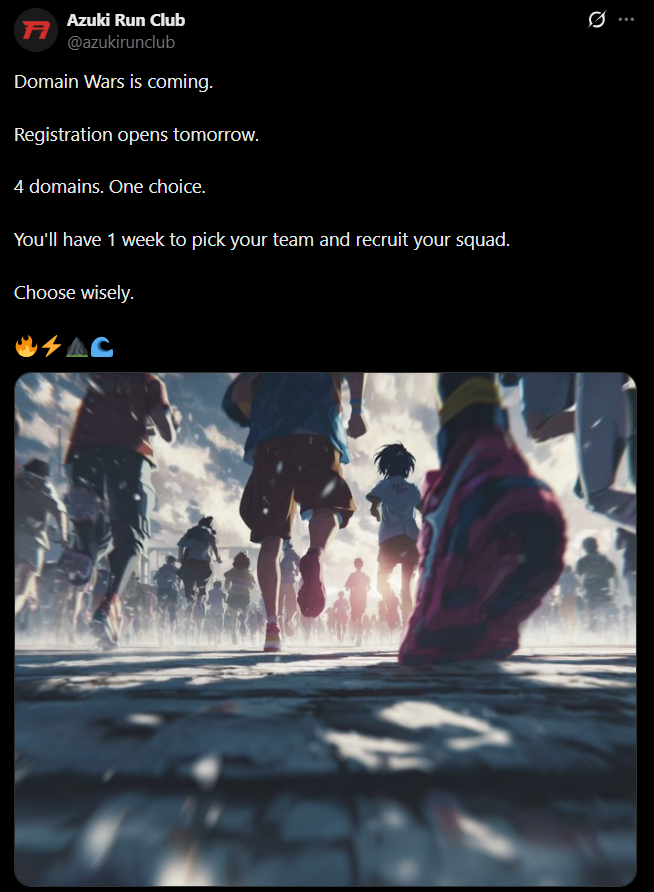
It shifts the focus away from extraction and toward participation. People aren’t running to maximize returns, they’re running because they’re part of something. And that subtle difference changes how engagement feels.
NFTs Are Becoming Participation Layers
This is where the bigger idea starts to show. NFTs have always struggled to move beyond speculation, but this model pushes toward something else, turning ownership into activity. It’s less about holding an asset and more about being part of an experience tied to it.
Participants still need to meet minimum activity thresholds, but the emphasis isn’t on optimization. It’s on showing up, contributing, and being visible within a shared environment. That kind of interaction feels more sustainable, even if it’s less flashy.
A Simpler Model That Actually Works
Azuki Run Club works because it doesn’t try too hard to reinvent everything. It takes an existing community and gives it something real to do, something human. No complex tokenomics, no forced incentives, just movement and identity layered together.
And maybe that’s the point. In a space that often overcomplicates things, the most effective ideas might be the ones that feel the most natural.
Disclaimer: BlockNews provides independent reporting on crypto, blockchain, and digital finance. All content is for informational purposes only and does not constitute financial advice. Readers should do their own research before making investment decisions. Some articles may use AI tools to assist in drafting, but every piece is reviewed and edited by our editorial team of experienced crypto writers and analysts before publication.






 English (US) ·