
 3 months ago
73
3 months ago
73
- Bitcoin has recovered to roughly $67,000 as on-chain data shows buyers returning after the June sell-off.
- Accumulation activity has increased across wallet sizes, signaling renewed interest at lower prices.
- Despite stronger demand, options market positioning suggests volatility may remain elevated in the near term.
Bitcoin has clawed its way back toward the $67,000 mark after briefly sliding close to $60,000 earlier this month. The recovery has been impressive on the surface, especially considering how quickly sentiment deteriorated during the recent correction. More importantly, blockchain data suggests that real buyers stepped in as prices weakened, helping fuel the rebound.
Still, not everyone is ready to call a market bottom.
While on-chain metrics point to growing demand, another corner of the market is flashing caution. Options positioning, particularly on Deribit, suggests Bitcoin may be heading into an area where price swings become more violent rather than more stable. That leaves traders facing two competing narratives: improving demand versus a market structure that still favors volatility.
Bitcoin Buyers Returned as Prices Dropped
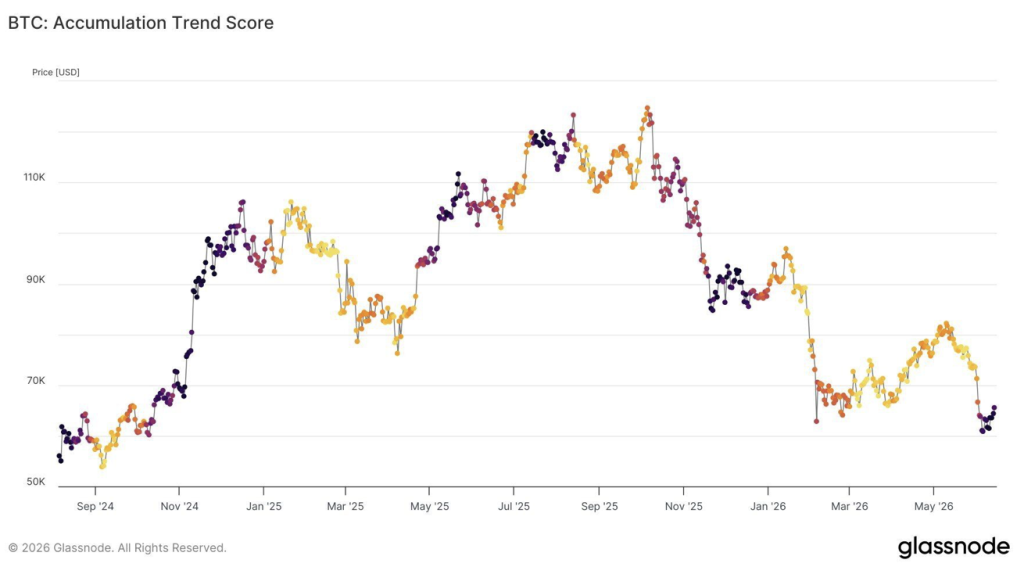
One of the clearest signs of renewed interest comes from Bitcoin’s Accumulation Trend Score, a metric that tracks whether wallets are adding to their holdings or distributing coins.
As Bitcoin drifted toward the $60,000 region in early June, accumulation began increasing across multiple wallet cohorts. Instead of triggering widespread panic, the decline attracted buyers looking to take advantage of lower prices.
That shift matters.
Historically, strong accumulation during a sell-off often suggests investors view the weakness as an opportunity rather than the beginning of a prolonged downturn. Large holders and smaller investors alike appeared willing to add exposure while prices were under pressure.
At the same time, exchange balances continued falling, hinting that many buyers were moving coins into long-term storage instead of preparing to sell them.
Demand Alone Doesn’t Guarantee a Bottom
As encouraging as the data looks, there is an important distinction traders should keep in mind.
Accumulation tells us that investors are buying. It does not tell us they are buying at the perfect time.
This same metric generated accumulation signals several times throughout previous corrections, yet prices continued drifting lower afterward. Strong demand can exist during a downtrend without immediately reversing it.
Another factor complicating the picture. The June bounce was partly fueled by forced liquidations. As leveraged positions were wiped out, short sellers rushed to cover positions, accelerating the rebound.
That’s why some analysts remain cautious.
Part of Bitcoin’s recovery may reflect genuine demand. Another portion likely came from mechanical market forces rather than long-term conviction.
Options Markets Are Flashing a Warning
While on-chain activity has improved, options data paints a less comfortable picture.
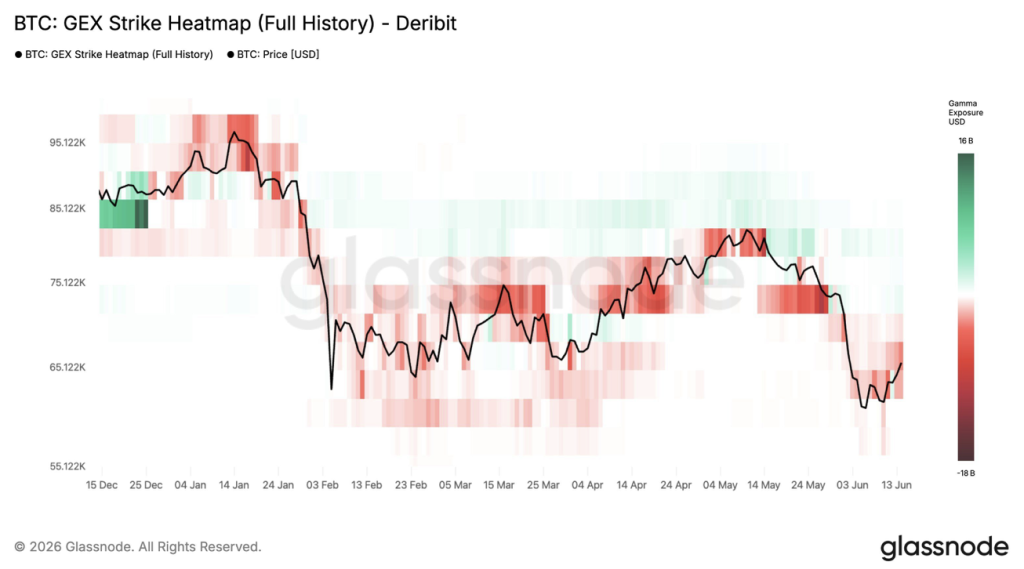
According to Deribit positioning data, Bitcoin is currently trading near a dense cluster of negative gamma exposure around the $67,000 level. For traders unfamiliar with the concept, gamma influences how options dealers hedge their positions.
In positive gamma environments, dealers tend to buy weakness and sell strength, which helps smooth out volatility.
Negative gamma does the opposite.
Dealers often end up selling into declines and chasing rallies, creating larger price swings in both directions. That dynamic can amplify volatility and make market moves feel more erratic.
Unfortunately for bulls, Bitcoin currently sits inside this less stable zone.
Stability Doesn’t Arrive Until Higher Levels
The more constructive area sits significantly higher.
Analysts point to the $80,000 to $85,000 range as a region where positive gamma exposure becomes more dominant. If Bitcoin can eventually reclaim that zone, options market dynamics would become more supportive and price action could stabilize.
There’s a catch, though.
That same area may also act as resistance. Dealers positioned there would likely sell into strength, potentially slowing Bitcoin’s advance as it approaches those levels.
In other words, the market may need to fight through resistance before it can enjoy the benefits of a more stable environment.
The Key Bitcoin Levels to Watch
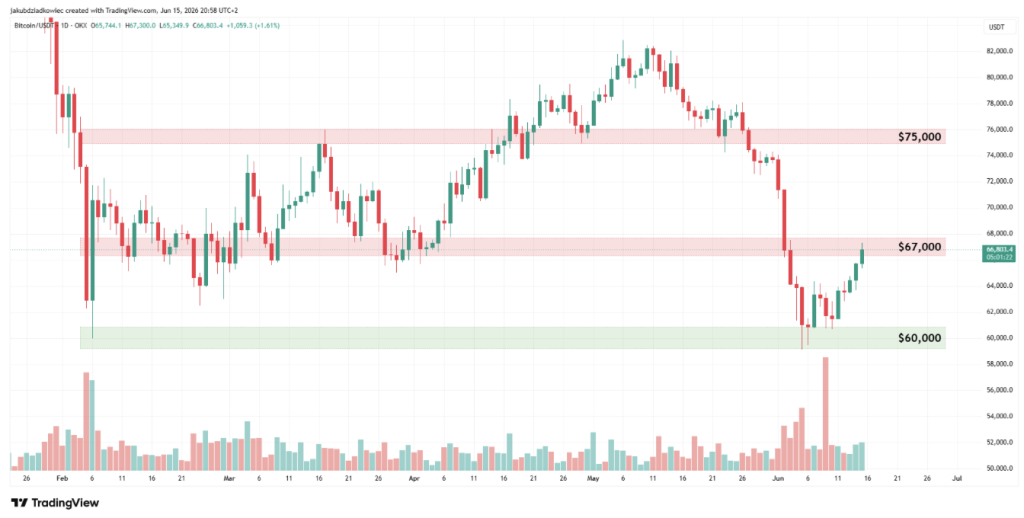
For now, three major price zones are drawing the most attention.
The first is the $60,000 area, which served as the recent low and remains the foundation of the current recovery. If Bitcoin loses that level decisively, the accumulation narrative could quickly weaken.
Next comes the current region around $67,000. This is effectively the market’s volatility pivot. As long as Bitcoin remains trapped in this zone, traders should expect larger swings rather than a smooth climb higher.
The final area sits between $75,000 and $80,000. Reclaiming that range would significantly strengthen the bullish case and move Bitcoin closer to the more stable positive-gamma environment.
Why Patience May Still Be the Best Strategy
The return of buyers is undoubtedly encouraging. On-chain demand has improved, exchange balances continue falling, and accumulation metrics show growing interest from investors willing to buy the dip.
Yet the options market is sending a very different message.
Until Bitcoin breaks above the volatility-heavy zone surrounding current prices and moves closer to the stabilizing region higher up, caution remains warranted. The recovery may ultimately develop into something much larger, but for now, the evidence suggests traders should remain patient rather than assume the bottom is already locked in.
Disclaimer: BlockNews provides independent reporting on crypto, blockchain, and digital finance. All content is for informational purposes only and does not constitute financial advice. Readers should do their own research before making investment decisions. Some articles may use AI tools to assist in drafting, but every piece is reviewed and edited by our editorial team of experienced crypto writers and analysts before publication.







 English (US) ·