
 3 months ago
80
3 months ago
80
- Bitcoin balances held in OTC markets have fallen to record lows as whales continue accumulating.
- CryptoQuant data shows roughly 400,000 BTC has disappeared from OTC holdings since 2022.
- Despite tightening supply, on-chain indicators suggest Bitcoin has not yet entered a confirmed recovery phase.
Bitcoin may be sending mixed signals right now, but one trend is becoming increasingly difficult to ignore: available supply is getting harder to find. Fresh on-chain data shows that Bitcoin liquidity within over-the-counter (OTC) markets has continued shrinking, reaching what analysts believe is the lowest level ever recorded.
Normally, that might sound like a technical detail buried in market reports. But OTC desks play a major role in facilitating large transactions for institutions, whales, and high-net-worth investors. When balances fall dramatically while buying continues, it can signal that supply is becoming increasingly scarce beneath the surface.
The question now is whether that shrinking supply eventually translates into a stronger market rally.
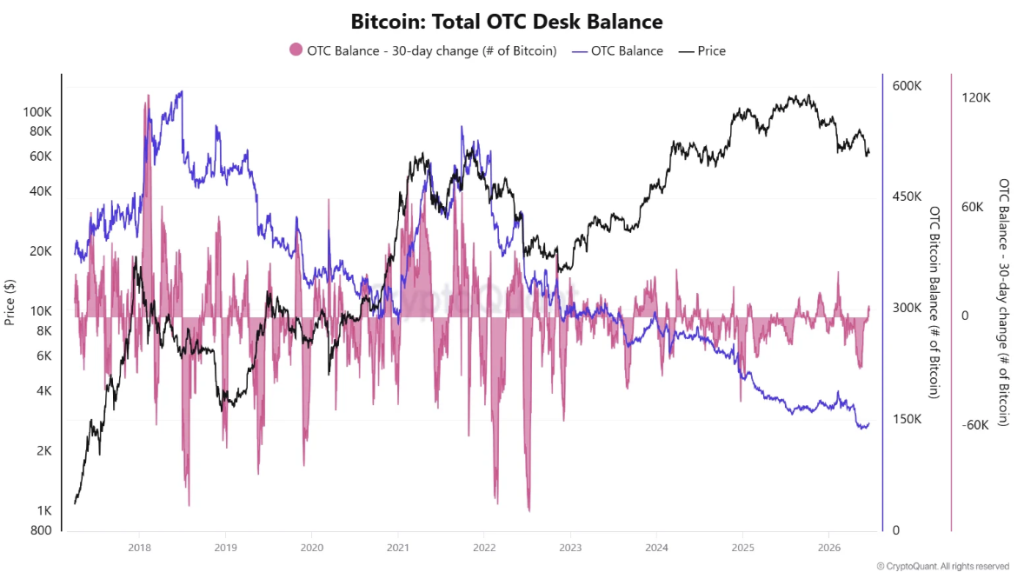
OTC Bitcoin Holdings Continue to Decline
According to CryptoQuant, Bitcoin balances held across OTC markets have dropped significantly over the past few years. Since 2022, holdings have reportedly fallen from around 550,000 BTC to approximately 150,000 BTC.
That’s a decline of roughly 400,000 Bitcoin.
What’s particularly interesting is that the drop has occurred while large investors continue accumulating. Historically, OTC balances often increase near the latter stages of bull markets as investors prepare to distribute holdings. This cycle, however, appears to be following a different script.
Instead of rising, available balances have continued moving lower.
That suggests whales are absorbing supply faster than it can be replenished, creating a much tighter liquidity environment than previous market cycles.
This Cycle Looks Different
CryptoQuant argues that the current market structure does not resemble earlier Bitcoin bull runs.
In prior cycles, whale accumulation typically slowed before OTC balances began climbing. This time, accumulation has persisted for much longer while balance growth remains notably weak. In fact, OTC reserves have continued shrinking even during periods when Bitcoin prices stabilized.
That divergence is attracting attention.
Some analysts believe the prolonged accumulation phase may be delaying the next major rally. The logic is fairly straightforward: as long as large investors continue quietly buying, available supply keeps tightening. Once that accumulation phase eventually ends, the market may be left with significantly less liquid Bitcoin available for purchase.
If demand increases at that point, price pressure could intensify quickly.
Of course, timing remains the difficult part. Supply shortages alone do not guarantee immediate gains.
Liquidity Is Tightening Beneath the Surface
One of the more important takeaways from the OTC data is that liquidity appears to be getting progressively thinner.
In traditional markets, liquidity helps absorb large buy and sell orders without causing major price swings. When liquidity declines, markets can become more sensitive to shifts in demand.
That’s partly why some traders are paying close attention to these OTC trends.
If institutional demand returns aggressively while available Bitcoin remains constrained, the imbalance between buyers and sellers could create stronger upward pressure. At least, that’s the theory many market participants are watching.
For now, the data suggests accumulation remains active and supply continues moving off the market.
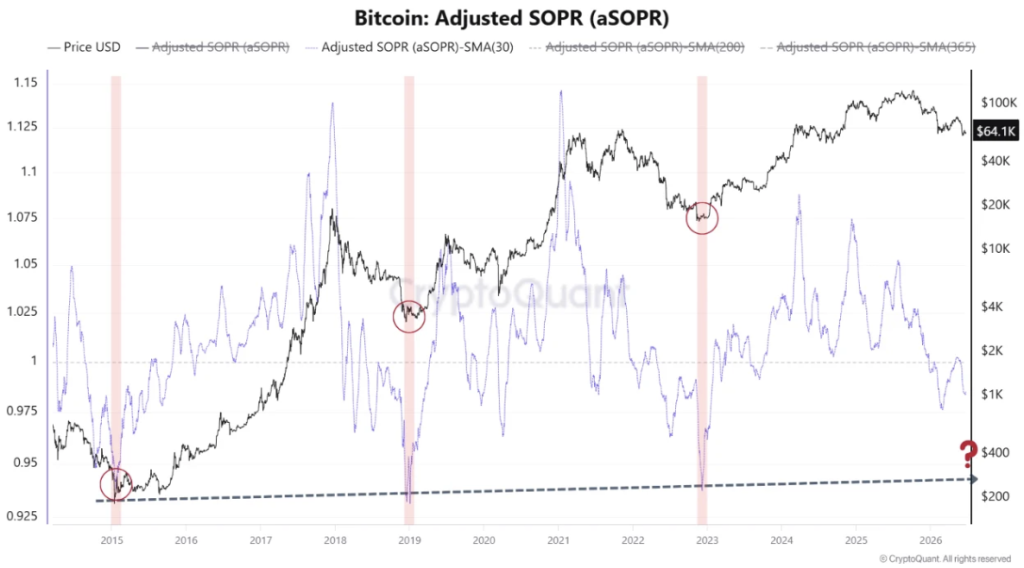
Recovery Signals Remain Elusive
While shrinking supply sounds bullish, not every on-chain metric paints an optimistic picture.
CryptoQuant’s adjusted Spent Output Profit Ratio, commonly known as aSOPR, continues trading below the important level of 1. This metric measures whether investors are spending coins at a profit or a loss.
Right now, the data suggests many participants are still selling at a loss.
Even more notably, the 30-day moving average of aSOPR has failed to reclaim the 1 threshold. Historically, sustained recoveries have often started only after this metric moves above 1 and successfully holds that level.
Until that happens, analysts remain cautious about declaring the beginning of a new bullish phase.
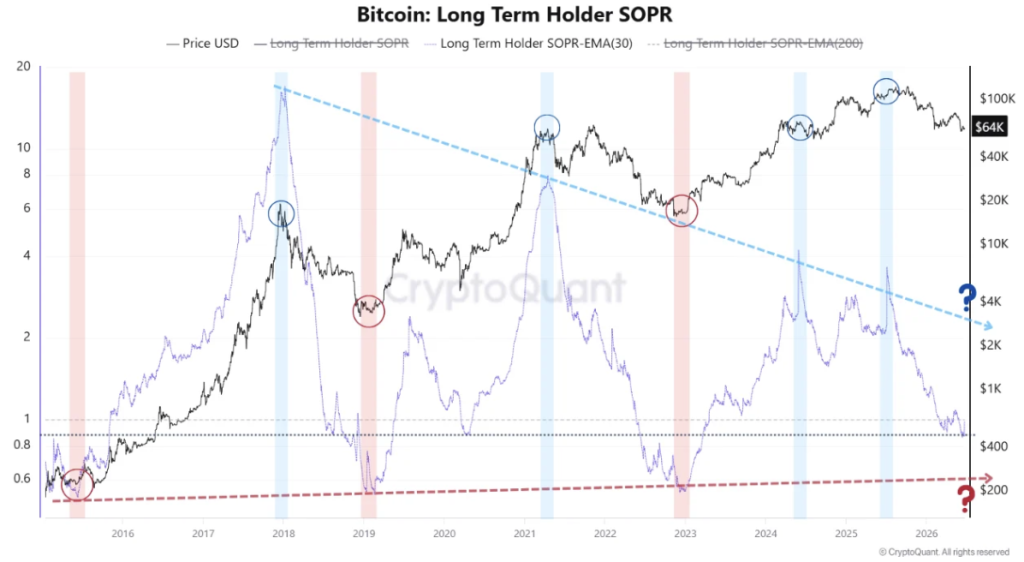
Long-Term Holders Are Taking Smaller Profits
Another signal raising questions involves long-term holder behavior.
According to CryptoQuant, investors who have held Bitcoin for extended periods are currently realizing much smaller profits than they did during previous market peaks. This trend is reflected in the declining Long-Term Holder SOPR metric.
That may seem like a small detail, but historically it has mattered.
Periods where long-term holders take fewer profits can sometimes occur near deeper market reset phases. These resets have often appeared around major Bitcoin bottoms, when sentiment weakens and speculative excess is gradually flushed from the system.
If the pattern continues, some analysts believe the market could still have additional consolidation ahead before a stronger recovery emerges.
Strategy Continues Buying Bitcoin
Despite the cautious signals appearing across parts of the market, institutional accumulation has not completely disappeared.
Michael Saylor’s Strategy recently disclosed another Bitcoin purchase, acquiring 520 BTC for approximately $35 million. Following the latest transaction, the company now holds an enormous 847,363 Bitcoin.
That figure reinforces a trend that has become increasingly familiar over the past several years: while some investors remain uncertain, certain institutions continue treating Bitcoin as a long-term strategic asset.
Whether that conviction ultimately proves correct remains to be seen. But the buying activity certainly adds another layer to the ongoing supply story.
Bitcoin Faces a Supply Squeeze, but Recovery Is Not Confirmed
The current Bitcoin market presents an unusual mix of signals. On one hand, OTC balances have fallen to historic lows, whale accumulation remains active, and available liquidity continues shrinking. Those developments suggest supply-side conditions are becoming increasingly tight.
On the other hand, profit-taking metrics and broader demand indicators still lack the strength typically associated with a confirmed bull market recovery.
For now, Bitcoin appears caught between accumulation and hesitation. Supply is tightening, confidence among large holders remains strong, but broader market participation has yet to fully return.
The next major move may depend on which side gains momentum first.
Disclaimer: BlockNews provides independent reporting on crypto, blockchain, and digital finance. All content is for informational purposes only and does not constitute financial advice. Readers should do their own research before making investment decisions. Some articles may use AI tools to assist in drafting, but every piece is reviewed and edited by our editorial team of experienced crypto writers and analysts before publication.








 English (US) ·