
 1 month ago
68
1 month ago
68
- Core Scientific plans to expand its Oklahoma campus to roughly 1.5 GW of power capacity
- The company is shifting aggressively toward AI and high-density compute infrastructure
- AI data center demand is projected to exceed $810 billion globally by 2033
Core Scientific is making a pretty clear bet on where the next wave of infrastructure demand is headed, and it’s not just Bitcoin mining anymore. The company announced a major expansion of its Muskogee, Oklahoma campus, targeting around 1.5 gigawatts of gross power capacity, with a large portion dedicated to AI-focused colocation infrastructure.
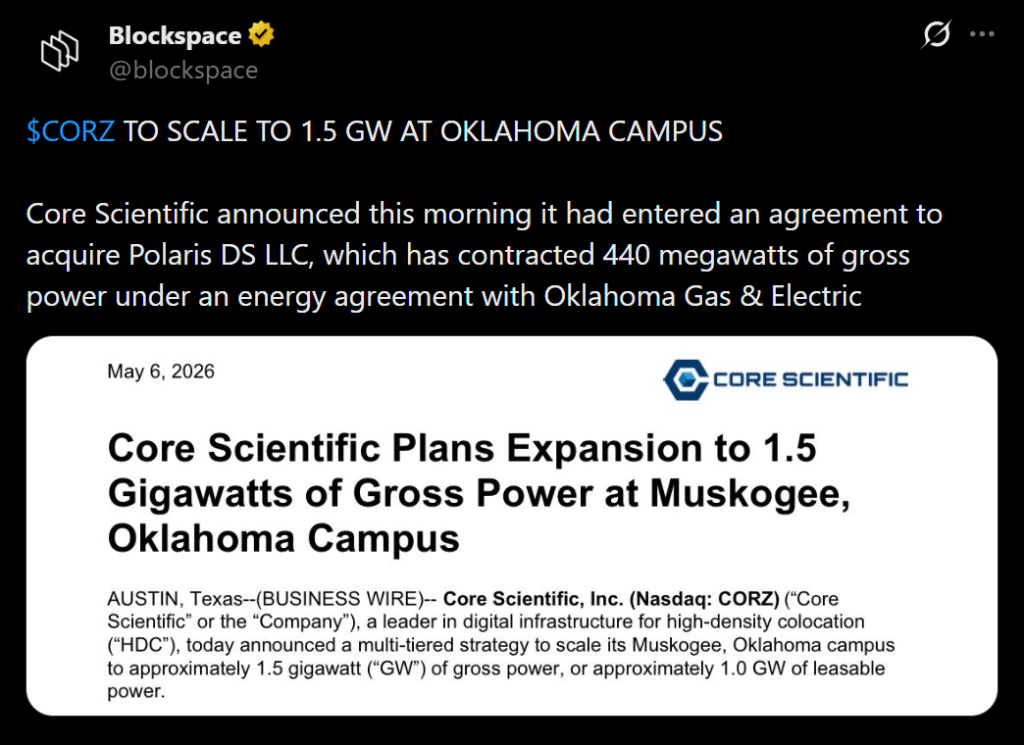
That’s a serious number, even by hyperscale data center standards.
Power Is Becoming the Real Asset
The expansion includes an agreement to acquire Polaris DS LLC, which adds 440 MW of contracted power access through Oklahoma Gas & Electric. In today’s market, that power access may actually be more valuable than the buildings themselves.
AI infrastructure demand has exploded so quickly that companies able to secure electricity and deploy facilities rapidly suddenly have a major advantage.
Crypto Mining Infrastructure Evolves Again
Core Scientific originally built its business around Bitcoin mining, but like several large-scale operators, it’s increasingly repositioning itself as a broader compute infrastructure company.
The overlap makes sense. Mining firms already understand power procurement, cooling systems, and large-scale data operations, all things AI companies now desperately need.
The AI Market Is Driving the Shift
According to industry forecasts, the AI data center market could grow from roughly $147 billion this year to more than $810 billion by 2033. That kind of growth changes incentives very quickly.

Electricity, land, and deployment speed are becoming strategic assets in the same way internet infrastructure was during earlier tech cycles.
A Repeatable Expansion Model
What’s interesting about Core Scientific’s approach is that the company isn’t treating this as a one-off project. Management described the Muskogee buildout as part of a repeatable expansion model combining acquisitions, existing grid access, and behind-the-meter power solutions.
A similar strategy is already underway in Pecos, Texas, which suggests the company sees this as a scalable template rather than a speculative experiment.
Investors Are Starting to Notice
Shares jumped sharply after the announcement, reflecting growing investor interest in anything tied to AI infrastructure and energy capacity. Right now, markets are rewarding companies that can deliver compute power quickly, especially when competitors face multi-year delays building from scratch.
And timing matters a lot in this race.
Crypto and AI Are Quietly Converging
The bigger picture here is that crypto mining infrastructure and AI infrastructure are starting to overlap in meaningful ways. The same facilities once optimized for Bitcoin mining are increasingly being adapted for machine learning workloads and high-performance computing.
For companies like Core Scientific, that transition could end up being more important long-term than mining itself. And for investors, it’s another sign that the line between crypto infrastructure and broader tech infrastructure is getting thinner by the quarter.
Disclaimer: BlockNews provides independent reporting on crypto, blockchain, and digital finance. All content is for informational purposes only and does not constitute financial advice. Readers should do their own research before making investment decisions. Some articles may use AI tools to assist in drafting, but every piece is reviewed and edited by our editorial team of experienced crypto writers and analysts before publication.








 English (US) ·