
 1 month ago
43
1 month ago
43
- Ethereum co-founder Joseph Lubin called digital asset treasury firms a “profound innovation” at Consensus Miami 2026
- Lubin praised companies like Strategy, SharpLink, and BitMine for treating ETH as long-term strategic capital
- He believes Ethereum’s role in tokenization and settlement could eventually connect trillions in traditional finance to onchain infrastructure
Joseph Lubin has spent years talking about Ethereum as infrastructure for the future financial system. What changed recently is that the institutions are finally starting to show up too.
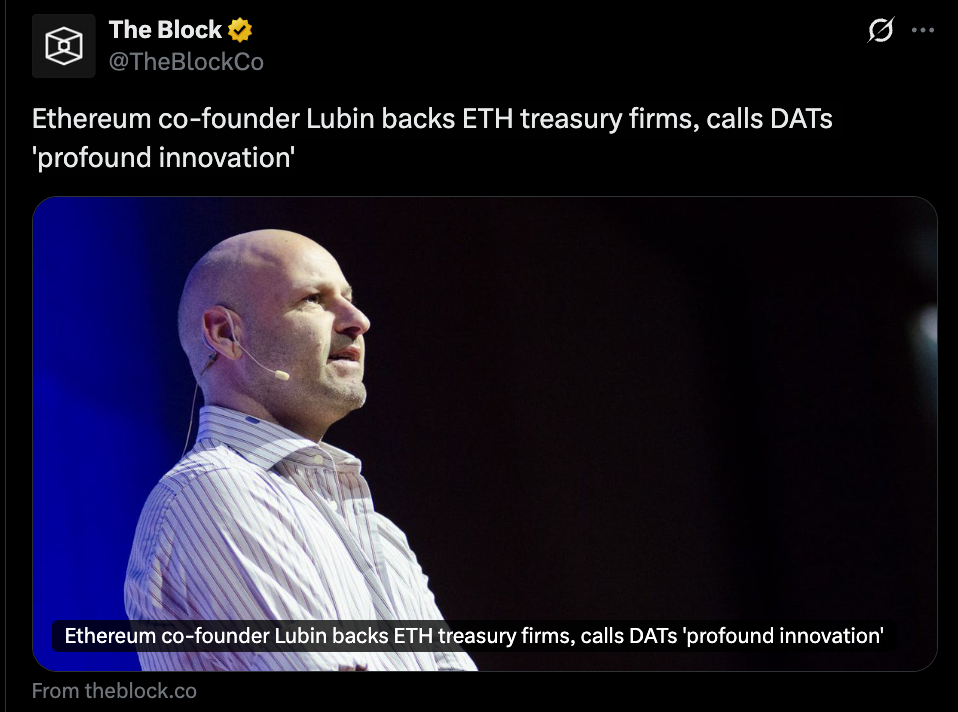
Speaking at Consensus Miami 2026, the Ethereum co-founder described digital asset treasury companies, often called DATs, as one of the most important structural developments happening in crypto right now.
The Treasury Model Is Expanding Beyond Bitcoin
For years, Michael Saylor’s Strategy dominated the conversation around corporate crypto treasuries. Bitcoin sat at the center of that narrative almost exclusively.
Now Ethereum-focused treasury firms are beginning to emerge, and Lubin clearly thinks the market is underestimating how significant that shift could become.
Lubin Drew a Clear Line Between Real Treasury Firms and Opportunistic Copies
One of the more important parts of his comments was the distinction he made between serious treasury strategies and low-quality imitators.
According to Lubin, companies holding strong assets like ETH with long-term conviction represent genuine innovation. Firms attaching treasury narratives to weak or unsustainable tokens, on the other hand, risk damaging the entire model.
Ethereum’s Infrastructure Argument Is Growing Stronger
Lubin’s broader thesis centers on Ethereum becoming foundational financial infrastructure. He argued that Ethereum’s ecosystem has matured enough to attract both regulators and traditional finance institutions in ways that simply were not possible a few years ago.
That matters because the scale of traditional finance dwarfs crypto today. Lubin pointed to an estimated $600 trillion to $700 trillion in global financial assets that could eventually move onto blockchain rails over time.
ETH as a “Trust Commodity”
One of the more interesting ideas he mentioned was Ethereum functioning as a “trust commodity.”

The argument is that ETH gains value not just from speculation, but from its role in securing, validating, and settling economic activity across onchain systems. As tokenization expands, the underlying network securing those transactions becomes increasingly important.
Tokenization Is Moving From Theory to Deployment
Lubin also referenced tokenization efforts tied to major financial infrastructure firms, including progress around DTCC pilots built on Ethereum-related systems.
That’s important because tokenization has quietly become one of the strongest institutional narratives in crypto. Instead of debating whether blockchain matters, firms are increasingly asking how to integrate it into existing markets.
The ETH Treasury Story May Still Be Early
The current ETH treasury movement is still tiny compared to traditional capital markets. But that’s exactly why some investors see the opportunity as asymmetric.
If Bitcoin treasury adoption was the first institutional wave, Ethereum treasury strategies could become the next stage, especially as staking, tokenization, and Layer-2 scaling continue maturing simultaneously.
The Infrastructure Is Starting to Look Real
Crypto markets still move emotionally in the short term, but Lubin’s argument is ultimately about infrastructure, not hype.
If traditional finance increasingly settles assets onchain, Ethereum benefits directly from becoming part of the plumbing underneath global markets. And if that transition accelerates over the next decade, today’s treasury accumulation strategies may end up looking far less speculative than they currently seem.
Disclaimer: BlockNews provides independent reporting on crypto, blockchain, and digital finance. All content is for informational purposes only and does not constitute financial advice. Readers should do their own research before making investment decisions. Some articles may use AI tools to assist in drafting, but every piece is reviewed and edited by our editorial team of experienced crypto writers and analysts before publication.







 English (US) ·