
 3 hours ago
15
3 hours ago
15
TLDR
- WTI crude plummeted up to 5.1%, reaching its lowest point in almost two months following diplomatic progress reports
- European natural gas futures declined as much as 8.4% amid the same developments
- Reports indicate a 14-point framework agreement between Washington and Tehran includes removing oil sanctions
- President Trump indicated a potential signing ceremony could occur this weekend with Vice President JD Vance in attendance
- The critical Strait of Hormuz waterway, accounting for 20% of global petroleum traffic, may reopen within one month
Oil prices experienced a significant decline Friday following emerging reports that Washington and Tehran are nearing completion of a diplomatic agreement that could resolve months of tensions and restore stability to international energy markets.
West Texas Intermediate crude experienced a decline of up to 5.1%, touching its lowest valuation in approximately eight weeks. Simultaneously, European natural gas futures tumbled as much as 8.4% based on the diplomatic developments.
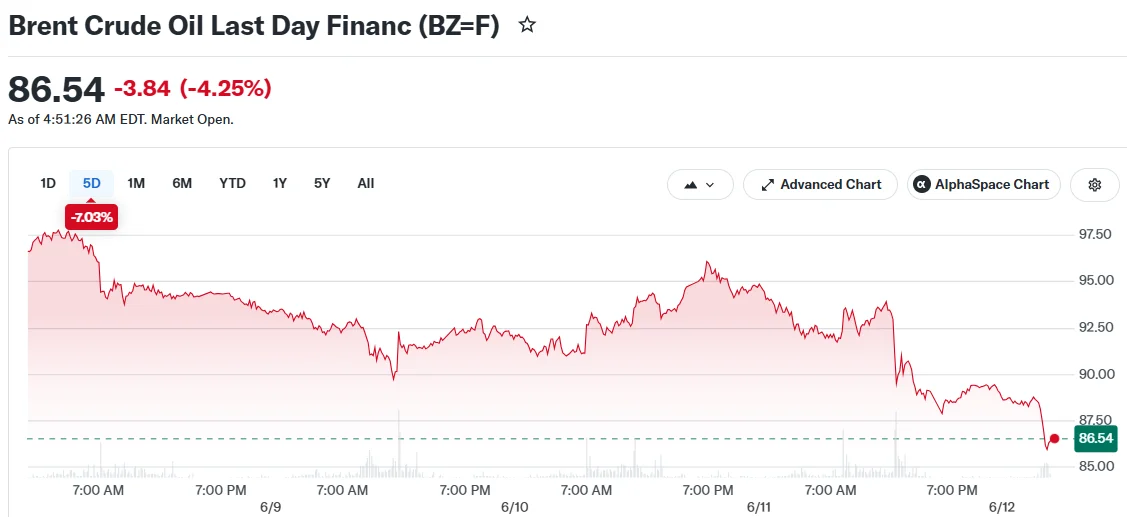 Brent Crude Oil Last Day Financ (BZ=F)
The market reaction followed reports from Iran’s semi-official Mehr News Agency indicating that a 14-point framework document had been negotiated between the two nations. According to the reports, the framework encompasses provisions for eliminating American petroleum sanctions against Iran.
The agency stated that Iranian authorities must still provide formal approval for the arrangement. Additional provisions reportedly include the withdrawal of American military forces from Iran’s vicinity and the restoration of access to the Strait of Hormuz within a 30-day timeframe.
What Trump Said
President Trump addressed journalists from the Oval Office, suggesting that a formal signing ceremony might take place as soon as this weekend in Europe. He confirmed that Vice President JD Vance would represent the administration if the agreement proceeds.
Trump further stated that Iran’s supreme leader had consented to a framework, while emphasizing that the arrangement remains incomplete. He suspended previously scheduled military strikes against Iran in light of the ongoing negotiations.
JUST IN: 
 Iranian state media confirms deal with the US and says it includes lifting sanctions, withdrawing US military from around Iran, and ending the naval blockade.
— BRICS News (@BRICSinfo) June 12, 2026
The President has previously suggested on multiple occasions that an Iranian agreement was imminent. However, none of those prior announcements materialized into a finalized accord.
Why the Strait of Hormuz Matters
The Strait of Hormuz represents one of the planet’s most strategically vital maritime corridors. Approximately 20% of global petroleum production transits through this narrow waterway.
Tehran had previously declared the strait off-limits to all maritime traffic following recent confrontations. This declaration contributed to upward pressure on energy prices during recent weeks.
Security concerns in the region persist. Fox News disclosed that American military forces neutralized two Iranian assault drones overnight that appeared to be approaching commercial shipping vessels.
Notwithstanding these security challenges, the volume of vessels departing the Strait of Hormuz has shown an uptick in recent weeks.
At 2335 GMT on June 11, front-month WTI crude oil futures were trading at $85.94 per barrel, representing a 2.0% decrease.
ANZ Research analysts observed that the diplomatic de-escalation has generated optimism regarding reduced disruption to regional petroleum supplies.
Haris Khurshid, a market analyst with Karobaar Capital LP in Chicago, suggested the market appears to be calculating that both parties face greater risks from failed negotiations than from reaching a compromise. He clarified this assessment doesn’t necessarily indicate an imminent agreement, but rather that markets no longer view collapse as the predominant probability.
The agreement remains unsigned. According to the White House, final provisions require completion over the coming days.
The post Crude Oil Prices Plunge on Reports of Imminent US-Iran Nuclear Agreement appeared first on Blockonomi.




 English (US) ·