
 1 month ago
27
1 month ago
27
Denmark’s biggest bank only recently started letting customers buy into Bitcoin and Ether — and that may explain a lot.
Banks, Tax Rules Kept Many Danes On The Sidelines
For years, Danish banks largely shut the door on crypto. Most refused to let customers purchase digital assets through their platforms and often warned against them as too risky. An uneven tax structure added another layer of friction. The result: a country where crypto never quite caught on the way it did elsewhere in Europe.
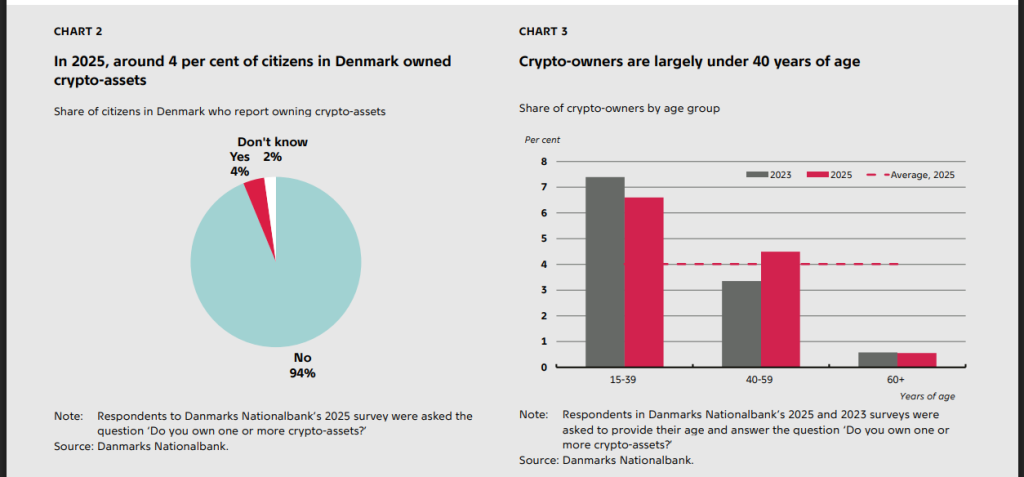
A new staff paper from Danmarks Nationalbank puts a number on it. Just 4% of Danish citizens currently hold cryptocurrency — a figure that hasn’t moved since 2023, even as ownership climbed across much of the continent.
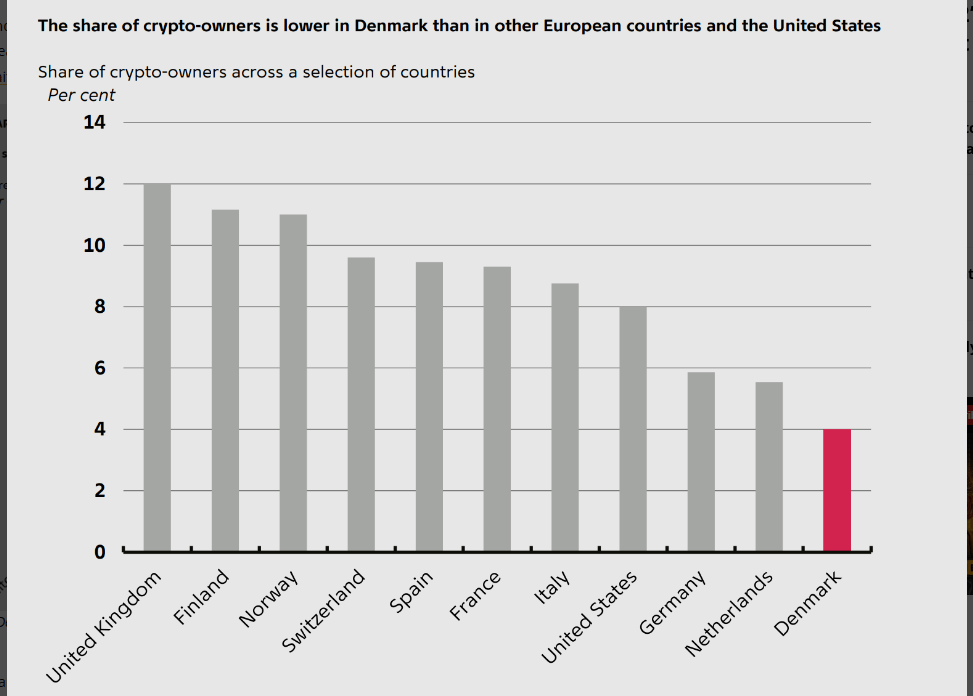
Norway, Finland, and the United Kingdom each report more than 10% of their populations holding crypto assets, according to the central bank’s findings. Denmark sits well below that range.
The survey behind the paper was conducted by Epinion between October and November 2025. It gathered responses from over 3,000 people aged 15 and above through Denmark’s Digital Post system. The sample was weighted to match national demographics.
Most Holders Keep Small Positions
Among those who do own crypto in Denmark, the amounts are mostly modest. The majority of holders reported positions below 10,000 Danish kroner — roughly $1,570. Total crypto holdings across the country are estimated somewhere between $317 million and $847 million.
Indirect exposure through crypto-linked stocks and exchange-traded products has grown since 2023 but remains thin, sitting at around $211 million, or about 0.4% of total equity holdings in the country.
Crypto is also rarely used to pay for anything. Data shows that most holders treat their digital assets purely as investments. Actual use in transactions — buying goods or services with crypto — stays uncommon.
Around 70-75% of holders keep their assets with crypto service providers rather than managing their own wallets. Only 20-30% use self-hosted storage.
Ownership also skews heavily toward younger, higher-income Danes. Participation drops sharply among people over 60.
There are signs that access is opening up. Earlier this year, Danske Bank — the country’s largest — began offering customers exposure to Bitcoin and Ether through exchange-traded products.
Officials at the bank said demand for crypto as part of broader investment portfolios has been growing, and that the European Union’s Markets in Crypto-Assets Regulation gave them enough of a regulatory footing to move forward.
Whether that translates into a higher ownership rate remains to be seen. For now, Denmark’s 4% holds — a number shaped less by public disinterest and more by the institutional environment that surrounded crypto for the better part of a decade.
Featured image from Lonely Planet, chart from TradingView






 English (US) ·