
 1 month ago
69
1 month ago
69
- Bitcoin and Ethereum have both fallen sharply this year, but Ethereum still offers staking income.
- Ethereum’s smart contract ecosystem remains much larger than rival Layer-1 networks.
- Upcoming upgrades could help Ethereum improve speed, fees, and scalability over time.
Bitcoin and Ethereum have both taken a heavy hit this year, with each crypto asset down around 40% as investors pull back from riskier markets. Higher rate fears, geopolitical tension, and broader macro pressure have all weighed on sentiment. Big public listings, including SpaceX, may have also pulled attention and capital away from crypto for a while.
Still, both assets remain important long-term players. Bitcoin continues to stand out as a hedge against aggressive monetary expansion, while Ethereum remains the leading blockchain for developers, apps, and tokenized assets. But right now, Ethereum may have the stronger case, especially for investors looking beyond simple price recovery.
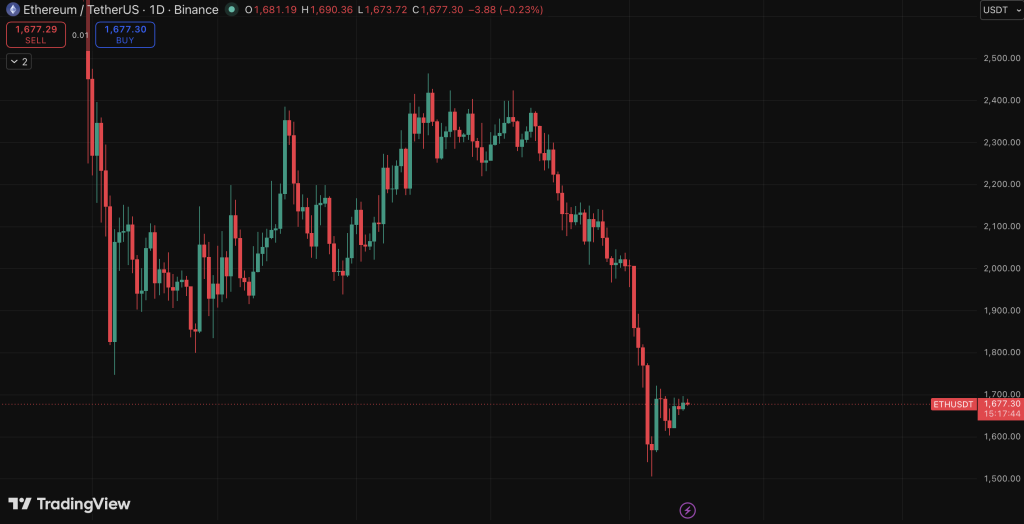
Ethereum Offers Staking Rewards
One of Ethereum’s clearest advantages is staking. ETH holders can lock up their tokens on the Ethereum network and earn rewards, with current yields generally sitting around 3% to 4%. That gives investors a way to generate income while waiting through market volatility, which is not a small thing in a rough market.
Bitcoin does not offer native staking. Holders can only wait for price appreciation, while Ethereum holders can earn rewards along the way. That difference matters, especially when the market is moving sideways or lower. It also explains why major corporate ETH holders, including Bitmine, have reportedly staked much of their Ethereum position.
Smart Contracts Keep Ethereum Ahead
Ethereum also has a much deeper smart contract ecosystem than Bitcoin. Bitcoin still operates as a proof-of-work blockchain focused mainly on scarcity and settlement, while Ethereum shifted to proof-of-stake in 2022. That change opened the door for staking, stronger energy efficiency, and a developer-heavy ecosystem built around decentralized applications.
By late 2025, Ethereum had nearly 32,000 active developers, putting it well ahead of rivals like Solana and Cardano. That developer lead matters because more builders usually means more apps, more tokenized assets, and more transaction activity.
When Ethereum activity rises, part of the ETH used for transaction fees gets burned. In simple terms, some supply disappears forever. So if network usage grows, Ethereum can benefit from both stronger demand and tighter supply, which gives ETH a very different value structure than many other crypto assets.
Ethereum Is Still Evolving
Ethereum’s biggest weakness has always been speed and cost. Solana and Cardano can process transactions more quickly at the base layer, which has forced Ethereum to keep improving. Instead of standing still, the network has leaned heavily into Layer-2 scaling solutions that process data off-chain and help reduce pressure on the main chain.
Ethereum developers are also working toward major upgrades known as The Verge, The Purge, and The Splurge. These upgrades are expected to improve scalability, reduce congestion, lower gas fees, and make the network more efficient over time.
That ongoing evolution gives Ethereum a growth angle Bitcoin does not really have. Bitcoin’s strength is that it rarely changes. Ethereum’s strength is that it keeps adapting. For investors who want a more active blockchain economy, that flexibility may be more attractive.
ETH May Have the Better Long-Term Setup
Bitcoin still has a powerful investment case. Its fixed supply, global recognition, and role as digital hard money are difficult to ignore. But Ethereum offers something different: staking rewards, smart contract demand, token burns, developer growth, and a roadmap built around continued improvement.
That does not make ETH risk-free, of course. It remains volatile, and competition from faster blockchains is real. But if decentralized apps, tokenized assets, and blockchain-based finance keep expanding, Ethereum may be positioned to capture more of that activity than Bitcoin.
For now, both Bitcoin and Ethereum remain core crypto assets. But if the question is which one looks more attractive today, Ethereum has the edge.
Disclaimer: BlockNews provides independent reporting on crypto, blockchain, and digital finance. All content is for informational purposes only and does not constitute financial advice. Readers should do their own research before making investment decisions. Some articles may use AI tools to assist in drafting, but every piece is reviewed and edited by our editorial team of experienced crypto writers and analysts before publication.





 English (US) ·