
 3 months ago
80
3 months ago
80
- Ethereum burn continues to outpace supply despite lower gas fees in 2026
- Validator yields remain competitive with traditional financial markets
- User activity and wallet growth across Layer 2 networks are still expanding
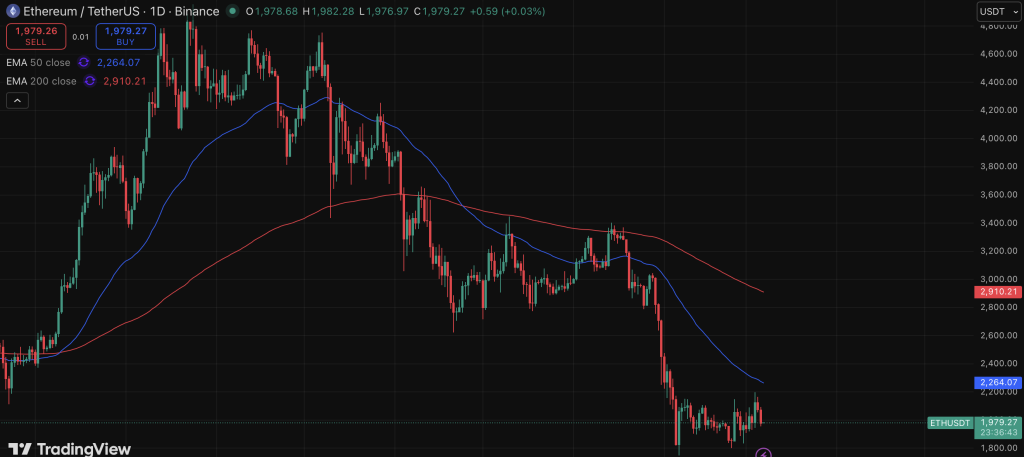
Ethereum’s latest network metrics are starting to push back against the recent wave of bearish commentary. A short report from Culper Research tried to raise concerns around fee compression, spam activity, and whether validators can remain profitable long term. But when you actually look at the on-chain numbers from early 2026, the picture doesn’t look nearly as fragile as the critics suggest.
In fact, Ethereum’s burn mechanism is still running strong. Data from February shows daily ETH burn reaching roughly $1.2 billion, comfortably outpacing the network’s 0.8% annual inflation rate. That means the protocol continues destroying more ETH than it creates, keeping the broader supply dynamic tilted toward deflation — something many investors were watching closely.
Ethereum Burn Rate Pushes Back Against Bearish Claims
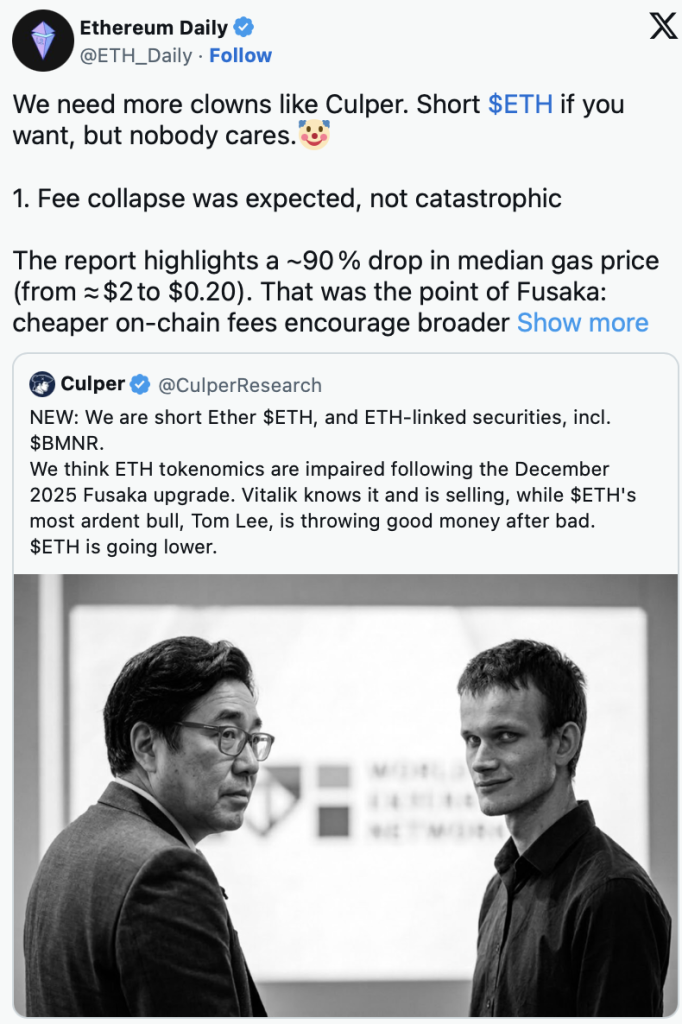
One of the main arguments in the Culper report focused on gas fees. Median gas prices dropped almost 90%, sliding from roughly $2 down to around $0.20 after the Fusaka upgrade rolled out. At first glance that kind of drop might sound alarming, but the context matters quite a bit.
Lower fees were actually the whole point of the upgrade. Fusaka was designed to reduce base-layer costs and push more activity toward Layer 2 networks like Optimism and Arbitrum. The drop in fees wasn’t a warning sign, it was more or less expected from day one.
Even with those lower per-transaction costs, total ETH burn held around $1.2 billion per day throughout February. That still exceeds Ethereum’s inflation rate, meaning the network remains effectively deflationary in real terms. Once you include burn data in the equation, the bearish tokenomics argument starts to lose a bit of weight.
Some voices in the crypto community didn’t hold back either. Ethereum Daily, a commentary account on X, responded bluntly to the Culper report, saying: “We need more clowns like Culper. Short $ETH if you want, but nobody cares.” The remark spread quickly online and sparked a fairly loud debate across crypto circles.
Lower Ethereum Fees Are Drawing More Users
Another thing worth noting is how lower fees are changing accessibility. Cheaper transactions make the network easier for everyday users to interact with, especially smaller retail participants who used to avoid Ethereum during periods of high congestion.
That accessibility can quietly fuel adoption over time. More wallets, more activity, more applications — all of it tends to increase the overall volume moving through the ecosystem. And interestingly enough, even if individual transaction fees are lower, higher activity can still drive strong burn totals across the network.
So the relationship between fees and burn isn’t always straightforward. Lower prices don’t automatically mean weaker economics.
Validator Returns Remain Competitive in 2026
Validator economics, another point raised in the Culper report, also appear relatively stable. Ethereum block rewards are still sitting around 2 ETH per block, and when MEV rewards are included the total validator APR has ranged between roughly 4% and 5% during March 2026.
That return sits slightly above the 10-year U.S. Treasury yield, which has been hovering near 4.2%. For many investors, that comparison matters. If staking returns remain competitive with traditional safe yields, participation usually stays healthy.
Right now about 19 million ETH is staked across the network, representing roughly 66% of the circulating supply. That figure is well above the 30% to 40% range typically viewed as sufficient for strong network security.
The staking withdrawal queue also hasn’t shown signs of stress. It has remained relatively stable near 3.2 million ETH for about six months, contradicting claims that a growing backlog of withdrawals is forming.
Network Activity Continues to Expand
Culper’s report also highlighted dust attacks, suggesting they represent around 22% of Ethereum transactions. But when analysts remove Layer 2 batch submissions from the calculation, spam transactions appear to make up closer to just 4% of actual activity.
Meanwhile, genuine user growth continues moving upward. Non-spam wallet creation increased about 12% year-over-year in the first quarter of 2026. Even more striking, active addresses jumped roughly 117% compared to the same period last year.
A lot of that growth is being driven by Layer 2 ecosystems. Networks like Optimism, Arbitrum, Base, and various zk-EVM implementations are bringing large waves of new users into the broader Ethereum environment.
BitMine’s Ethereum Holdings Also Come Into Focus
Another point in the Culper report involved BitMine (BMNR) and its Ethereum exposure. The firm currently holds around 4.47 million ETH, which places the value of its holdings somewhere near $9 billion based on current market prices.
Its staking operations alone generate an estimated $350 million in annual fees. And with more than $3 billion in cash equivalents sitting on the balance sheet, the company doesn’t appear to be under immediate financial pressure.
Taken together, the broader Ethereum data paints a somewhat different picture than the one critics tried to highlight. Fee compression exists, sure — but it was engineered into the system. Meanwhile burn rates, staking participation, and network growth still look fairly healthy.
So the bearish narrative… well, it may not be as airtight as it first sounded.
Disclaimer: BlockNews provides independent reporting on crypto, blockchain, and digital finance. All content is for informational purposes only and does not constitute financial advice. Readers should do their own research before making investment decisions. Some articles may use AI tools to assist in drafting, but every piece is reviewed and edited by our editorial team of experienced crypto writers and analysts before publication.




 English (US) ·