
 4 months ago
84
4 months ago
84
- Ethereum held above $2,100 after reports suggested progress toward a US-Iran cease-fire agreement.
- Thomas Lee said rising oil prices remain Ethereum’s biggest short-term macro headwind.
- ETH still faces strong technical resistance beneath key moving averages despite holding support.
Ethereum managed to stay above the important $2,100 support zone on Thursday after fresh reports suggested the United States and Iran may be moving closer toward a cease-fire agreement reportedly mediated by Pakistan. According to the circulating reports, the proposed deal includes a broader cease-fire arrangement alongside a joint monitoring mechanism covering activity in the Strait of Hormuz, one of the world’s most critical oil shipping routes.
The market reaction was immediate. Oil prices cooled sharply, with US crude reportedly sliding from above $100 back toward the $96 region, while the S&P 500 recovered into positive territory. For crypto markets, especially Ethereum, the shift in oil sentiment may end up becoming much more important than traders initially expected.
Thomas Lee Says Oil Prices Are Driving Ethereum’s Short-Term Struggles
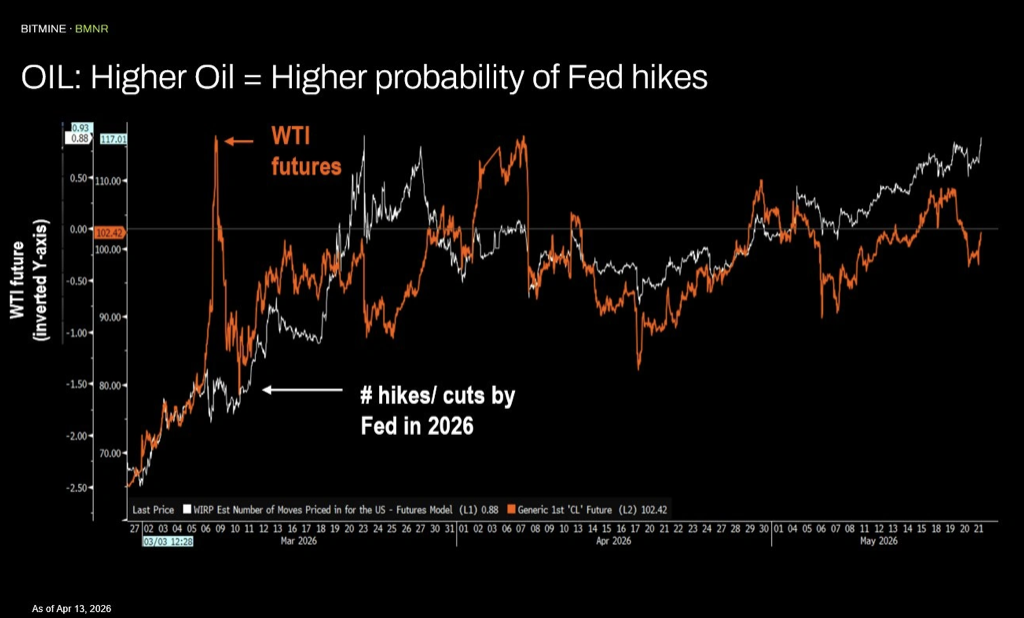
BitMine Immersion Chairman Thomas Lee argued that oil has effectively become one of the largest short-term forces influencing Ethereum price behavior right now. In a Thursday post on X, Lee explained that elevated oil prices increase inflation pressure, which then raises the probability of additional Federal Reserve tightening measures.
According to Lee, the relationship is becoming relatively straightforward for markets.
Higher oil prices increase inflation expectations. Higher inflation raises the chances of Fed rate hikes. And tighter monetary policy tends to reduce liquidity flowing into risk assets like crypto. In that environment, Ethereum and broader digital asset markets often struggle to maintain momentum.
Lee pointed directly toward the Federal Open Market Committee’s latest meeting minutes, where officials reiterated concerns about inflation remaining above the Fed’s 2% target. If energy prices remain elevated too long, the central bank could become more aggressive again.
That’s why oil suddenly matters so much to ETH traders.
In another post earlier this week, Lee described rising oil prices as Ethereum’s “biggest headwind” at the moment, noting that ETH’s correlation with crude oil recently climbed to unusually high levels. As oil rallied over the past several weeks, Ethereum steadily weakened underneath growing macro pressure.
Still, Lee also argued that the relationship may only represent temporary tactical noise rather than a long-term structural problem for Ethereum itself.
Long-Term Ethereum Outlook Still Supported by Tokenization and AI
Despite the near-term weakness, Lee maintained a broadly bullish longer-term view on Ethereum. He argued that structural drivers tied to tokenization and agentic AI systems could eventually support stronger ETH performance once macro conditions stabilize again.
That position has created some debate among market participants though, mainly because Lee previously described Ethereum as one of the stronger-performing assets during the early stages of the US-Iran conflict. Some traders now view the recent comments as a sentiment reversal, while others believe he’s simply separating short-term macro pressure from longer-term adoption trends.
Meanwhile, BitMine itself remains heavily exposed to Ethereum. The company currently holds roughly 5.278 million ETH, making it the largest known corporate Ethereum treasury after another round of acquisitions completed last week.
Ethereum Technical Structure Still Looks Fragile
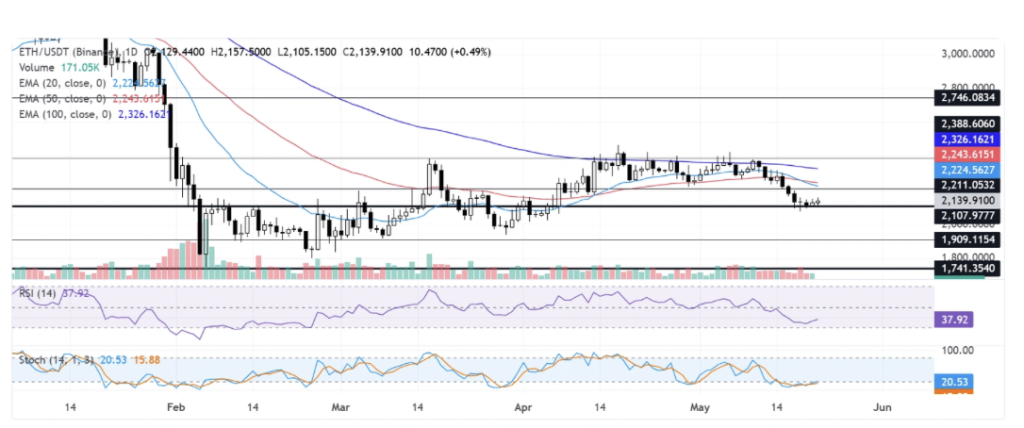
From a technical perspective, Ethereum continues showing signs of short-term weakness even while buyers defend support near $2,108. Coinglass data showed roughly $47.9 million in crypto liquidations across Ethereum positions over the past 24 hours, including around $24.2 million tied specifically to long liquidations.
On the daily chart, ETH still trades beneath its 20-day, 50-day, and 100-day Exponential Moving Averages, which currently cluster between approximately $2,225 and $2,326. That stacked EMA structure continues reinforcing bearish pressure overhead and suggests that recent rebounds remain corrective rather than full trend reversals for now.
Momentum indicators also lean cautious. Ethereum’s Relative Strength Index currently sits near 38, signaling lingering bearish control without reaching deeply oversold territory. Meanwhile, the Stochastic indicator around 21 reflects weak momentum conditions still dominating the market underneath the surface.
If ETH attempts another recovery push, the first resistance zone sits near $2,211, followed closely by the 20-day EMA near $2,225 and the 50-day EMA around $2,244. Beyond that, the 100-day EMA near $2,326 becomes the next major technical barrier before traders begin targeting the larger resistance region around $2,388.
On the downside, immediate support remains anchored near $2,108. If sellers break below that area convincingly, deeper downside targets near $1,909 and $1,741 may come back into focus fairly quickly. Additional broader support levels sit lower near $1,524 and $1,405 if macro conditions worsen again.
For now, Ethereum remains caught between improving geopolitical headlines and still-fragile technical momentum. Whether ETH stabilizes or resumes sliding may depend heavily on what happens next with oil prices and broader Federal Reserve expectations.
Disclaimer: BlockNews provides independent reporting on crypto, blockchain, and digital finance. All content is for informational purposes only and does not constitute financial advice. Readers should do their own research before making investment decisions. Some articles may use AI tools to assist in drafting, but every piece is reviewed and edited by our editorial team of experienced crypto writers and analysts before publication.







 English (US) ·