
 4 months ago
99
4 months ago
99
- Glassnode estimates over 6 million BTC may already be vulnerable under future quantum computing scenarios.
- Operational exposure caused by address reuse represents the largest category of potentially exposed Bitcoin.
- Developers are discussing quantum-resistant Bitcoin upgrades as global quantum research accelerates.
A new report from blockchain analytics firm Glassnode is putting fresh attention on one of Bitcoin’s biggest long-term security concerns — quantum computing. According to research released Wednesday, more than 6 million BTC, worth roughly $469 billion at current prices, may already be vulnerable if sufficiently powerful quantum computers eventually become operational.
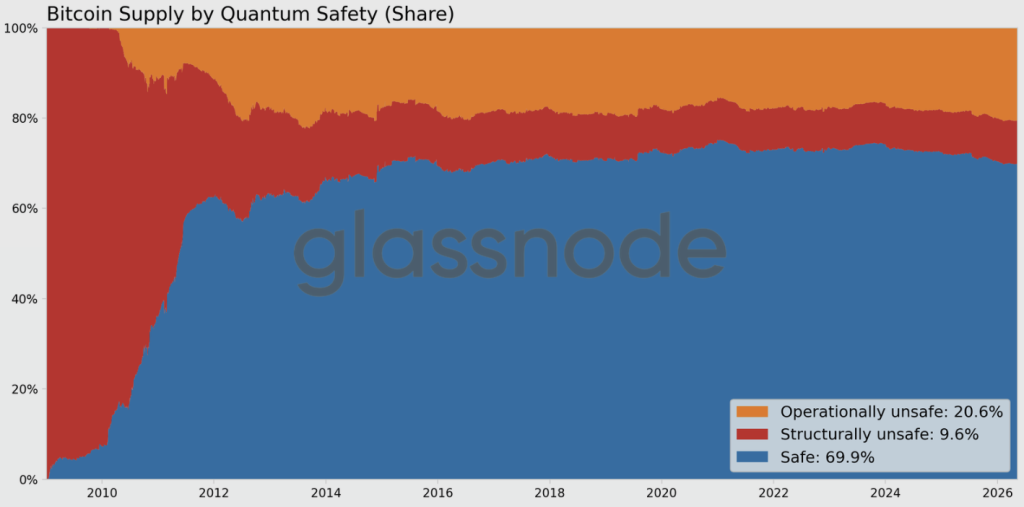
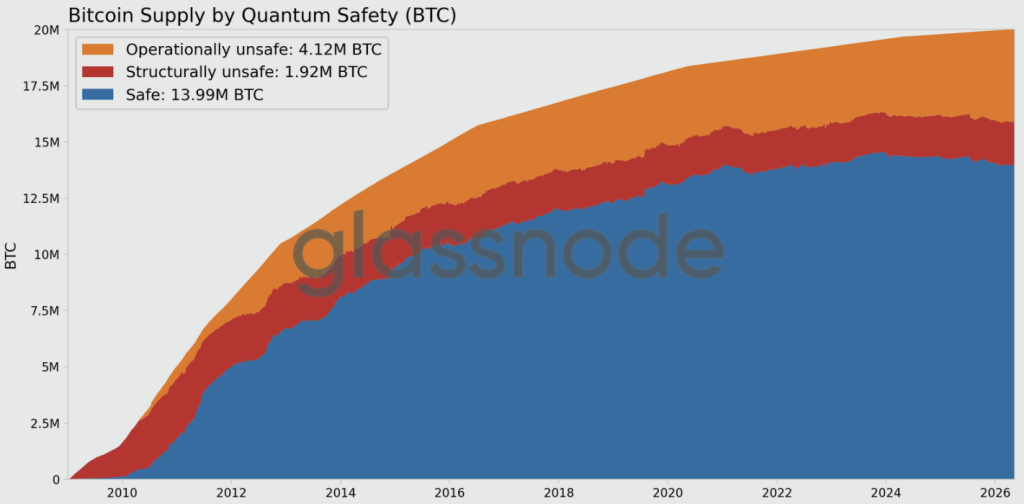
That figure represents around 30.2% of Bitcoin’s circulating supply. The remaining 13.99 million BTC, according to the report, currently shows no visible public-key exposure on-chain. While concerns around “Q-Day” — the moment quantum computers become strong enough to crack modern cryptography — still remain largely theoretical for now, the report suggests the groundwork for future vulnerabilities already exists quietly inside Bitcoin’s architecture.
Why Quantum Computers Could Become a Problem for Bitcoin
The issue revolves around how Bitcoin wallets are secured.
Every Bitcoin address relies on a private key paired with a public key. Under normal conditions, the private key remains secret while the public key only becomes visible on-chain under certain transaction conditions. The fear among researchers is that future quantum computers running Shor’s algorithm could theoretically reverse-engineer private keys directly from exposed public keys.
If that capability ever becomes practical, any Bitcoin address with a revealed public key could immediately become a target.
Glassnode’s report explains that exposure doesn’t affect all Bitcoin equally. Instead, vulnerable coins fall into two main categories: structural exposure and operational exposure.
Structural exposure accounts for roughly 1.92 million BTC, or about 9.6% of the circulating supply. These are coins stored in older script structures where public keys are revealed by design. That includes early “pay-to-public-key” wallets commonly associated with Satoshi Nakamoto-era mining, older multisignature wallet systems, and even certain newer Taproot outputs.
A large portion of those coins may never move again anyway. Lost wallets, abandoned holdings, and inaccessible early addresses could remain permanently frozen regardless of future upgrades.
Address Reuse Creates a Much Larger Risk Pool
The larger concern comes from what Glassnode describes as operational exposure. This category includes approximately 4.12 million BTC — around 20.6% of Bitcoin’s total issued supply.
Unlike structurally exposed wallets, these coins only became vulnerable because of address reuse.
Here’s the problem. When users repeatedly receive Bitcoin at the same address, eventually spending from that address reveals the associated public key on-chain. Once exposed, any remaining balance tied to that address theoretically becomes vulnerable under a future quantum attack scenario.
In other words, bad wallet hygiene may quietly create long-term security risks.
Crypto exchanges appear heavily represented inside this category. According to Glassnode, roughly 1.66 million BTC of operationally exposed supply belongs to exchange-related wallets, representing about 40% of all operationally unsafe Bitcoin currently identified.
Interestingly, exposure levels vary sharply between platforms.
Coinbase reportedly maintains relatively strong custody practices, with only around 5% of its labeled balances appearing exposed. Meanwhile, Binance and Bitfinex showed much higher exposure figures near 85% and 100% respectively based on publicly labeled wallet structures included in the analysis.
Glassnode emphasized though that the findings should not be interpreted as solvency concerns or immediate danger signals. The report focuses more on wallet architecture and custody design rather than imminent security failures.
Governments and Developers Begin Preparing for a Quantum Future
One interesting detail from the report involves sovereign Bitcoin holdings. According to Glassnode, countries like the United States, the United Kingdom, and El Salvador currently show zero measurable quantum exposure across publicly identified state-controlled holdings.
At the same time, Bitcoin developers are already debating how the network might eventually transition toward more quantum-resistant cryptographic standards if necessary.
One proposal currently being discussed, BIP-360, would introduce more quantum-resistant transaction formats to help reduce long-term exposure risks. Another controversial proposal suggests freezing older unmigrated coins after a specific deadline if users fail to upgrade to safer wallet formats.
That idea remains highly debated inside the Bitcoin community, especially because it could affect dormant wallets, lost coins, and early holdings tied to Bitcoin’s earliest participants.
Quantum Computing Race Continues Accelerating Globally
Importantly, Glassnode’s report stops far short of claiming quantum computers capable of breaking Bitcoin already exist. Instead, the research is framed more as a baseline measurement showing how much Bitcoin could theoretically become exposed if quantum breakthroughs eventually arrive.
Still, momentum around quantum development continues accelerating globally.
Some researchers now estimate that “Q-Day” could realistically arrive sometime between 2030 and 2032, though opinions vary widely depending on technological progress. Earlier this week, the United States government announced plans to invest more than $2 billion into quantum startups and semiconductor foundries aimed at strengthening domestic quantum research capabilities.
For now, Bitcoin itself remains secure under existing technology. But the report makes one thing increasingly clear — if quantum computing eventually reaches the required scale, the conversation around wallet security, address reuse, and cryptographic migration may become far more urgent than many investors currently realize.
Disclaimer: BlockNews provides independent reporting on crypto, blockchain, and digital finance. All content is for informational purposes only and does not constitute financial advice. Readers should do their own research before making investment decisions. Some articles may use AI tools to assist in drafting, but every piece is reviewed and edited by our editorial team of experienced crypto writers and analysts before publication.







 English (US) ·