
 1 hour ago
22
1 hour ago
22
TLDR
- Gold hovered around $4,271 per ounce, posting a weekly decline exceeding 2%.
- Crude oil prices remained elevated amid ongoing US-Iran tensions over the Strait of Hormuz.
- The 30-year Treasury yield surged near 5.5%, reaching levels unseen in more than twenty years.
- Market participants anticipate potential additional Federal Reserve rate increases following last week’s hike.
- Silver declined approximately 4% over the week, while platinum and palladium showed relative stability.
Precious metals faced headwinds on Friday, with gold positioned for its steepest weekly decline in more than three months. The yellow metal hovered near $4,271 per ounce, marking a weekly retreat of over 2% from the prior Friday’s closing levels.
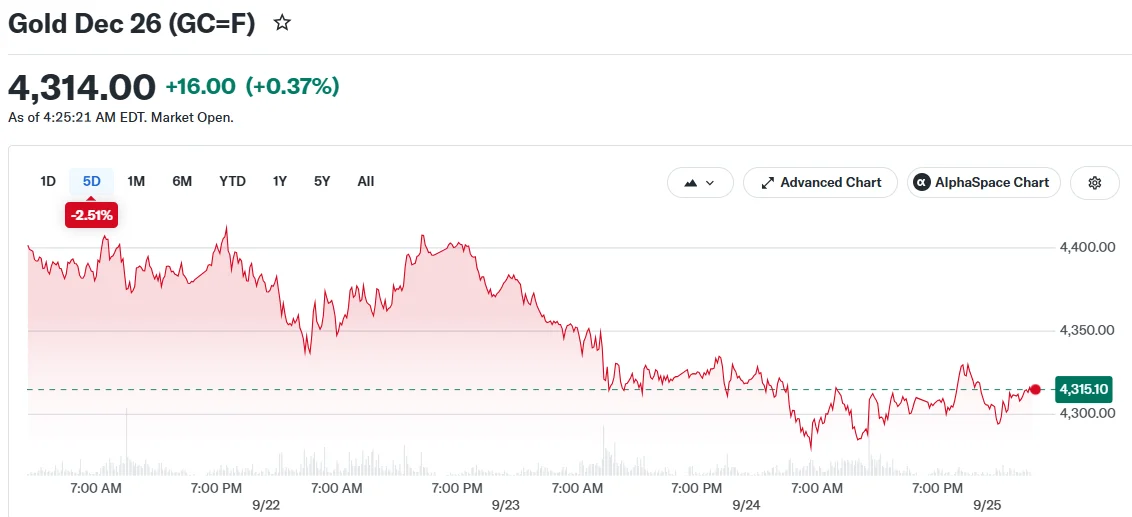 Gold Dec 26 (GC=F)
The decline unfolds against a backdrop of persistently elevated energy costs. Market participants are scrutinizing whether sustained commodity price pressures will compel the Federal Reserve to implement additional monetary tightening measures.
Crude oil markets stabilized on Friday following Thursday’s sharp rally. The energy surge resulted from persistent diplomatic gridlock between Washington and Tehran regarding access through the Strait of Hormuz.
Hormuz Crisis Sustains Energy Market Volatility
The Strait of Hormuz serves as a critical chokepoint for international petroleum transport. According to reports, diplomatic negotiators are pursuing a staged agreement framework.
The proposed arrangement would see Iran restore full passage through the strategic waterway. Simultaneously, Washington would dismantle its blockade affecting an Iranian maritime facility.

 BREAKING: Iran offers U.S. a 7-DAY plan to reopen the Strait of Hormuz and restart negotiations, per FT.
Iranian Foreign Minister Abbas Araghchi says Hormuz could be reopened by the end of the seventh day if certain conditions are met, with broader talks also set to resume.… pic.twitter.com/TcnmfVrcZY
— Coin Bureau (@coinbureau) September 25, 2026
Pending resolution of this diplomatic impasse, oil prices are anticipated to maintain elevated levels. This sustains upward pressure on consumer prices, a persistent challenge confronting monetary authorities.
Elevated energy expenditures can decelerate the disinflation process. This dynamic complicates the Federal Reserve’s assessment of when conditions might warrant policy normalization.
The central bank implemented its first rate increase in three years last week. Financial markets are now analyzing the likelihood of subsequent tightening actions.
Bond Market Selloff Pushes Yields to Generational Highs
Fixed-income markets experienced substantial selling pressure on Thursday. The liquidation followed renewed inflation anxieties connected to petroleum market developments.
Apprehensions regarding expanding federal obligations simultaneously pressured bond valuations. The benchmark 30-year Treasury yield approached 5.5%.
This represents the loftiest level for long-duration government debt in over two decades. Advancing yields generally enhance the relative attractiveness of interest-bearing securities versus gold.
Since gold generates no yield, the metal characteristically underperforms during periods of rising interest rates. This fundamental relationship has been a primary headwind for bullion valuations in recent trading sessions.
The US Dollar Index registered modest gains on Friday. The greenback had already advanced through five consecutive sessions.
Dollar appreciation can diminish gold’s purchasing power for international buyers settling transactions in alternative currencies. This mechanism creates supplementary downward price pressure.
Notwithstanding the recent retreat, certain market professionals characterize the pullback as transitory. One hedge fund executive highlighted structural factors continuing to underpin gold valuations.
Research teams at ANZ observed that investment appetite for gold has remained resilient. They emphasized the absence of significant liquidation despite the challenging macroeconomic environment.
This pattern indicates investors are maintaining their gold allocations rather than capitulating during price weakness. The metal’s immediate trajectory remains closely linked to developments in energy markets, interest rates, and Federal Reserve policy signals.
Complementary precious metals similarly registered weekly losses. Silver contracted roughly 4% over the period, settling around $63.68 per ounce.
Platinum and palladium valuations remained relatively unchanged on Friday. These metals have demonstrated less volatility compared to the pronounced movements observed in gold and silver.
During Friday morning transactions in Singapore, spot gold stood at $4,271.54 per ounce, down 0.1% intraday. Gold futures contracts, conversely, advanced 0.3% to $4,309.72, illustrating divergent pricing dynamics across different gold market segments as the weekend approached.
The post Gold Tumbles Toward Weekly Loss as Iran Crisis Intensifies Rate Hike Speculation appeared first on Blockonomi.





 English (US) ·