
 5 months ago
82
5 months ago
82
- Google warns quantum attacks could break encryption by 2029
- Crypto wallets exposed through vulnerable digital signatures
- “Store now, decrypt later” raises long-term security concerns
For years, quantum computing felt like a distant problem, something for the 2040s, maybe later. Now that timeline is shrinking fast. Google is signaling that machines capable of breaking today’s encryption could arrive before 2030, and that changes the conversation entirely. Crypto doesn’t rely on trust, it relies on math. And that math is exactly what quantum systems are built to challenge.
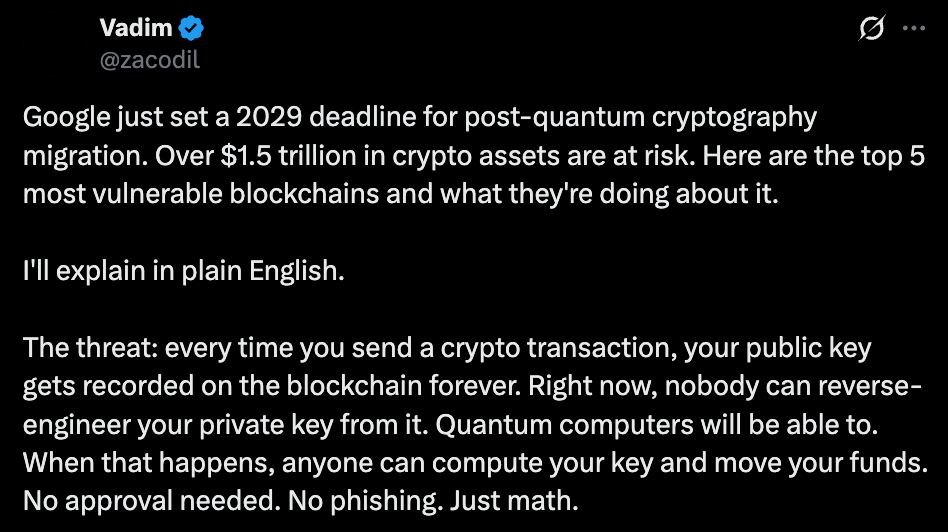
The shift isn’t immediate, but it’s no longer abstract either. What used to be theoretical is now entering a timeframe that developers and users actually need to think about, maybe sooner than expected.
Why Crypto Wallets Are Directly at Risk
Crypto wallets depend on cryptographic signatures to prove ownership. That system works because it’s practically impossible, with today’s computers, to derive a private key from a public one. Quantum computing changes that assumption.
If those protections break, control over funds breaks with it. Once a private key is exposed, assets can be moved instantly, with no reversal. Some researchers have already pointed out that wallets with exposed public keys, especially those used frequently, could become early targets.
The “Store Now, Decrypt Later” Problem
What makes this more unsettling is that the threat doesn’t start when quantum computers arrive. It may have already started. The concept is simple, collect encrypted data today, and wait until the technology exists to break it later.
That means transaction histories, wallet interactions, and even identity-linked data could already be sitting somewhere, stored and waiting. It’s not about immediate loss, it’s about delayed vulnerability.
The Timeline Is Getting Tighter
The idea of “Q-Day,” the point where quantum machines can break current encryption, used to feel distant. Now it’s being discussed within a few years. That doesn’t mean crypto breaks overnight, but it does mean the window to prepare is smaller than many expected.

And preparation in crypto isn’t trivial. Upgrading cryptographic standards across networks, wallets, and infrastructure takes time, coordination, and consensus.
Can Crypto Adapt in Time?
The good news is that solutions are being explored. Quantum-resistant cryptography already exists in early forms, and discussions around upgrading blockchain security have been ongoing. But moving from theory to implementation is a different challenge entirely.
Crypto has adapted before, but usually under less pressure. This time, the clock feels more real.
A Race Between Innovation and Risk
This isn’t about panic, at least not yet. It’s about recognizing that the timeline has shifted. Quantum computing isn’t just a distant possibility anymore, it’s a countdown.
Crypto will likely evolve to handle it, but the real question is speed. Whether the ecosystem can upgrade fast enough before the threat becomes practical. And right now, that answer isn’t fully clear.
Disclaimer: BlockNews provides independent reporting on crypto, blockchain, and digital finance. All content is for informational purposes only and does not constitute financial advice. Readers should do their own research before making investment decisions. Some articles may use AI tools to assist in drafting, but every piece is reviewed and edited by our editorial team of experienced crypto writers and analysts before publication.








 English (US) ·