
 3 months ago
71
3 months ago
71
- Hyperliquid continues to show stronger momentum, with RSI holding above 60 despite weeks of consolidation.
- Solana remains above key support levels but is still struggling to recover from its recent correction.
- Current market structure suggests HYPE has a clearer path toward $80 than SOL in the short term.
Hyperliquid’s price has become one of the most talked-about stories in crypto lately. While much of the market struggled to gain traction, HYPE managed to break away from the pack and climb to a fresh all-time high. Solana, on the other hand, has faced a tougher road. After getting rejected near the $100 mark, SOL has been unable to reclaim the important $75 resistance level, although it continues to defend support around $60. Both assets enjoyed impressive rallies, but neither has been able to break through their latest resistance barriers, leaving traders watching closely to see which token gets to $80 first.
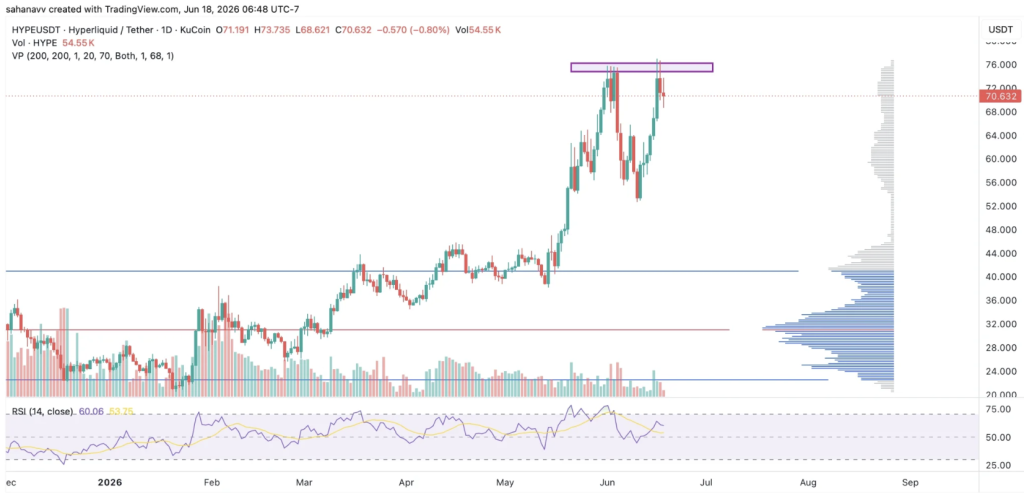
Hyperliquid Maintains the Momentum Edge
The technical picture continues to favor Hyperliquid. Even after spending several weeks moving sideways, HYPE’s daily Relative Strength Index remains comfortably above 60. That’s often a sign that bullish momentum is still present beneath the surface, even if price action appears quiet for the moment. Repeated attempts to challenge the $75 to $76 resistance zone also hint that buyers are steadily absorbing selling pressure near the highs rather than backing away.
Solana presents a noticeably different setup. While the token has recovered from oversold conditions following its sharp correction in June, its RSI remains below 50. That suggests momentum is still relatively weak compared to Hyperliquid’s recent performance. Although SOL has reclaimed support above $67 and avoided deeper losses, it has yet to display the kind of sustained strength that pushed HYPE toward record levels. For now, traders seem more confident in Hyperliquid’s trend.
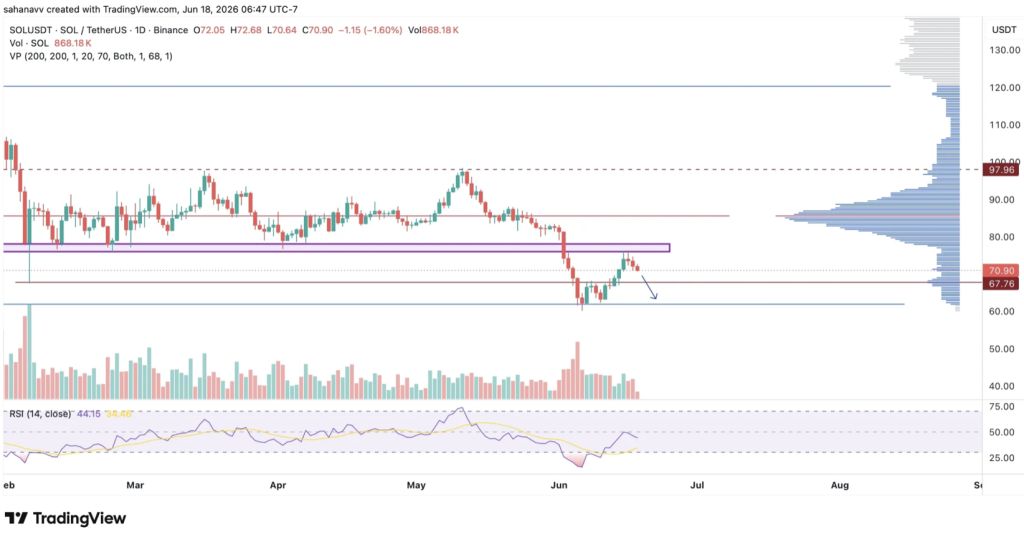
Key Price Levels Could Decide the Next Move
For Hyperliquid, the biggest hurdle remains the $75 to $76 range. A clean breakout above that zone could quickly place the $80 target within reach and potentially trigger another leg higher. If momentum continues to build, the token may even challenge new highs beyond that level. On the downside, the $67 to $68 area remains critical support, and maintaining that range will be important for preserving the current bullish structure.
Solana faces a more complicated challenge. Before even thinking about $80, bulls need to reclaim the $77 to $79 supply zone that has repeatedly capped upside attempts. Beyond that sits another significant resistance cluster around $87, creating multiple obstacles for buyers to overcome. If SOL cannot break through those levels, the token could easily drift back toward the $63 to $65 support region for another test.
Which Crypto Has the Better Chance of Hitting $80?
Looking strictly at the current chart structure, Hyperliquid appears to have the advantage. The token remains locked in a stronger uptrend, trades much closer to its breakout zone, and continues to display healthier momentum readings than Solana. It simply requires a smaller move to reach the $80 milestone, which naturally improves its odds.
That doesn’t mean Solana should be counted out. The network remains one of the strongest ecosystems in crypto and has proven its ability to stage powerful recoveries when sentiment improves. Still, from a short-term trading perspective, HYPE currently looks better positioned. Unless SOL can quickly reclaim lost resistance levels and rebuild momentum, Hyperliquid seems more likely to win the race to $80.
Disclaimer: BlockNews provides independent reporting on crypto, blockchain, and digital finance. All content is for informational purposes only and does not constitute financial advice. Readers should do their own research before making investment decisions. Some articles may use AI tools to assist in drafting, but every piece is reviewed and edited by our editorial team of experienced crypto writers and analysts before publication.







 English (US) ·