
 2 hours ago
28
2 hours ago
28
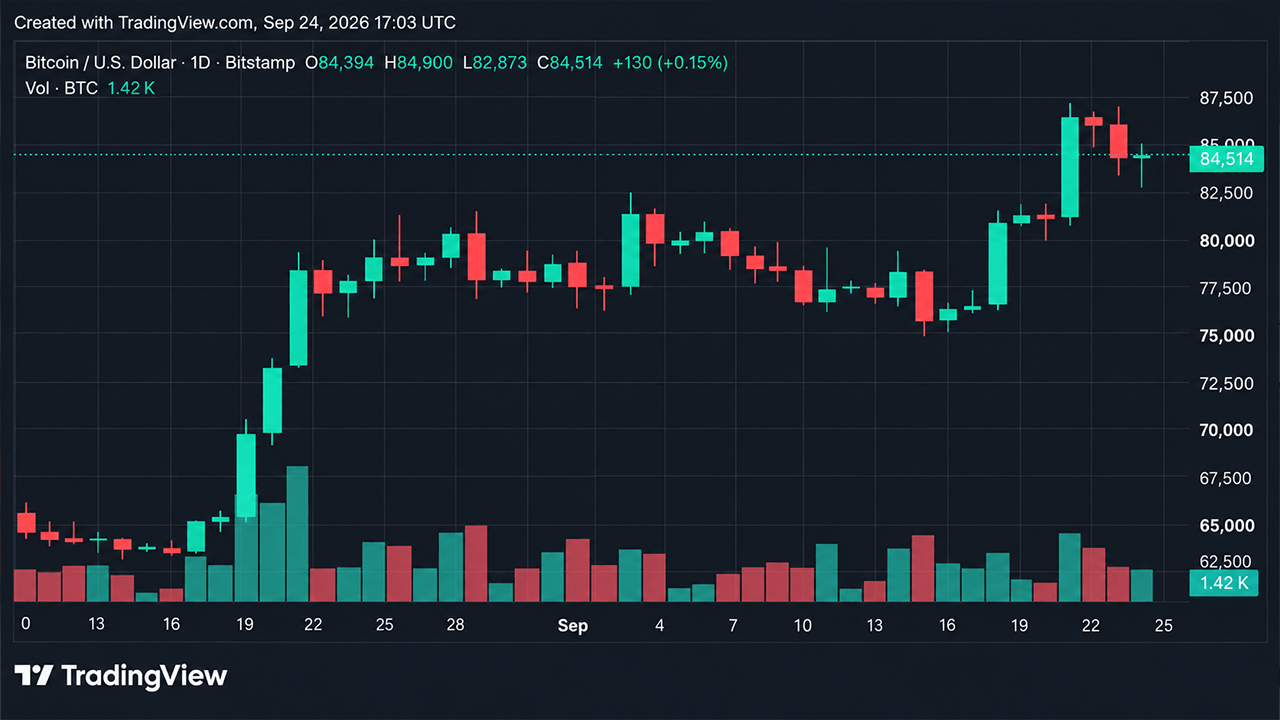
Bitcoin’s recent move above JPMorgan’s estimated average production cost of about $85,000 is relevant less as a standalone price signal than as a possible change in miners’ funding pressure. JPMorgan’s view is conditional: if Bitcoin remains above that level for long enough, miners may face less need to sell newly mined or treasury-held BTC. The estimate is a soft threshold, not an unbreakable market floor.
Bitcoin was around $84,187 when checked on September 25, slightly below the threshold after recently moving above it. A brief move above an average production-cost estimate does not automatically eliminate miner selling pressure or make every operation economical, since miner economics vary substantially by operator.
The practical question is therefore whether realised revenue stays high enough, for long enough, to affect equipment and financing decisions and the amount of BTC miners must sell to meet operating obligations.
The $85,000 threshold is a soft floor
JPMorgan described production cost as a “soft floor”, rather than a hard price floor. That framing is important. Mining does not stop across the network the instant BTC falls below an estimated average cost, nor do miners automatically become cash-generative the instant it rises back above one.
Instead, sustained sub-cost pricing tends to concentrate stress among operators with less efficient fleets, higher electricity costs, weaker access to capital or lower cash reserves. Those companies may sell Bitcoin to finance operations, turn off machines, or leave the market. The resulting reduction in network capacity can eventually lower competition for the remaining miners, but that adjustment is neither immediate nor uniform.
JPMorgan’s estimate therefore provides a useful sector-level reference point. It describes the broad economics confronting mining operators, not the exact break-even price for each business or each piece of hardware. Nor does it establish that BTC must trade at that price: market prices can remain below estimated production costs while miners absorb losses, use cash, sell inventory or reduce capacity.
A sustained recovery above the benchmark could ease those choices at the margin. It could mean fewer BTC sales by miners that had been using holdings as a source of liquidity, particularly if their operating costs are close to the sector average. But the word “sustained” carries most of the analytical weight. At $84,187 on September 25, Bitcoin remained just under the estimate that JPMorgan had identified as the relevant pressure point.
A 280-day sub-cost stretch has already driven capacity out
JPMorgan’s comparison is stark: Bitcoin prices had spent roughly 280 days below production cost, against about 224 days during the 2018 bear market.
The bank also cited a roughly 19% fall in hash rate from its October peak and a roughly 15% decline in mining difficulty. In its reading, some uneconomic capacity had already left the network.
Those figures describe a network that has begun to adjust before any sustained move above the roughly $85,000 production-cost estimate. When high-cost miners sell Bitcoin, shut equipment, or exit, lower capacity can reduce the computational burden for the operators still active and improve their marginal economics.
That is why the estimate functions as a soft floor rather than a hard stop. A recovery above it would arrive after an extended shakeout; lower hash rate can show both the discipline of the survivors and the extent of the capacity loss that preceded them.
Public-miner costs are not one number
CoinShares put publicly listed miners’ weighted-average cash cost at approximately $79,995 per BTC in the fourth quarter of 2025, close to JPMorgan’s $85,000 estimate. That makes JPMorgan’s figure a plausible broad sector benchmark for a sizeable share of listed mining capacity.
Costs vary widely by measure and operator. Riot Platforms reported a first-quarter 2026 cash cost excluding depreciation of $44,629 per BTC, while CoinShares estimated fourth-quarter 2025 all-in costs of $153,040 for MARA and $170,366 for Riot. Riot’s measure excludes depreciation, CoinShares’ figures are all-in estimates, and the reporting periods differ. The variation shows why an industry-wide production-cost estimate is not a company-specific profitability measure.
Miners’ cost structures and financial positions differ, so the data do not support treating every public miner as equally compelled to sell below $85,000 or equally relieved from selling above it. If Bitcoin remains above JPMorgan’s estimated average production cost, selling pressure may ease for miners closest to that margin, but sector-wide BTC sales would not necessarily cease and miners would not necessarily make identical treasury decisions.
Treasury depletion and AI revenue reshape the selling question
Mining economics are only part of the immediate selling calculation. CoinShares said publicly listed miners collectively reduced their BTC treasuries by more than 15,000 BTC from peak levels. It also estimated that roughly 15% to 20% of the global mining fleet was unprofitable at the reported hash price, according to its first-quarter 2026 mining report.
That combination limits the case for declaring a quick end to miner-related supply pressure. Treasury sales already made cannot be reversed by a modest price rebound, and the unprofitable portion of the fleet points to continuing strain somewhere in the network. A miner that has drawn down holdings during a 280-day sub-cost period may still prioritise liquidity even if spot BTC temporarily moves above an average cost estimate.
The sector’s move toward artificial intelligence and high-performance computing introduces a second complication. JPMorgan said miners are redirecting capacity toward AI revenue. In one direction, that can slow Bitcoin hash-rate growth because resources that might have supported mining are allocated elsewhere.
In the other direction, diversified revenue can reduce reliance on selling BTC to fund operations. For companies able to make that shift, the link between Bitcoin’s price and required treasury sales may become less direct, although the effect will depend on each operator’s exposure to those businesses and cannot be assumed across the sector.
JPMorgan’s $85,000 level is consequently best viewed as a conditional relief point after a lengthy industry adjustment. It identifies where aggregate economics may become less punitive. The extent to which that becomes lower BTC selling will be decided by uneven costs, the state of miners’ remaining treasuries and whether non-mining revenue is sufficiently material to change their cash needs.
Disclaimer: This article is provided for informational purposes only. It is not offered or intended to be used as legal, tax, investment, financial, or other advice.








 English (US) ·