
 1 hour ago
9
1 hour ago
9
Key Takeaways
- Nestlé shares have plummeted approximately 41% from their early 2022 peaks, erasing around $177 billion in shareholder value during an extended downturn.
- CEO Philipp Navratil is implementing a sweeping restructuring that includes eliminating 16,000 positions while concentrating on high-growth categories including coffee, pet nutrition, snacks, and wellness products — with organic growth projections of 3%–4% for 2025.
- Q1 2026 real internal growth (RIG) climbed 1.2% compared to the prior year, triggering a 5.9% single-day stock rally — the strongest performance since October 2025.
- The company successfully negotiated with Spanish labor unions to decrease workforce reductions by 20%, lowering cuts from 301 to no more than 242 employees.
- Activist pressure is mounting for Nestlé to divest its approximately $47 billion L’Oréal stake for share repurchases, while appetite-suppressing medications and international trade tensions pose ongoing challenges.
Nestlé (NESN) has suffered a devastating decline of roughly 41% since the beginning of 2022, eliminating approximately $177 billion in market capitalization. The Switzerland-based consumer goods conglomerate has cycled through three chief executives in barely more than a year while grappling with failed expansion attempts and consistently underwhelming revenue performance.
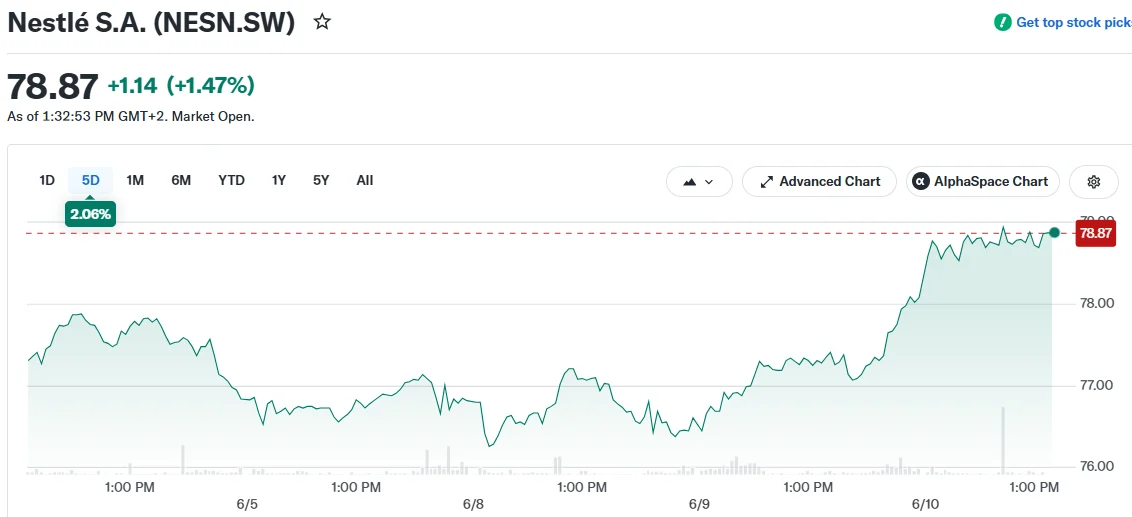 Nestlé S.A. (NESN.SW)
Philipp Navratil, who assumed the CEO position in September 2025, now shoulders the responsibility for reversing the company’s fortunes. His approach has been notably aggressive.
Navratil has unveiled a plan to eliminate 16,000 positions worldwide — representing approximately 6% of the total employee base — with expectations that this restructuring will generate roughly CHF3 billion ($3.8 billion) in cost savings by 2027. The workforce reduction initiative has already commenced throughout European operations.
This week in Spain, Nestlé successfully negotiated with labor representatives to reduce the scope of planned layoffs to a ceiling of 242 roles, down from the originally proposed 301. This represents a 20% decrease. The negotiated agreement encompasses severance packages, a job placement program for displaced workers, and opportunities for internal transfers.
The reductions affect numerous Nestlé facilities across Spain, including the Girona production site — which stands as the company’s most extensive instant coffee manufacturing operation in Europe and ranks third globally.
Signs of Operational Improvement
Beyond workforce reductions, Navratil is streamlining the product portfolio. He’s divesting underperforming segments such as San Pellegrino and certain Häagen-Dazs operations, while intensifying investment in coffee, pet nutrition, snack foods, and health-focused products.
His primary performance indicator is RIG — real internal growth — which tracks actual volume increases rather than revenue generated through price hikes. During the first quarter of 2026, RIG increased 1.2% year-over-year throughout most business units. The announcement propelled shares up 5.9% in a single trading session, marking the strongest daily performance since October 2025.
Shares currently trade at approximately 18 times projected earnings, significantly below the five-year historical average of 23 times.
Navratil’s first acquisition transaction was unveiled earlier this month: a complete takeover of ready-to-drink nutrition company yfood Labs, which generated approximately €150 million in revenue during 2025 while maintaining double-digit expansion rates.
Critical Challenges on the Horizon
The recovery narrative faces several obstacles.
Nestlé maintains approximately a 20% ownership position in L’Oréal, currently valued at just below $47 billion. Certain shareholders, including Barron’s Roundtable member Christopher Rossbach from J. Stern, are advocating for liquidating this stake to fund share buyback programs. CFO Anna Manz has resisted this proposal, characterizing the investment as “a very high-performing investment.”
GLP-1 weight-management pharmaceuticals present another challenge, as patients using these medications typically reduce overall food consumption. Navratil has countered by emphasizing that Nestlé provides nutritional solutions, not merely caloric products.
Geopolitical instability represents an additional risk factor. Continuing conflicts surrounding the Strait of Hormuz could escalate commodity prices, constraining Nestlé’s pricing flexibility — the identical challenge that eroded market position in 2022 and 2023 when the company implemented price increases of 8.2% and 7.5%, respectively.
Nestlé has established organic growth objectives of 3% to 4% for the current year. Analysts view this target as ambitious. Annual free cash flow is projected to expand to CHF12.9 billion by 2030, compared to CHF9.2 billion currently.
The company has maintained an uninterrupted dividend growth streak since 1996. The most recent distribution was CHF3.10 per share, representing a yield of 3.94%.
The post Nestlé (NESN) Stock Surges 6% as CEO Navratil’s Turnaround Strategy Shows Early Progress appeared first on Blockonomi.



 English (US) ·