
 10 minutes ago
4
10 minutes ago
4
Nvidia announced it will work with major manufacturers to build lightweight laptops powered by its new AI-focused system-on-chips, marking the first time Nvidia has designed full system-on-chip silicon purpose-built for portable computers.
The move takes Nvidia from its traditional role as a discrete GPU supplier into territory long controlled by Intel, AMD, and Qualcomm. The goal: laptops that can run AI agents locally, without needing to phone home to the cloud.
What Nvidia is actually building
The new laptop chips belong to Nvidia’s N1 and N1X series, both built on Arm architecture. The flagship N1X packs 6,144 CUDA cores and up to 20 Arm CPU cores into a single chip.
The N1X targets up to 1,000 TOPS of AI performance, enough to run multi-agent AI systems right on your laptop without any cloud connection.
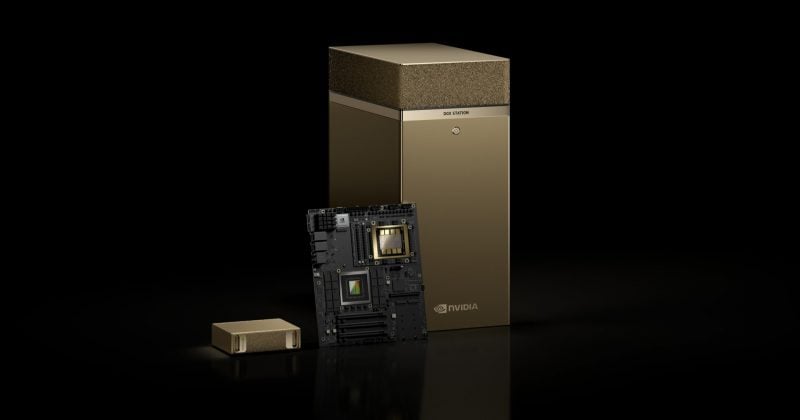
The chip shares its silicon DNA with the GB10 Grace Blackwell Superchip found in Nvidia’s DGX Spark desktop system. That desktop unit delivers 1 petaFLOP of FP4 AI performance and comes loaded with 128GB of unified LPDDR5X memory, enough to run AI models with up to 200 billion parameters. The DGX Spark is set to ship in mid-October 2025.
Dell, Lenovo, and Microsoft Surface are all lined up as launch partners for N1X laptops, with devices anticipated around late May or early June 2026, timed to coincide with Computex 2026.
Why local AI agents matter
These machines are designed to run local, persistent AI agents using frameworks like NemoClaw and OpenClaw. These agents would operate continuously on-device, handling tasks autonomously without streaming data to remote servers.
The unified memory architecture is critical here. By sharing a single pool of LPDDR5X memory between CPU and GPU cores, the N1X eliminates the bottleneck that traditionally forces data to shuttle between separate memory banks. For developers building AI applications, this means the full CUDA software stack runs natively on a laptop.
What this means for investors
Qualcomm recently entered the laptop market with its Snapdragon X Elite chips for Windows machines. Nvidia is now arriving with deep GPU expertise married to a mature AI software ecosystem.
The broader PC industry has been trying to sell consumers on “AI PCs” for over a year, mostly by adding neural processing units onto existing chip designs. Nvidia is betting that consumers and enterprises will pay a premium for laptops that can run sophisticated, multi-agent AI workflows locally.
Nvidia has never shipped a laptop SoC at scale. Battery life optimization, thermal management in thin chassis, and OEM relationship management at the consumer level are all skills the company will need to prove it has mastered by the time these devices hit shelves in 2026.
Disclosure: This article was edited by Editorial Team. For more information on how we create and review content, see our Editorial Policy.








 English (US) ·