
 2 months ago
84
2 months ago
84
Key Takeaways
- Brent crude jumped 4% to reach $97.87 per barrel, marking its strongest performance since the beginning of June
- Iranian authorities announced a total shutdown of the Strait of Hormuz following an oil tanker explosion
- Houthi forces launched attacks on two Saudi Arabian oil tankers navigating through the Bab el-Mandeb strait in the Red Sea
- American military forces conducted their twelfth consecutive night of operations targeting Iranian positions
- Goldman Sachs analysts forecast sustained elevated oil prices throughout the summer months of July and August
Global oil markets extended their winning streak to five consecutive sessions on Thursday, with Brent crude advancing 4% to settle at $97.87 per barrel—the highest valuation recorded since June 3. Meanwhile, U.S. West Texas Intermediate crude increased 3.2% to reach $89.63 per barrel.
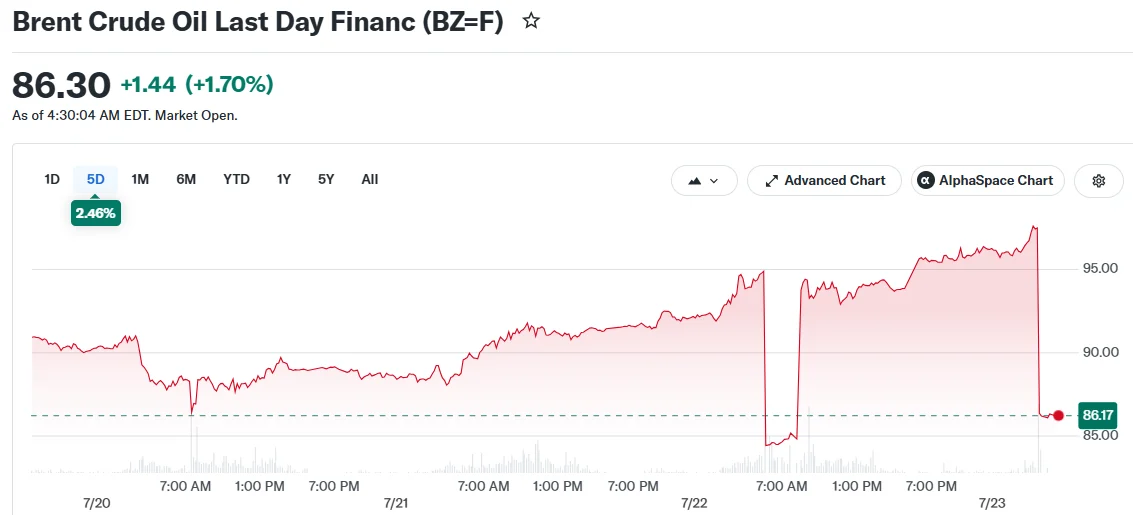 Brent Crude Oil Last Day Financ (BZ=F)
The significant price movement stemmed from renewed concerns regarding potential supply interruptions at two strategically vital global oil transportation corridors.
According to Iran’s Revolutionary Guards, an oil tanker experienced a fire following an explosion on a mined route situated south of the Strait of Hormuz, in proximity to Oman’s coastline. Two additional tankers reversed their course. Subsequently, Iranian officials announced the complete closure of the strait, issuing warnings that no tanker would receive passage authorization without advance coordination with Iranian maritime authorities.
Red Sea Operations Intensify Under Houthi Campaign
During the same timeframe, Houthi militants with ties to Iran announced successful strikes against two Saudi Arabian oil tankers—identified as ENCELA and LAYLIA—operating in Red Sea waters. The militant organization justified the attacks by claiming the vessels had breached a newly established maritime blockade designed to target Saudi-affiliated shipping operations.
Saudi officials have yet to provide verification of any vessel damage. However, these strikes represent a significant escalation in a regional confrontation now simultaneously threatening both the Strait of Hormuz and the Bab el-Mandeb strait.
Combined, these critical maritime passages facilitate a substantial portion of global seaborne crude oil transport. The Bab el-Mandeb strait serves as the connection between the Red Sea and the Gulf of Aden. Goldman Sachs analysts noted that oil transportation through this passage has maintained an average of nearly 9 million barrels daily over the previous month, with approximately 4 million barrels per day representing volumes that would prove extremely difficult to redirect should both strategic passages face simultaneous blockades.
Multiple Saudi crude tankers destined for Indian and Chinese markets had already modified their planned routes earlier in the week in response to Houthi maritime warnings.
American Military Operations Against Iran Continue
The United States military confirmed completion of its twelfth consecutive overnight strike operation targeting Iranian facilities. President Donald Trump had previously pledged to destroy Iranian infrastructure—including bridges and power generation facilities—each time Iran conducts hostile actions against vessels transiting the Strait of Hormuz.
Ahmad Assiri, research strategist at Pepperstone, observed that market participants are now factoring in “a concerning likelihood of supply disruptions at a second critical chokepoint,” maintaining bullish momentum for near-term crude oil pricing.
Goldman Sachs forecasts that crude oil will maintain the majority of its recent price appreciation through the July and August period. The financial institution cited diminishing worldwide inventory levels, reduced Middle Eastern production capacity, heightened summer travel season demand, and a deceleration in strategic petroleum reserve releases.
However, one contrasting data element emerged. The U.S. Energy Information Administration released figures showing an unexpected increase in commercial crude stockpiles of 2 million barrels during the week concluded on July 17, elevating total reserves to 411.7 million barrels. Both gasoline and distillate inventories similarly registered increases.
Notwithstanding the inventory accumulation, market participants maintained their attention on transportation vulnerabilities, escalating maritime insurance premiums, and the ongoing threat of additional assaults on tanker vessels or energy sector infrastructure.
The post Oil Markets Surge as Iran Closes Strait of Hormuz Amid Regional Tensions appeared first on Blockonomi.





 English (US) ·