
 2 months ago
48
2 months ago
48
- Attackers minted up to 1 billion DOT via Hyperbridge exploit
- Tokens were dumped on Ethereum within an hour
- Native Polkadot chain was not directly affected
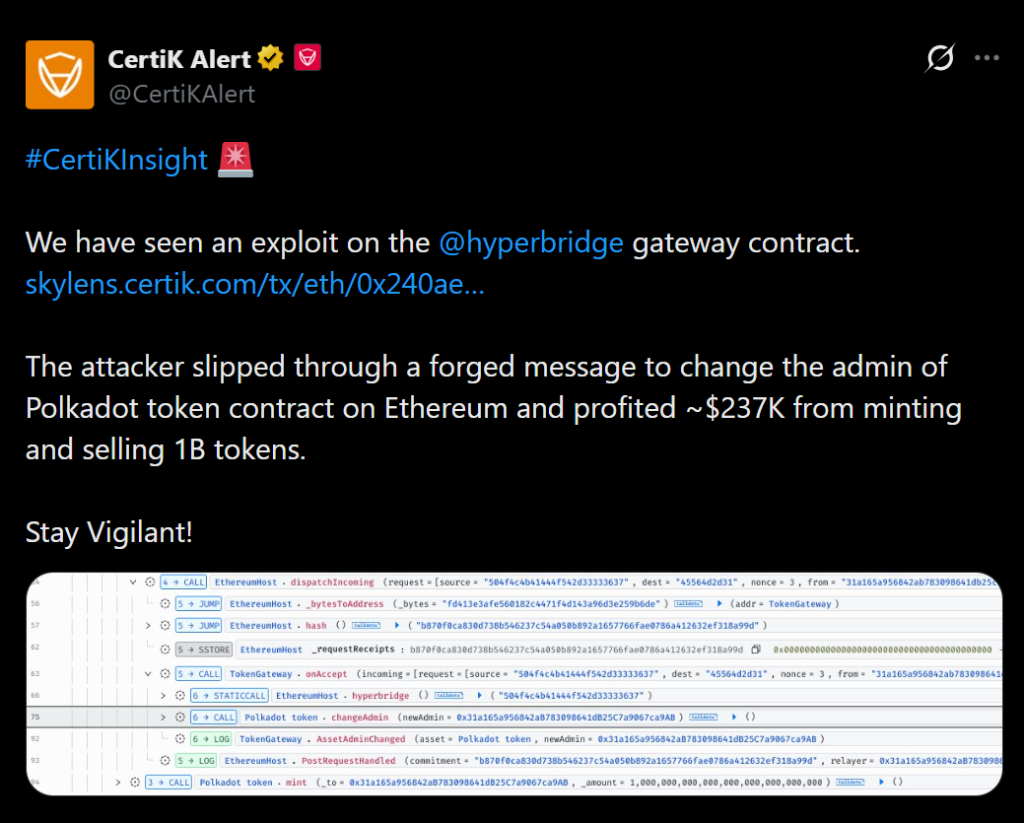
A major exploit just hit the Polkadot ecosystem, and it unfolded fast, almost too fast. Attackers managed to mint up to one billion DOT tokens through a vulnerability in Hyperbridge, a cross-chain solution built on Polkadot. Within roughly an hour, those tokens were already being dumped on Ethereum, wiping out prices in affected pools almost instantly.

The speed of the attack is what stands out. There was no slow drain, no drawn-out manipulation, just mint, move, and dump. By the time most people realized what was happening, the damage had already been done, which, unfortunately, is becoming a pattern in cross-chain exploits.
Governance Access Was the Entry Point
According to on-chain data, the breach began when attacker-controlled wallets gained governance access to the bridge contract. That’s a critical failure point, because once governance is compromised, control over minting and protocol functions can follow quickly.
From there, the attackers minted an enormous supply of DOT on Ethereum, something that shouldn’t have been possible under normal conditions. That supply was then sold off rapidly, crashing prices in the specific liquidity pools tied to the bridge.
The Damage Was Contained, But Still Serious
Importantly, the native Polkadot blockchain itself wasn’t directly affected. The exploit was isolated to Hyperbridge, which operates as an interoperability layer rather than part of the core network. That distinction matters, at least in terms of systemic risk.
Still, the impact was noticeable. DOT dropped from around $1.23 to $1.17 as news of the exploit spread, reflecting broader market concern even if the core chain remained intact. In crypto, even isolated incidents tend to ripple outward.
Cross-Chain Infrastructure Remains a Weak Point
Hyperbridge is designed to enable secure communication between blockchains using cryptographic proofs, which sounds robust in theory. But in practice, bridges continue to be one of the most vulnerable parts of the ecosystem.
They sit between chains, holding value and relying on complex logic, which makes them attractive targets. And when something goes wrong, like in this case, the consequences can escalate quickly because of how much control is concentrated in a single point.
Another Reminder of Crypto Risk
This incident adds to a long list of bridge-related exploits, and it reinforces a point the market keeps relearning. Interoperability is powerful, but it comes with trade-offs, especially around security and governance.
For now, the situation seems contained to Hyperbridge, but the broader takeaway is harder to ignore. As crypto infrastructure becomes more complex, the attack surface grows with it, and incidents like this remind everyone just how quickly things can break.
Disclaimer: BlockNews provides independent reporting on crypto, blockchain, and digital finance. All content is for informational purposes only and does not constitute financial advice. Readers should do their own research before making investment decisions. Some articles may use AI tools to assist in drafting, but every piece is reviewed and edited by our editorial team of experienced crypto writers and analysts before publication.









 English (US) ·