
 2 hours ago
11
2 hours ago
11
- Ripple currently controls roughly 32.9 billion XRP in escrow accounts.
- While some estimates suggest the escrow could be depleted by 2035 or 2036, Ripple’s future decisions could significantly alter that timeline.
- Ripple CTO Emeritus David Schwartz says comparing XRP’s escrow model to Bitcoin’s issuance schedule oversimplifies two very different systems.
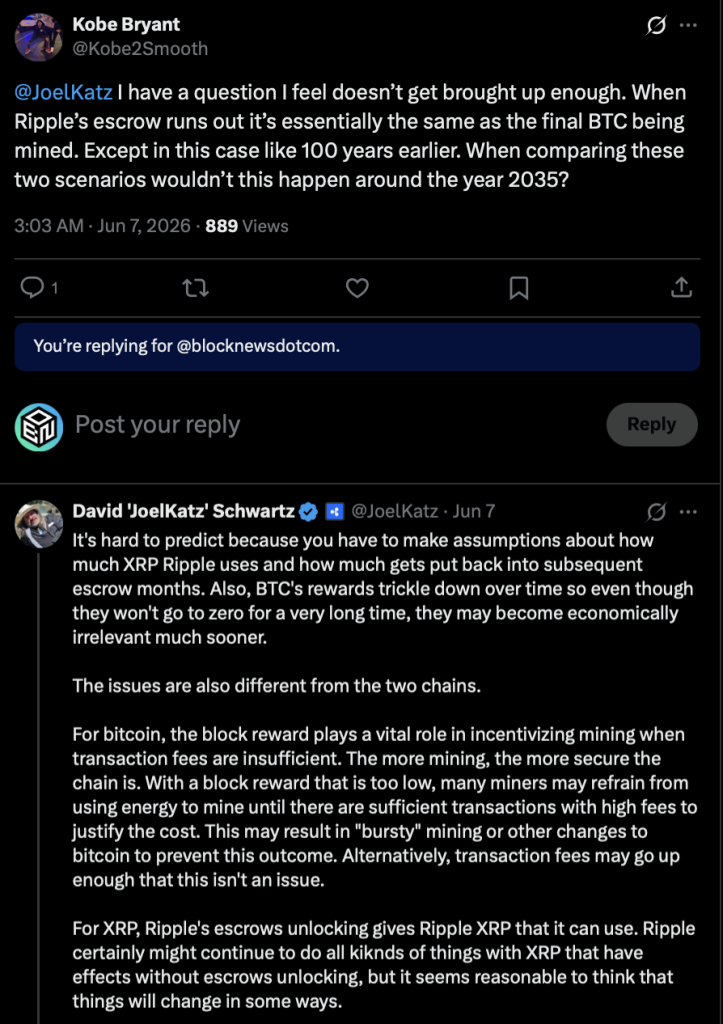
Ripple’s long-running XRP escrow program is once again attracting attention across the crypto community, this time after CTO Emeritus David Schwartz weighed in on questions surrounding the company’s remaining holdings and when those reserves might eventually run dry.
At the center of the discussion is Ripple’s escrow balance, which currently stands at approximately 32.9 billion XRP according to on-chain data. Some community members have attempted to calculate when those funds could be fully released, but Schwartz argues that any estimate comes with a major caveat: nobody knows exactly how Ripple will choose to manage its XRP years from now.
That uncertainty, he suggests, makes predicting an exact depletion date far more complicated than many people assume.
Ripple’s Escrow Clock Isn’t Set in Stone
Ripple currently unlocks 1 billion XRP from escrow every month. However, the company rarely keeps the entire amount in circulation. In most cases, Ripple returns between 700 million and 800 million XRP back into escrow, effectively reducing the net amount entering the market.
Based on that pattern, some XRP community members have estimated that Ripple’s escrow accounts could be exhausted sometime between 2035 and 2036. Those projections have circulated for years and recently resurfaced after community member Kobe compared XRP’s release mechanism to Bitcoin’s eventual completion of new coin issuance.
The argument was fairly straightforward. Just as Bitcoin will one day stop producing new coins through mining rewards, Ripple’s escrow program will eventually come to an end when all remaining XRP has been distributed.
Schwartz, however, pushed back on the certainty of those timelines.
According to him, projections only work if current behavior remains unchanged. And that’s a pretty big assumption.
Future XRP Usage Could Change Everything
Responding to questions online, Schwartz noted that Ripple’s future XRP strategy remains an important unknown variable. The company could decide to return more XRP to escrow, release less, release more, or even alter its overall approach depending on business needs and market conditions.
In other words, today’s release schedule does not automatically guarantee tomorrow’s release schedule.
“It’s difficult to predict exactly,” Schwartz explained while discussing the escrow balance. The statement highlights a reality that often gets lost in long-term forecasts. Business decisions evolve, markets change, and crypto ecosystems rarely follow a perfectly linear path over a decade or more.
As a result, any depletion estimate should be viewed as an approximation rather than a certainty.
Why Bitcoin and XRP Are Fundamentally Different
Schwartz also addressed the growing tendency to compare Ripple’s escrow mechanism with Bitcoin’s issuance model.
While both systems involve distributing assets over time, he argued that they serve entirely different purposes.
Bitcoin introduces new coins through mining rewards, which are gradually reduced during scheduled halving events. Those rewards provide economic incentives for miners who secure the network and process transactions.
Over time, Bitcoin’s block rewards become smaller, eventually forcing miners to rely more heavily on transaction fees. According to Schwartz, that transition raises important questions about how mining economics may evolve in future decades.
He suggested that miners could potentially operate in cycles, becoming active when conditions are profitable and stepping back when rewards decline. He described this possibility as a more “bursty” mining environment, where participation fluctuates based on economic incentives.
Alternatively, transaction fees may rise enough to sustain miner participation without major disruptions.
Either way, Schwartz believes Bitcoin’s distribution model addresses a very different challenge than Ripple’s escrow system.
Ripple’s Role Doesn’t End When Escrow Ends
One of the more interesting points raised during the discussion involved Ripple’s future after escrow depletion.
Some investors assume that once the escrow balance reaches zero, Ripple’s involvement with XRP will diminish significantly. Schwartz disagrees with that idea.
While he acknowledged that monthly escrow releases currently provide Ripple with a steady source of XRP, he emphasized that the company’s participation in the ecosystem is not dependent solely on those distributions.
Even after the escrow program concludes, Ripple could continue supporting XRP-related products, partnerships, infrastructure initiatives, and ecosystem development efforts. The end of escrow would change how XRP enters circulation, but it would not necessarily remove Ripple from the equation.
The Timeline Remains a Moving Target
For now, XRPScan data continues to show approximately 32.9 billion XRP locked in Ripple-controlled escrow accounts. Based on current release patterns, depletion sometime in the mid-2030s remains a reasonable estimate.
Still, Schwartz’s comments serve as an important reminder that projections depend heavily on assumptions.
The crypto industry changes quickly. Business priorities shift. Market conditions evolve. And over the next decade, Ripple may choose to manage its XRP reserves very differently than it does today.
That’s why, despite countless spreadsheets and community forecasts, the true end date of Ripple’s escrow program remains an open question.
Disclaimer: BlockNews provides independent reporting on crypto, blockchain, and digital finance. All content is for informational purposes only and does not constitute financial advice. Readers should do their own research before making investment decisions. Some articles may use AI tools to assist in drafting, but every piece is reviewed and edited by our editorial team of experienced crypto writers and analysts before publication.





 English (US) ·